WITH the coming of winter, most of the birds left us, to spend the cold months in the warmer South, where they were more sure of finding food. But with the return of spring, each day brings thousands of little feathered home-seekers back to our northern States. Each one has his bright little eyes open for a suitable place to establish his home, and raise his family. For this purpose the birds desire and look for about the same conditions that men do when they are locating their homes. There must be a safe and sheltered place for the nest, plenty of food and pure water near at hand, and if possible, quiet and congenial surroundings.
Now, birds are both pleasant and interesting neighbors, and with a little forethought and work we may in all probability induce some of them to build their homes near ours. This is very easy for those who live in the country, where they have large gardens and orchards; but if one really wants to entertain the birds, even a small city back-yard can be made inviting.
In the first place, the little gentlemen in feathers must be made to feel that they and their families will be safe. Cats are their sworn enemies, and the very sight of Sir Thomas dozing in the sun will be argument weighty enough to counterbalance many favorable points to the birds’ way of thinking. Neither does it take them long to learn to avoid places frequented by gunners or small boys with sling-shots.
Those are fortunate who have about their homes berry-bearing vines and shrubs, such as the Virginia creeper, mountain-ash, and the like, as these furnish a sure food supply during the weeks when the nests are full of wide-open, hungry mouths, and are never overlooked by the little home-seekers. However, we can do much for the birds by planting in our flower and vegetable gardens plants of whose seeds they are fond, such as the sunflower and blue corn-flower. A few stalks of mustard or lettuce, or a few radishes or turnips allowed to go to seed, will also help to furnish food for the birds. In addition to these, chopped apple or vegetables, bread crumbs, cracked wheat or oats, hemp, millet, or other small seeds, sprinkled upon the ground, fence, or shed roof, are always acceptable. A shelf fastened to a tree near enough the house to be watched by the inmates, and upon which food is regularly placed, will prove interesting to the family both summer and winter. For the birds will soon learn to come to it; and when food is scarce elsewhere, it will be the feasting-place for a motley throng of feathered folk.
After food and shelter are reasonably sure, water for drinking and bathing is the birds’ first consideration. For, especially in a country where there are few lakes and streams, the birds, during the hot season, suffer more for lack of water than for anything else.
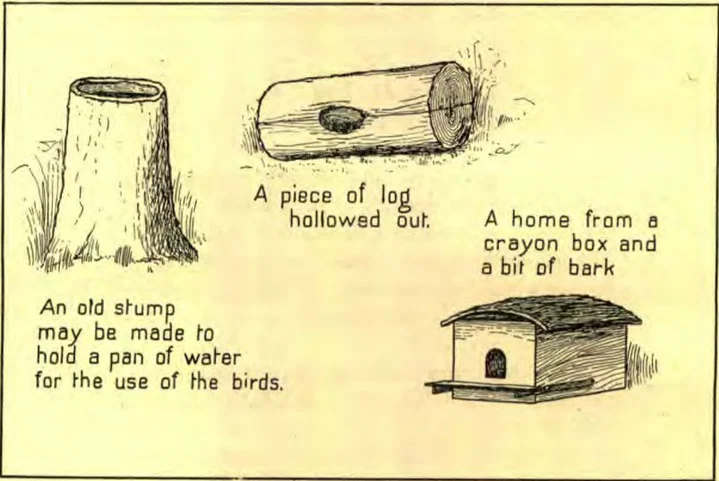
If one does not care to trouble with any further preparation for the birds, he will find that a rather shallow pan, placed in some shady place, high enough to be out of the reach of cats, and kept filled with fresh water during the warm season, will be a never-ending source of pleasure and education. The water should be replenished several times a day and should not be more than two or two and one-half inches deep, as a bird wants to feel sure of his footing when he steps in for his bath.
Some birds take kindly to houses of human building and design. Particularly in places where hollow trees suitable for nesting purposes are scarce, these artificial homes are much sought after; and if they are made with an eye to convenience, and suitably located, they are seldom tenantless. In making houses for the birds, remember that they like privacy when they are home-making, and so do not build the house to accommodate more than two families; those with room for only one family are even more acceptable. “Flats” are as undesirable and as unnatural for birds as they are for the homing and raising of a human family. Care should be taken to place these houses in a cool, sheltered place, and to fasten them securely.
Building materials too are always gladly received by the birds at nest-building time, and bits of string, thread, cotton, horse-hairs, and other such things, which may be scattered about, will be quite sure to be used.
ETHEL REEDER FARNSWORTH.