On a journey from East London to Kimberly in 1896, the writer found himself with five others, three Englishmen and two Boers, in one of the small compartments of the ordinary English railway carriage. These compartments have two seats reaching from side to side and facing each other. The Storm Berg had been passed, and we should have arrived at the Dutch village of Steynsburg at dark, and at De Aar before daybreak next morning. A long drought had denuded the veld of every vestige of life. Besides, it was autumn, when these up-country plains are brown and dry; so traveling was dull indeed. April is not the season for rain, which generally falls in these districts during the summer, from November to March. But nature sometimes seems out of her course here, as in other lands, and a cold, steady rain came on that night. Our engine had gone wrong, darkness fell, and we were still below Steynsburg. While passengers slept, the disabled engine rested; and when approaching daylight enticed us out of the cold, leather-lined berths, we expected to see the familiar iron-roofed houses of De Aar. But only rain and flooded sandy plains extended, ocean like, before us. The roof of our compartment had sprung a leak, and with overcoats and blankets, the six of us tried to keep warm.
This was but four months after Dr. Jameson, once a resident physician of Kimberly, had attempted to conquer the Transvaal with three hundred men,—an episode not tending toward warm feelings between Dutch and English. Our Dutch companions had entered the train in the night; and though we knew they were there, the dim light of an African railway carriage gave but slight idea of their physique. I knew they smoked, as nine hundred and ninety-nine out of every thousand men in this land do. Providentially being the one, I may innocently have given offense to my Boer friends by persistently keeping the window next to me open. Now, in the slowly increasing light of that rainy day, Boer eyed Briton, and Briton eyed Boer. All were cold and somewhat wet, and the situation was altogether cool. My American manner and speech, being recognized by the Boers, soon relieved me of embarrassment, and gave me the place of an interested spectator. These two Boers were farmers, and fairly good types of their race. Both sturdy fellows of full six feet two, broad shouldered, with keen blue eyes and sunbrowned complexion, they looked equal to the endurance of a Spartan.
Farming in South Africa is altogether unlike what is usually understood by that term. The Boer farm has from three to five thousand acres, generally of treeless, rocky ground. If there be any attraction or value about it, it is because somewhere within its borders is found a spring or fountain, marked by the presence of two or three willow-trees. Near this fountain the farmer builds a one-story, flat-roofed house, made of sun-dried brick, and plastered over with a white mixture of cement and coarse gravel. All well-to-do farms are characterized by these white houses, which serve as landmarks for many miles around.
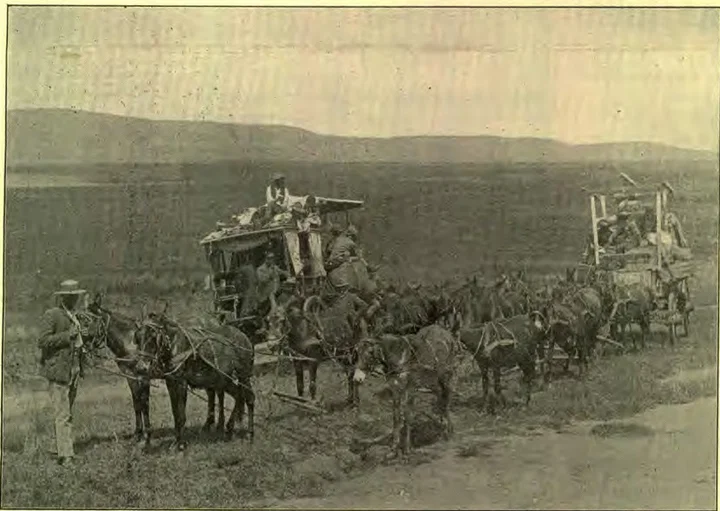
The farmer’s occupation is the raising of sheep and cattle. He must have no fewer than thirty or forty good oxen, as it requires at least sixteen of these animals to haul one of his great transport wagons over the hills and sandy roads. From six to a dozen horses are needed for riding and driving. It is a disgrace, here, for a man to be seen walking any considerable distance; therefore horses are much in demand. All ordinary errands to the village, or “burg,” which may be several miles distant (though the Boer never reckons by miles, but always by “hours,” six miles on horseback being an hour); visits from farmhouse to farmhouse, of which the Boer is extremely fond; overseeing his flocks and herds, under the care of Kaffir servants,—all this and more is done from the back of an agile horse. Thus the Boer farmer is trained from early boyhood to skillful horsemanship.
While our train dragged wearily along that rainy morning, one of the party managed slightly to relieve the coolness of the situation by remarking that the train had lost its route, which appeared not altogether impossible under the circumstances. Not until nine o’clock, and long after the “down train” had passed, did we pull up at the well-known junction. If in the Roman empire all roads led to Rome, surely in South Africa all roads lead to De Aar; for through this place of possibly two dozen houses, amid an apparently limitless, barren, sandy plain, every traveler from the south must pass into Africa. Here some of our party were transferred into a mixed freight, proceeding to Kimberly; others took another direction, and we lost sight of our Boer companions.
The hundred miles from De Aar to the Modder River is an almost unbroken plain, as level as a floor, relieved only by occasional small, flat-topped hills called “kopjes” by the Dutch. Between these little cone-shaped hills the railroad winds its way. The Orange River is crossed half-way between De Aar and the Modder. The British troops, landing at Cape Town for the relief of Kimberly, were carried by rail to Orange River. Except in the rainy season, the Orange at this place appears a great stream of sand, having only a rivulet of water somewhere within its wide bed. The Modder is a much narrower stream, yet just above the point where it is crossed by the railway, stretches a long island. This island and the river-banks are well covered with bushes and small trees. Here forty thousand British troops on November 18, 1900, met seven or eight thousand Boers in the first important battle between the two armies. On the day following a thousand English dead were counted by the keeper of the hotel which stood on the north side of the river.
After inflicting this loss upon the British, with but small loss to themselves, the Boers quietly withdrew, and made a more strongly defended position ten miles nearer Kimberly, at Magersfontein. Waiting nearly a month, the English moved forward only after receiving large re-enforcements. Then came Magersfontein, where the famed “Black Watch” (a detachment of Scotch Highlanders) was all but annihilated. Here the picked men from the world army of thep. 154 British, in number at least four to one, were time after time from morning to night hurled against the entrenched lines of Boer farmers, only to retire broken and defeated. Then for eight long weeks, there lay an army of vastly superior numbers, and being constantly re-enforced, but not choosing again to face these men of the veld. It is believed that the battle of Magersfontein cost the British double the number of men in killed and wounded that were lost at Modder River. One of the Black Watch, who, with his regiment, charged the Boer entrenchments at Magersfontein, says that the barbed wire stretched in front of the advancing line at the sides of the trenches effectually stopped their progress. They rushed upon this wire, became entangled, and even tried to pull it down with their hands. Some of their number, shot by the Boers, were left standing against the wire fences upon which they fell. Such are some of the horrors of modern warfare.
While the British army, after falling back, lay along the Modder for two months, Kimberly lay in state,—a state of siege. When endurance of all their ills seemed no longer possible,—at the very moment when the wretched inhabitants were being hurried down the shafts of the diamond mines, the only remaining place of safety from the increasing rain of shells,—the banners of the “Relief Column” under General French were seen fluttering far across the brown veld, and from the starving populace went up a wild shout of joy as their rescuers entered the city.
JOEL CYRUS ROGERS.