The Mourning-Dove

14%

Review and Herald Publishing Company · Battle Creek, Mich. · May 15, 1902

FromThe Youth’s Instructor, Vol. L., No. 20

Read the full edition

The Mourning-Dove

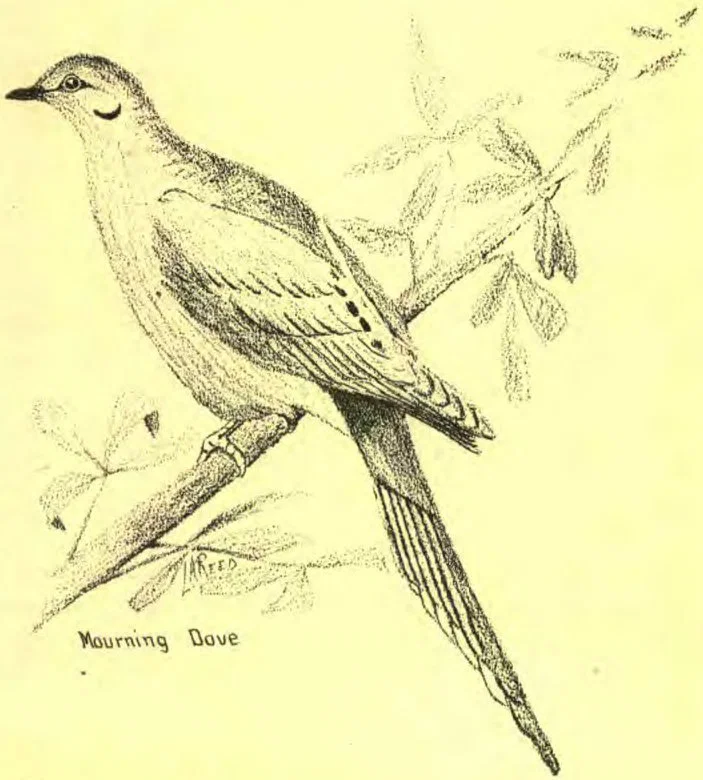
Doves look something like wild pigeons, but are much smaller, and their rapid flight is accompanied with a whistling sound. Wild pigeons have a bluish, slate-colored rump, while the dove’s is olive grayish-brown. The dove also has a black mark below the ear.
“Sometimes,” writes Florence Merriam, “we see the soft, fawn-colored creature looking out at us from the foliage of a tree, turning its head from side to side to inspect us, while its mate calls solicitously, ‘Coo-o-o, ah-coo-o-o — coo-o-o — coo-o-o!’ Again we see it walking along the ground, moving its head back and forth with the peculiar motion of the doves; then we hear a musical whir as it passes swiftly through the air beside us, and on looking up catch sight of the white circlet of its long vanishing tail; or perhaps watch it soar low over the bushes, with wings stiffly spread till it gets near the nest, when it alights with a wabbling motion of wings and tail.”
In the dry parts of Arizona, the Mourning-dove has been known to nest so far from water that it could go to drink only twice each day. But the mountaineers, trained in the lore of the woods, know its habit, and follow it when in search of water. If the dove is once made sure of your protection, it will build its nest in your garden. In central Illinois I have found the bird very tame.
During the nesting season the doves will be found in pairs. After the nesting season, they gather in flocks, and frequent grain and corn fields. Major Bendire thinks the pairs remain mated throughout the year, as they are seen together summer and winter. Their conduct toward one another shows that the name Turtle-dove, which has become synonymous with tenderness and affection, is more appropriate than the name Mourning-dove. L. A. Reed.
Mourning Dove
Mourning Dove