COME with me, if you please, and I will give you a brief introduction to a voyage across the Atlantic. Our good ship, the “Oceanic,” will sail from Pier 45, New York Harbor, at three o’clock this afternoon. We have spent the night at Smith and McNeal’s Hotel, corner of Fulton and Jefferson streets, and this morning we must organize carefully if we would have all the trunks and luggage on board, and everything “ship-shape” for the voyage.
Attention to Details
Some one is detailed to transfer the baggage from the railway station to the wharf, and see that it is properly marked with labels at least two hours before sailing. Another collects the tickets, and takes them to the head office of the White Star Company to be countersigned. The man who has been appointed as treasurer and financier of the party receives all the money, from each of the party, with the exception of a dollar or two to spend on shipboard. This he takes to the exchange office, and secures English sovereigns at the rate of about $4.88 each. It is better to get one’s money exchanged in New York than to wait until reaching London; for British money is at a discount in New York, and it can, therefore, be purchased at a more favorable rate.
With all these details carefully arranged, we collect the hand baggage, “count noses” to make certain that no one is being left, and hurry off to the steamer, accompanied by a few friends from among the New York workers, who are always interested in seeing the missionaries off.
The stewards direct us to our cabins. We open the door and look inside, and then look at the hand luggage, and then at one another. Some one says: “What a cute little room! Doesn’t it look like a playhouse?” “Where do you think we are to put this luggage?” says the practical member of the party. The bed isn’t big enough for one to sleep in, but it looks as if we would have to share our eighteen-inch beds with the valises.
But necessity is the mother of invention. Little by little the parcels are packed away under the berths. The coats and hats are hung on the hooks; and the little box (called a “Stateroom”!) begins to look as if people are really going to live in it. As soon as the boxes are adjusted, we go outside to make certain that the trunks have all been put on board.
Good-by! Bon Voyage!
All these details have occupied the larger part of the day, and the time appointed for the good ship to sail has come. The first, second, and third gongs have sounded, warning the visitors that they must go ashore.
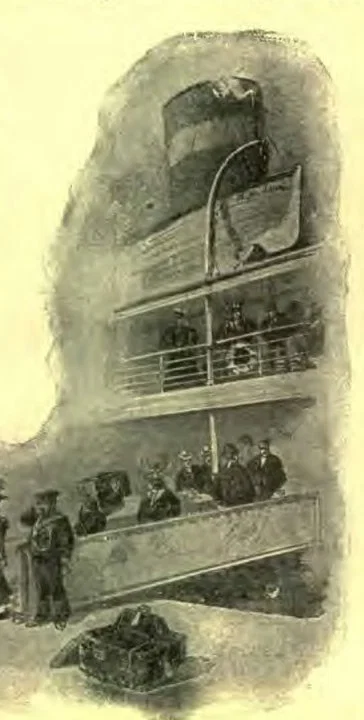
Now the last straggler is off. The gangplanks are hauled down; the great ropes and cords are thrown off; and the old ship begins to swing, almost imperceptibly, away from her moorings. “Good-by!” “Good-by!” “Shake the end of my finger if you can.” “No, I can’t.” “Reach down the end of your umbrella.” And so we shake the umbrella at each end so as to extend the good-by as far as possible. “Bon voyage!” “Did you take your lemons?” “Oh, yes, I have the lemons and the crackers and the smelling-bottle, which you say are sure remedies for seasickness, under my pillow, all ready for use if they are needed.” We who are on the ship climb into prominent positions, some on the rope-ladders and others on the railing, where we wave good-bys until the ship glides around the pier out of sight.
Sunshine and Shadow
What a mingling of joy and sorrow is seen at these partings! Some are going home, and their joy is unbounded. Others are parting with dear friends, whom they may never meet again. We would that all who are thus compelled to part with their loved ones could have the blessed comfort and assurance enjoyed by our missionaries, who know that God has called them to the work, and that they are followed by the prayers and blessings of all who are dear to them.
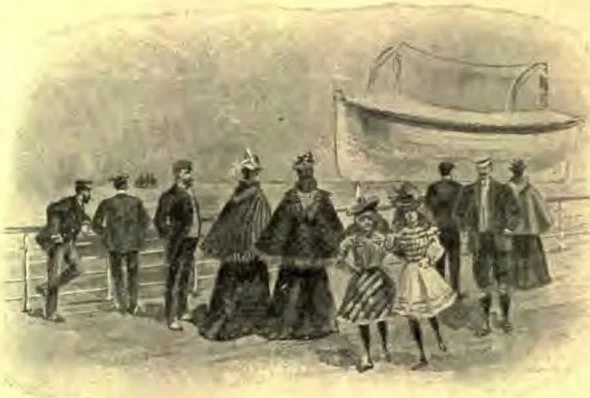
But now we are gliding quietly out of the harbor; and we watch with thrilling interest the most striking landmarks as we pass. Behind us are the great sky-scrapers of New York, towering high above the surrounding city. On either side are the forts, the fine buildings, and hundreds of crafts of every conceivable size and shape.
Rocked on the Deep
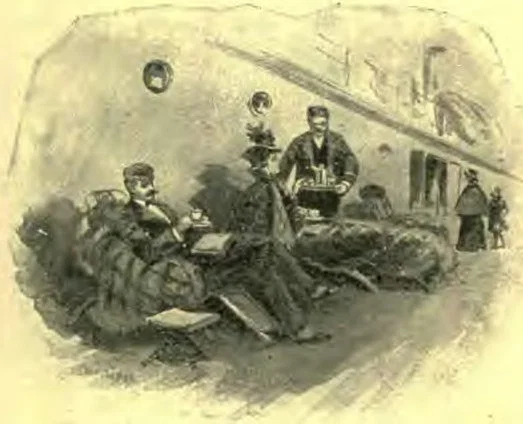
We have passed the Goddess of Liberty and Sandy Hook; and the old ship begins to change her bearings, and “stand out” for the open sea. How delightful the first swing of the vessel as she responds to the heaving rollers! The first motions are so agreeable we begin to gain confidence, and talk with much assurance of our enjoyment of the sea; but little by little the motion becomes monotonous, and the crowds on deck begin to thin out. A lady remembers that she left her baby in care of the stewardess, and hastens down to look after it; but she doesn’t come back. The gentleman who talked so loudly, and affirmed that he was never sick at sea, must go down to get his cap; but he doesn’t come back. By the time the ship has rolled for two hours, all the passengers, with the exception of a dozen really good sailors, are in their bunks, having their first experience in being “rocked in the cradle of the deep.”
Seasickness
I will not attempt to describe seasickness. It must be experienced to be appreciated; and, in fact, when it is experienced, one knows very little about it. Hundreds of remedies have been recommended for it; and some of them provep. 2 helpful on one voyage, and hurtful on another. An eminent physician whose name is well known tried various experiments in harmony with his theories when he first crossed the Atlantic. The experiments were successful; and he wrote an extended article giving various “sure cures for seasickness.” On his second voyage all his remedies failed, and he was wholly “at sea.”
It is a sickness that everybody is ashamed of. The patient hurries to his cabin, or goes behind the masts or funnel of the steamer, or looks over the edge of the vessel with a studied expression,—anything to convey the impression that he is all right. The experience is very unpleasant, but the result is seldom serious. Perhaps no other sickness could make a man so thoroughly miserable and do him so little harm. He is dizzy and confused. The sky is in the water, and the water is in the sky. First, the door is in the side of his cabin; then it is in the top, and next in the bottom; and he finds himself in a cold perspiration, clinging to his berth, or hanging on to the floor. He is wretchedly miserable. He is positive that he has lost four times as much dinner as he ever ate; and his stomach seems to be the only thing that refuses to come up.
Remedies
After the first sickness wears away, some are able to read and study; others seem wholly incapacitated for doing anything except to lie flat on their backs.

It is amusing to see the various remedies that are tried. One tries lemons; another keeps one eye shut, or bandages it, which, by the way, is a very sensible thing to do. A great scientist has recently affirmed that seasickness can be prevented by looking in a mirror. The paper which makes the statement, however, adds that the only difficulty with the remedy is that it doesn’t work when it is tried. Unfortunately, that is the chief difficulty with all remedies. The only sure cure is to reach land. Bits of ice held in the mouth, or a cold cloth or ice on the back of the neck will sometimes give relief. Undoubtedly the best remedy is activity in the open air—on deck. An experienced steward once told me that he had seen many remedies tried; but he was certain that nothing was more successful than marching, playing games, and indulging in various active diversions on deck. Those travelers who are able to overcome the almost unconquerable desire to keep perfectly still in the bunk, and who persevere in activity on deck, usually enjoy the voyage after the first day or two. Men who are experienced in traveling pace the decks for hours; and after the first unpleasantness has passed away, it becomes a most enjoyable exercise.
Games
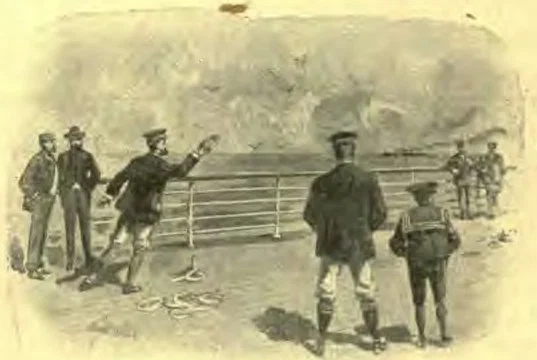
Then there are games, such as quoits, potato races, and all manner of little sports such as children enjoy on land. If, as the poet says, “men are only boys grown tall” when on land, they are emphatically boys at sea. They are cut off from the world; and a very little thing affords amusement, and becomes a pleasant pastime. I have seen the most dignified clergymen with their boots off, running enthusiastically in a potato race or in an egg race on deck. The more quiet members collect in companies on deck and sing; others go to the smoking-room and play cards and gamble; and still others spend most of their time in the library, reading and writing.
The Monotony of a Voyage
Life on an ocean steamer, after the novelty of the situation has worn off, becomes very monotonous. There are no points of land or other objects to mark the progress of the vessel. The horizon is a perfect circle, and seems only a mile or two away. It seems impossible that the ship is really making progress. She seems to be always struggling in the center of a small circle, but never advancing.
To be sure, there are variations in the sea: the ever-changing waves and the white, foamy wake of the ship are always interesting. The appearance of any kind of craft is a signal for a general rush to the ship’s side; and the boat is the subject of conversation and speculation until out of sight. A watchful eye will occasionally see a beautiful nautilus, a school of flying fish, or perhaps a floating spar from a stranded vessel. All such items are watched for with interest.
Concerts
Toward the close of the journey, when the passengers are nearly all able to be out, concerts are held in the dining-saloons, and frequently the fact is developed that there is most excellent talent on board; but more frequently the speaking and singing are rather inferior because of the fact that people with very little talent are often most willing to volunteer to “help out.”
Collections taken on such occasions are given to the Seamen’s Refuge in New York and Liverpool.
In the Hollow of His Hand
While much is said about the unpleasantness of sea voyages and the dangers of the sea, there is no good reason why we should fear. The dangers are no greater than on land. The arm of the Most High is as strong to support his children and care for them on the water as on the land. He says: “They that go down to the sea in ships, that do business in great waters; these see the works of the Lord, and his wonders in the deep.” “When thou passest through the waters, I will be with thee.” David said, “If I take the wings of the morning, and dwell in the uttermost parts of the sea; even there shall thy hand lead me, and thy right hand shall hold me.” E. R. PALMER.