(Continued)
JUST before the weaving reaches the end of the place where the warp was first wrapped around it. This will be readily understood when you come to try the work.
In making short pieces of this kind of work, it is best to select, for the wool, threads of hair that are long enough to finish it without splicing. But in covering canes, whips, or other articles of considerable length, this will be impossible; for, it will be remembered, a thread will weave only about one fourth of its length. Under such circumstances splicing will be necessary, and it is well to try splicing a few threads before the actual necessity arises. Where it is known that splicing must be resorted to, it is best to select threads of different lengths, so that they will not all have to be spliced at the same time. Otherwise the introduction of all the threads of the wool near the same place will make a bulge in the finished article that will detract from its appearance.
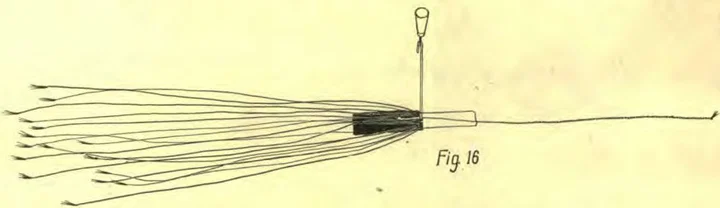
When there remains only about three inches of a thread, it is time to introduce a new one to take its place. To do this, place the thread parallel with the base, and pass one end under the warp and up between the latter and the finished work, as shown in Fig. 16. Then continue the weaving just as if the new thread were not there, until only about an inch of the old one remains. By that time the new thread will be so firmly held against the base by the warp that has been repeatedly wound around it that there will be no danger of its pulling out. Now when you come to the old thread, instead of taking a stitch with it, bring the new one up between the warp and the woven work. Then leave both, and continue the weaving till you come to them again. Make the regular stitch with the new thread, and then pull the old one down under the warp, between the latter and the woven work. Proceed with the weaving till the old thread is nearly covered; then cut off what remains of the end of the latter, and the splicing will be complete. In this manner, it will be seen, one end of every thread that is introduced after the work begins will be left projecting on the outside of the weaving. After the work is finished, these ends are drawn out slightly, and cut off with a sharp knife. The elasticity of the hair will draw the ends back into the weaving, so that the sharpest eye can not detect where the splice was made.p. 231
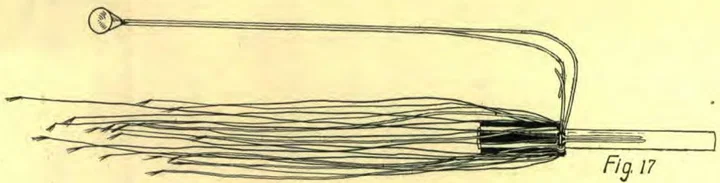
The warp ought by all means to be long enough to finish the work; but if, through carelessness or accident, it is necessary to splice it, both the old and the new warp must be divided in halves for a short distance. Discard half of the old warp, and bring half of the new into its place, as shown in Fig. 17. Continue the weaving a little more than one revolution, when the remainder of the old warp may be changed for the new in a similar manner.
There are two ways of hiding the ends of the threads where this kind of work is finished. One is to cover them with needlework. The other and better way is to pass each thread through a needle, draw it down between the base and the weaving, then up through the latter, cutting off the part that remains exposed.
J. EDGAR ROSS.