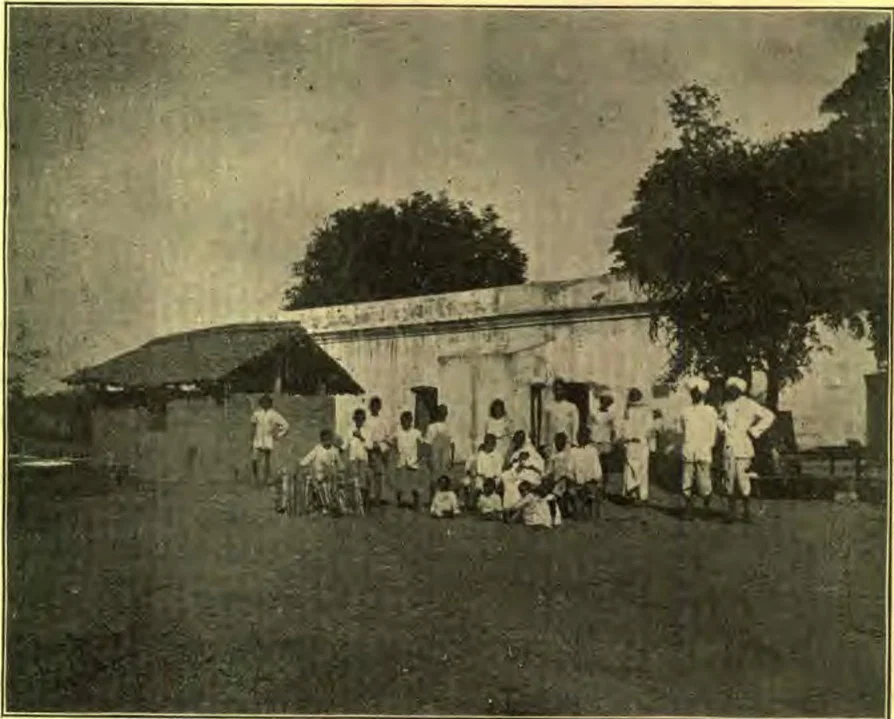
Children of India at Play

9%

Review and Herald Publishing Company · Battle Creek, Mich. · August 21, 1902

FromThe Youth’s Instructor, Youth’s Instructor, Vol. L, No. 34

Read the full edition

Children of India at Play

It is said that the children of India do not have as playful a childhood as do our own children. That is true. Boys and girls in India must grow up quicker, and be at work. Little girls must leave school, and be married off and settled down at about the age of twelve. The joys of a long and happy childhood of preparation for usefulness in life are surely cut short.
But the little folk of India have their happy time, after all, however short the years. No brighter eyes nor more pleasant faces can be found anywhere in the world. There are games and romps over field and hill, and trees to climb. In the cities, marbles and kite-flying are the chief delight of the boys. The kites of India are generally four-cornered ones, without tails. In the late afternoon and evening, during the kite season, the sky above Calcutta is full of bobbing kites. The flat roofs of the houses are the playground. A part of the game in kite-flying, I believe, is to saw one another’s strings in two, by crossing them in the air. Watching from the roof of our mission house in Bow Bazaar, I have noticed that men as well as boys fly kites.
The little girls like to play with dolls,— English dolls dressed like memsahibs, as the European ladies are called. I can not say just how they play with them. Perhaps they often hang them on the walls as ornaments. At any rate I know the little ones in our girls’ school expected each a doll at the end of the year, a very cheap one being thought a grand prize.
You would heartily enjoy watching our children at the Karmatar Orphanage school, in the play hours. The favorite game, I think, is ghoolie dunda, played very much as the American boys’ game of tip-cat, with a small stick as a bat, and a sharp-pointed block as a ball.
Marbles are called ghoolies, and the Indian boy shoots the marble by holding it with the thumb and forefinger, bending it back like a catapult, and then letting go suddenly. They aim very surely, too.
Sometimes, on visiting Karmatar, I would find it the fashion on the playground to favor bows and arrows. Then every boy and girl, even to the babies four, besought the mem for the strings about her parcels from the city, for use as bowstrings. Then again the cry was for slings. This form of amusement had to be somewhat severely kept down; for Juman, a little lad who came into the family from the wide world, where he had fought his way alone, could throw stones so far as to endanger heads on the village road. By piercing a joint of the green bamboo, which is easily cut, the boys make very effective squirt-guns, and sometimes, I fear, the water flew where it ought not. Boys will be boys, the world over, and it is a very nice thing to know just where to stop.
An interesting game is managed after this manner: The children join hands, and form a circle. One of their number remains outside, and comes up to the circle as the rajah, or king. The children challenge him:— “Rajah, rajah, where are you going?” “To bathe,” he answers. “Come into our tank,” the children in the circle cry. “There is but little water.” “Throw some money into it,” they respond. The boy throws a stone into the circle, and is allowed to enter. Then he dashes about, trying to find where hands are so loosely clasped that he can break out, saying, as he is held back, that he will tell their uncle, or tell their aunt, and so on, naming, if necessary, all the many relations that compose an Indian family. At last he breaks out, and all the members of the circle take after him to catch the running rajah.
ON THE PLAYGROUND AT KARMATAR
You could not help loving the Indian boys and girls. Amid all the evil influences of that heathen land, I believe many of them will yet be trained into useful workers in this cause that we love.
W. A. SPICER.