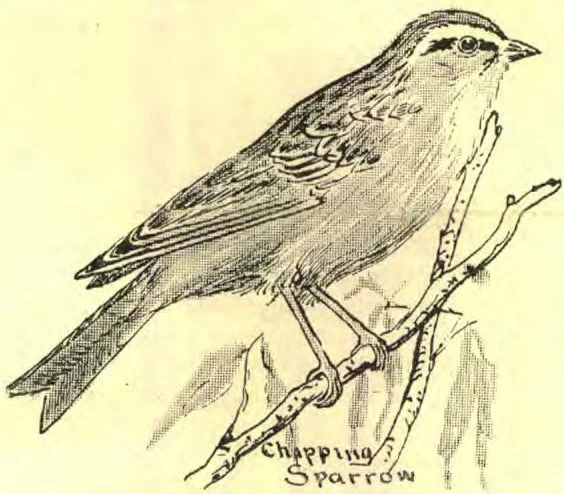
Chipping Sparrow
EVERY bird has its good qualities. Some have nothing but good characteristics, while others have some not so desirable. Bradford Torrey says that if he could have his way, the Chipping Sparrow should be known as the “door-step sparrow.” It is a very tame bird when kindly treated, and many pleasing anecdotes are related showing this characteristic. Here is one, told by Robert B. Lawrence, and quoted in “Birds of Village and Field,” which I can not refrain from giving you.
“For years at our place in Flushing, L. I., my father has fed some half-dozen of these Chipping Sparrows, and the young birds have taken bread or seed from his hand when it was held near the ground, but the old birds would never allow any such familiarity. One of the adult birds, however, seemed more inclined to do so than his companions; and at last, in the summer of 1879, mustered courage enough to follow the example of the young birds, and finding no ill effects, jumped onto my father’s finger, and, sitting there, ate his breakfast. The ice once broken, ‘Dick,’ as we christened him, seemed to lose all fear; and from that time always ate his breakfast from my father’s hand. . . . This continued all the summer; but when the fall came, with the first cold blasts Dick took his departure for the summer regions of the South. The next April, however, he returned, and without any hesitation came one morning at my father’s call, and in his old, accustomed way ate his breakfast from my father’s hand. Dick and his mate built their nest in the vines which clambered over our piazza, and spent the summer with us. . . . This year he has gone further, as he has several times, while sitting on my father’s hand, ceased eating, and poured forth his song of thanks. . . . It has long been known that birds would return to the same locality year after year, but that a wild bird should remember a person’s voice, and come back after his long wandering as tame and confiding as when he went away, is, I think, very remarkable.”
The Chipping Sparrow is one of the first birds to return to us in the spring, and several seasons about the first of April, I have heard his chirping trill, monotonous, high, and wiry, at times somewhat like an insect, but a sure reminder to us that he has just arrived from the South. At such times he was always hidden in the trees, and it was with difficulty that I could get sight of him.
The Chipping Sparrow destroys the seeds of some injurious weeds, such as the foxtail and crab-grass of our lawns, sometimes adding to his diet pigweed, chickweed, and knotweed. Among insects, he is not backward about eating cabbageworms, tent-caterpillars, cankerworms, and other pests. He winters in the Gulf States and Mexico, getting back home again between the first and the tenth of April.
Description.—Top of head, reddish-brown; under parts, plain gray; back, brown, streaked with black; bill, black. Length about five and one-fourth inches.
Vesper Sparrow
The Vesper Sparrow is quite a singer. His notes remind one somewhat of those of the Song Sparrow; but the song is, on the whole, sweeter and more plaintive. When singing, he usually selects an elevated perch, and works at nothing else.
You will often find him on the ground; and if you do not chase after him too closely, he will run ahead of you for some distance. If you overtake him, he will fly, swinging off on bounding wing, showing the white feathers on either side of his tail. These two white feathers are very good marks by which to identify him.
The bird is called Vesper Sparrow on account of his vesper, or evening, song. Florence A. Merriam tells of an interesting experience in connection with the “vespers” of this bird. They were first greeted by the voice of one of these sparrows. “He was perched on a stake in the meadow beside the lane; and as we stopped to listen, he poured out his beautiful vesper hymn. It had scarcely ceased when it was taken up by another of the rich-voiced choristers, and soon was being sung by glad, sweet voices scattered far through the meadows. In the stillness of the hour, with the level fields reaching to the golden horizon, the peaceful evening-song seemed full of new beauty; and we listened in silence to its calm, melodious notes till the sunset afterglow faded from the sky, and the twilight shadows gathered around us.”
Description.—Brownish-gray, streaked; patch on wings, reddish-brown; outer tail-feathers showing white in flight. Length, about six inches.
L. A. REED.