HORSEHAIR may be braided flat, round, or square; but the square braid is the most effective, and the one generally used. For a flat braid an odd number of strands, preferably five or seven, will be required. The braiding is similar to that done with three strands; and as it is so little used, no further explanation need be made here. A round braid may be made with four strands, but it will be too rough for our use. If eight, twelve, or sixteen strands are used, and braided around a cord as large as their aggregate size, the braid will be both round and smooth. But the braiding in this case will be exactly the same as for the square braid, and the result identical except in shape.
For the square braid eight strands will be required, though twelve or sixteen may be used. They may be all of one color, or half may be black and half white. Bind the necessary number together by tying a string around one end of the bunch. The knots on the ends of each strand, or thread, will keep it from slipping through the string, even though it is subjected to quite a pull. The ends of the string must be left long enough to form a loop by which the work may be held in some convenient manner while the braiding is being done.
By referring to Fig. 2, you will see braid just fairly begun, with the strands of the unbraided part widely separated, and numbered for the sake of more ready identification. The strands are numbered in just the order they are to be used, and when each has been used once, all will be back in the same position that they now occupy.
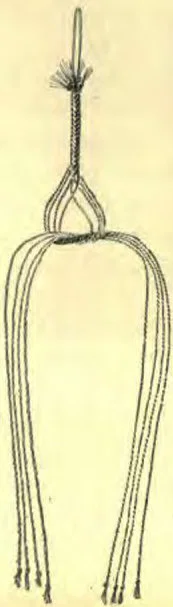
To proceed with the braiding, grasp the strands on the right—the even numbers—between the thumb and forefinger of the right hand; and with the left hand take number one, and pass it down under the others till it can be held between the middle and forefingers of the right hand. Now take the three strands remaining on the left, the odd numbers, between the thumb and forefinger of the left hand, release numbers eight and six, and bring number one up between four and six, over six and eight, and back to its own side in front of seven. This will crowd seven back to the place that five occupies in the illustration; five will take the place of three; and three will occupy position number one. Next take number two, pass it under and up between five and seven (it would be between three and five as the illustration now stands, but you will remember that one has been placed in front of seven), then across seven and one to position number eight. Numbers three, four, five, etc., are next used in their turn until the braid is finished. This may seem rather complicated when you read it, but once you get to work, it will be found quite simple.
If the strands get out of place, after a braid is started, it is often quite difficult to straighten them out again. For that reason a braid should not be left unfinished unless the right and left strands are tied in such a manner that there will be no danger of their becoming mixed. A