Wood-Anemone, or Windflower
The word “anemone” comes from a Greek word meaning “wind,” and was given to the different species of anemones, perhaps because they grow in windy places, or blossom during the windy season; possibly because the flowers were formerly supposed to open only when the wind was blowing. The anemones are often called “windflowers.”
In the days of early spring, when the trees present to sun, dew, and rain their tender, half-grown, half-transparent leaves, and the shade cast by their foliage is thin and “spotty,” the Wood-anemone may be found scattered here and there over the forest floor, or growing along the country roadside. In the mountains and in high altitudes, where the season is unusually late, the plant of course does not appear as early as in lower altitudes.
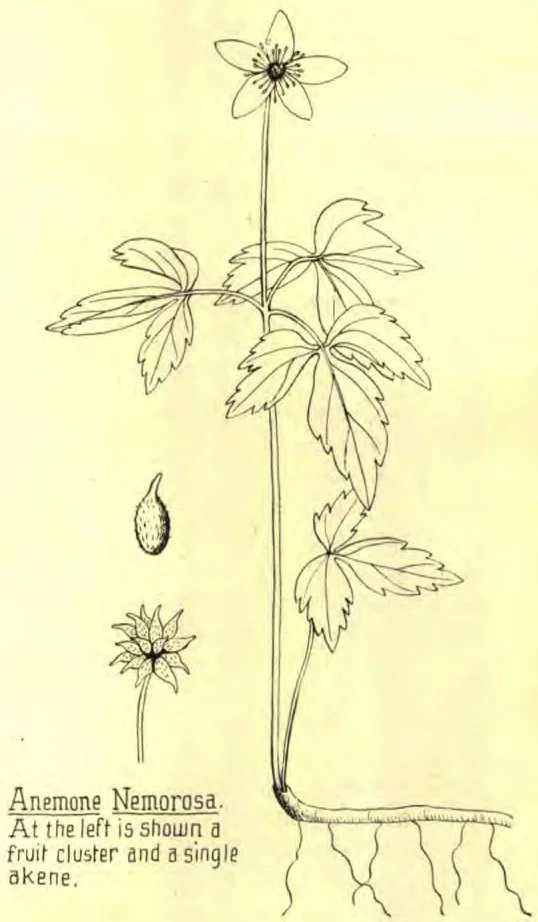
The stem is slender, and from four to ten inches high. A short distance below the blossom are three leaves, which are attached in a circle around the stem. Leaves arranged in this way beneath a flower or cluster of flowers, constitute what is known as an “in’vo-lu’cre.” An involucre may be formed of large leaves of the ordinary kind, as in the case of the Wood-anemone, or of small leaves resembling scales, and known as “bracts.”
The leaves of the Wood-anemone are compound with three or five delicate, wedge-shaped leaflets, and are attached to the stem by rather long petioles, or leaf-stalks. In addition to the leaves forming the involucre, there is often a radical leaf, which has the same form as the other leaves. A radical leaf is one which apparently comes from the root, but really from the base of the stem.
The corolla is absent, but the calyx is present, and closely resembles a corolla, consisting of four or more sepals, which are usually white or delicate crimson-pink, but sometimes of a purplish color. The flower is solitary, and borne on a short, upright peduncle, or flower-stalk.
The stem springs from a slender creeper growing just beneath the surface of the soil. This is quite well shown in the illustration. From its lower surface, roots are given off which fasten it to the soil. A stem of this kind, lying flat upon the ground and partly covered with the soil, or growing beneath its surface, is known as a rootstock, or rhizome. In most cases a rhizome resembles other stems in consisting of a succession of joints, and in bearing leaves and buds, though the leaves are small and scale-like. This resemblance is not so great in the Wood-anemone as we shall find it to be in some other plants.
Many plants spread rapidly by means of these underground stems, and at intervals send up branches into the air.
The rhizome is a sort of humble missionary. While it keeps out of sight itself, and makes no great parade of buds and leaves and blossoms, it is the channel through which nourishment is carried to the upright branches that spring from it. We may not all be preachers, or physicians, or teachers, or prominent leaders among men, but we may all be used as channels through which comfort, hope, and strength shall be ministered to those who are bearing heavy responsibilities.
The botanical terms used in this study, with which the reader should become familiar, are the following:—
Involucre: a circle of leaves below a flower or cluster of flowers.
Bract: a scale-like leaf.
Petiole: leaf-stalk by which the leaf is attached to the stem.
Radical: apparently springing from the root.
Peduncle: flower-stalk by which the flower is attached to the stem.
Rhizome, or Rootstock: a stem growing partially or entirely under the ground.
The terms corolla, calyx, petals, and sepals, have been used at different times in our past studies, and the reader should be well acquainted with them by this time. But if not, a dictionary should be consulted, so that when these terms are used again, there will be no difficulty in understanding what is meant.
B. E. Crawford.