INTRODUCTORY
Preceding Events.— Important events in the Saviour’s life since the healing of the paralytic:—
- The call of Matthew. Mark 2: 13–17.
- Question about fasting. Luke 5: 33–39.
Main Reference.— John 5: 1–17.
Other References.— None.
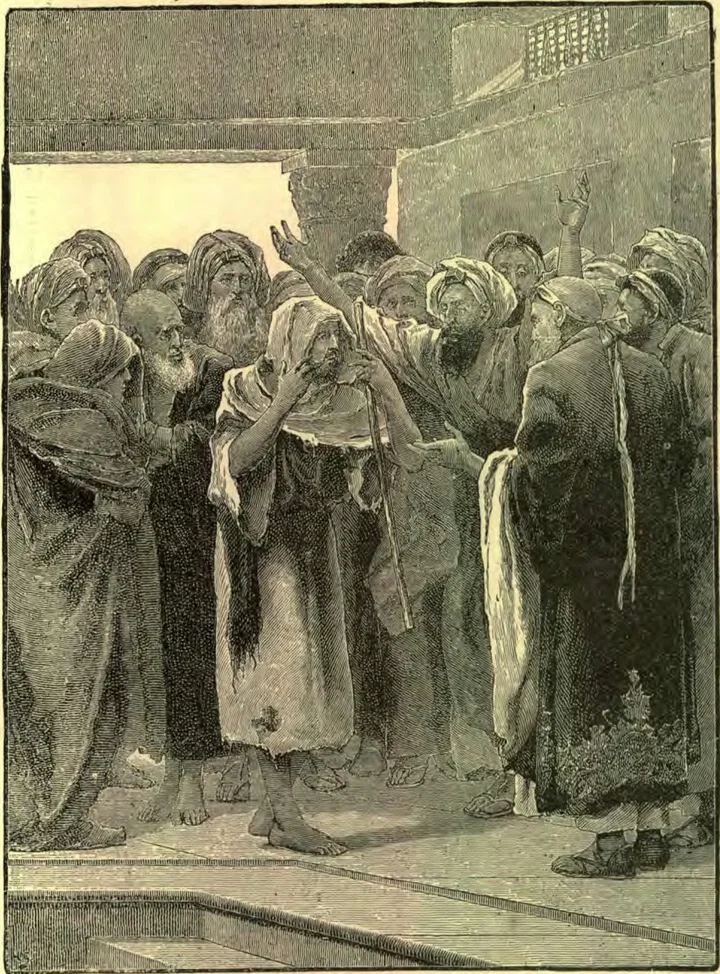
Bible Story of the Miracle.— “After this there was a feast of the Jews; and Jesus went up to Jerusalem. Now there is at Jerusalem by the sheep market a pool, which is called in the Hebrew tongue Bethesda, having five porches. In these lay a great multitude of impotent folk, of blind, halt, withered, waiting for the moving of the water. For an angel went down at a certain season into the pool, and troubled the water: whosoever then first after the troubling of the water stepped in was made whole of whatsoever disease he had. And a certain man was there, which had an infirmity thirty and eight years. When Jesus saw him lie, and knew that he had been now a long time in that case, he saith unto him, Wilt thou be made whole? The impotent man answered him, Sir, I have no man, when the water is troubled, to put me into the pool; but while I am coming, another steppeth down before me. Jesus saith unto him, Rise, take up thy bed, and walk. And immediately the man was made whole, and took up his bed, and walked: and on the same day was the Sabbath. The Jews therefore said unto him that was cured, It is the Sabbath day: it is not lawful for thee to carry thy bed. He answered them, He that made me whole, the same said unto me, Take up thy bed, and walk. Then asked they him, What man is that which said unto thee, Take up thy bed, and walk? And he that was healed wist not who it was: for Jesus had conveyed himself away, a multitude being in that place. Afterward Jesus findeth him in the temple, and said unto him, Behold, thou art made whole: sin no more, lest a worse thing come unto thee. The man departed, and told the Jews that it was Jesus, which had made him whole. And therefore did the Jews persecute Jesus, and sought to slay him, because he had done these things on the Sabbath day.” John 5: 1–17.
Circumstances.— Christ was attending the feast, probably the Passover. No doubt many worshipers were passing in and out of the temple.p. 338 Evidence of a growing prejudice against Christ had begun to appear. It was the Sabbath day. The miracle was performed without request, Christ himself asking the impotent man if he would be made whole. No such statement as, “Thy sins are forgiven thee,” or “Go in peace,” was made. The miracle stands alone in this respect.
Great Lesson.— “Sin no more, lest a worse thing come unto thee.” The great lesson of this miracle is contained in the foregoing admonition. This man’s condition was probably due to his own sin, and the Saviour warned him not to continue in transgression, lest a worse affliction overtake him. The Master warned this man to sow no more for suffering and disease, lest a still more disastrous harvest of affliction overtake him. Transgression always precedes its penalty.
STUDY OF THE MIRACLE
Having Five Porches.— On this Sabbath day the Great Physician was found at the place where he was most needed; for the five porches around the sheep market at the Pool of Bethesda were in reality five wards of a hospital filled to overflowing with sick folk. There were five different porches full of people. In almost any religious gathering to-day there may be found five porches of waiting ones,—five classes of careless, indifferent, or lukewarm souls. Some one has given the following classes: (1) those who are waiting for a more convenient season,—always reckoning on a fair “to-morrow,” though to-morrow is found only in the fool’s calendar; (2) those who are waiting for things startling or wonderful; (3) those who are waiting for the spirit to move them,—some sort of sheer compulsion; (4) those who are waiting for revival; and (5) those who are waiting for an impression. For all five classes the prescription is, Cease waiting, and come; look no longer at the pool, but look unto Jesus. “The word is nigh thee, even in thy mouth, and in thy heart.”
Waiting for the Moving of the Water.— While this pool is perhaps a type of the healing and saving grace of Christ, there is this one great distinction: its virtues were intermittent, while the stream that flows from the riven side of Christ is continual. At any time, without the waiting of a moment, the sinner, the afflicted soul, may find relief in the stream that flows from Calvary. Heaven’s stream is continuous; salvation’s waters are always troubled.
While the impotent man waited for the mysterious occasion that was supposed to impart healing power to the waters of the pool, the Divine Healer himself walked unnoticed and unrecognized among the sick ones. And to-day many Christians seek for blessings which hang over their heads, vainly striving for victories, which, did they only believe, are already won,—waiting in darkness and despair for forgiveness and peace which are already theirs. Jesus says, “Peace I leave with you, my peace I give unto you.” The devil’s delusion of waiting is one which he uses most frequently, and which meets with the greatest success. When Satan is unable longer to deceive or delude an erring soul, when a sinner is about to turn to God, then it is that the delusion of delusions—procrastination—is brought to bear upon the mind. “Wait until to-morrow; not to-day; some other day.” Any time will please the deceiver better than now; for “now,” the Lord has said, “is the accepted time.”
The Christian should wait, however long the time may be, until the Lord has spoken; but when the divine word has gone forth, we should no longer tarry. In the matter of forgiveness of sin, and the salvation of the soul, there is no need of waiting at any time; for Jesus said, “It is finished,” while on the cross. The sinful soul needs only to have a willing mind, and that, the Lord has said, is acceptable. 2 Cor. 8:12. The garment of the righteousness of Christ has been woven in the loom of heaven for every soul. Not one garment for all, but a perfect raiment for each one.
This poor sufferer was waiting for an angel when the Lord Jesus himself, the Commander of the angels, was by his side. How often, in our vain endeavor to secure some supposed blessing, we pass by, unrecognized, a greater blessing that the Lord had purposed to give us.
W. S. SADLER.