Chapter X—Earthquakes; Volcanoes; Hot-Springs and Geysers
§92. An earthquake is said to be a volcano without vent. The pent-up gases, which, as we learned in Section 72, are formed by the washing together of various chemicals within the earth, also by the uniting of water and previously burned limestone, must have some place of escape. The expansion caused by the heating of large quantities of earth and rock has also a part to act in the phenomena that accompany earthquakes. This internal pressure becomes so great that immense sections of land are severely shaken, and often misplaced. Whole islands have thus been raised up from the depths of the sea, while other portions of land have sunk away, and entirely disappeared.
§93. In many portions of our earth there are at present going on just such changes. The western coast of Greenland has for the past two centuries been gradually sinking away. So marked is this lowering of the land, that the early European settlements are now entirely or in part submerged. The southern portion of Sweden is also sinking at the rate of about four feet each century, while the northern portions are rising up out of the water at about the same rate. During an earthquake in Chile, in 1822, the coast of South America was raised from two to seven feet for a distance of one hundred miles. The whole area of territory thus elevated at that time was estimated at one hundred thousand square miles. In 1819, during an earthquake, a tract of land two thousand square miles in area, near the mouth of the Indus, sank from sight, and became an inland sea; while other portions of the country, fifty miles in length, and several miles in breadth, were elevated to a nearly uniform height of ten feet.
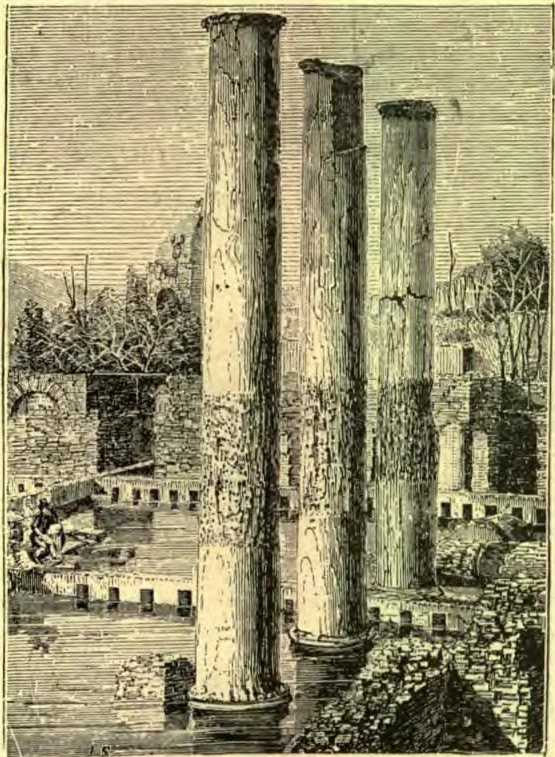
§94. Perhaps the most interesting example we have of a gradual change taking place in our earth's exterior is that displayed by the ruins of the Temple of Jupiter Serapis, built near Naples, on the shore of the Mediterranean, about the time of Christ. For centuries this magnificent structure lay buried beneath the surface of the earth; but in 1849 there were discovered the tops of three marble columns standing up out of the soil. Upon being excavated, it was found to be the above-mentioned temple. The structure was originally one hundred and thirty-four feet long by one hundred and fifteen feet wide; the roof was supported by forty-six pillars, each forty-two feet high, and five feet in diameter. Three of these columns are yet standing, and bear evidences that they were for some time partially submerged by the salty waters of the sea, as will be plainly seen by the accompanying illustration. The lower twelve feet are smooth, having been protected by the mud and earth, while the nine feet above this are eaten and scarred by a kind of boring shell-fish, such as now inhabit the Mediterranean waters, and whose remains are still found within the perforations of those pillars. Above this point the columns are smoother, having stood out of the water. The paving of the temple is now submerged. Five feet below this there is a second paving, showing that these oscillations of the land had gone on before the temple was finally deserted by the Romans.
§95. Experiments made some time ago by officers of the topographical corps of United States engineers, on the expansion of various rocks by heat, give data which prove that if a mass of sandstone a mile in thickness should be raised in temperature two hundred degrees Fahrenheit, it would expand sufficiently to lift its surface ten feet above its former level. Also that if a portion of the earth's crust one hundred miles in thickness were to have its temperature raised from six hundred to eight hundred degrees, it would produce an elevation of between two thousand and three thousand feet, while the cooling of the same mass would cause the lifted surface to recede to its original position. This explains the gradual changes that we see going on in our earth at present.
§96. Dr. Emmons, superintendent of the Geological Survey of North Carolina, states that the bottoms of the sounds on that coast are everywhere so thickly studded with stumps of the common pine of the mainland that it is necessary to remove them with gunpowder before a netp. 356 can be drawn for fishing. These stumps were not washed there by river currents, but actually grew where they now are, at a time when that land was above the level of the sea. These are all changes of recent date. Many instances might be given to substantiate the prophecy of Isa. 51:6, which says that the “earth shall wax old like a garment.”
§97. Since the day of the crucifixion, when “the earth did quake, and the rocks rent” (see Sections 78–82), this rebellious dominion of Satan has been shaken mightily time and again by the power of God. As the Saviour looked down the stream of time, and beheld the “waxing old” of this earth, he said, “And there shall be famines, and pestilences, and earthquakes, in divers places;” and thus it has been.
§98. According to our standard geologies, the greatest earthquake known to history is that which occurred at the opening of “the sixth seal,” Nov. 1, 1755. “And I beheld when he had opened the sixth seal, and, lo, there was a great earthquake; and the sun became black as sackcloth of hair, and the moon became as blood.” Rev. 6:12. This earthquake, which destroyed the city of Lisbon, in Portugal, gave no warning of its terrible approach save a rumbling noise like subterranean thunder. This was soon followed by successive shocks, which engulfed that wicked city, with its sixty thousand inhabitants. So completely did the earth open her mouth and swallow that seaport town, that it is said that not a single body ever came to the water’s surface to mark the spot where Lisbon once stood. The shock of this fearful event lasted only about five minutes; but over four million square miles of territory was shaken by it. The West Indies; the Atlantic States; the kingdoms of Scotland, Norway, and Sweden, recognized the opening of that seal. In Morocco upward of eight thousand persons perished.
§99. If this in the eyes of the Lord is considered as only “a great earthquake,” how terrible must be the one that shall shake this earth at the time of the close of its present history! “And there came a great voice out of the temple of heaven, from the throne, saying, It is done. And there were voices, and thunders, and lightnings; and there was a great earthquake, such as was not since men were upon the earth, so mighty an earthquake, and so great.” Rev. 16:17, 18.
QUESTIONS
Explain the cause of earthquakes. Describe some of the changes in the land elevation now going on, also their cause. In what manner is this cause produced? What would produce an opposite result? Tell all you can about the earthquake of 1755. Will there ever be a greater one? When? DR. O. C. GODSMARK.
2005 Magazine St., Louisville, Ky.