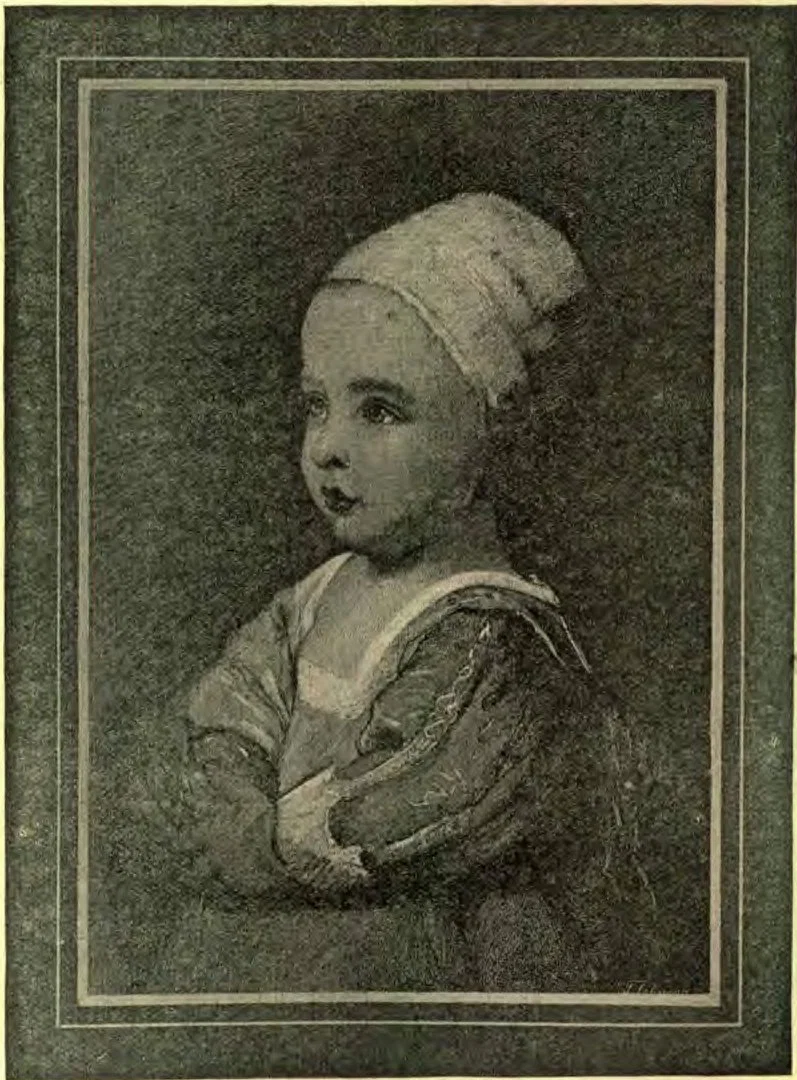
If Baby Stuart, whose picture looks down from many a school-room and nursery wall, could tell his own story, perhaps this is what he would say:—
“My father was King Charles I, of England. He was beheaded when I was sixteen years old. That was a long time ago—more than two hundred and fifty years. One hundred years before that, my great-grandmother, Mary Queen of Scots, was beheaded. So you see that to be a prince of the blood, as I was, was not the happiest thing in the world. After my father had been put to death, Oliver Cromwell, who had no royal blood in his veins, was made ruler of England. But it was not long before England decided to have a king again—to call back the Stuarts; and so my eldest brother was crowned Charles II. As Duke of York and Albany, and the next heir to the throne, I was as important a personage as could be seen at court; and I held high positions in the army. This picture was painted when I was about two years old, by a famous Dutch artist named Vandyke, whom my father, the king, kept busy painting his portraits and those of my mother, the queen, and of my brothers and sisters as well. It is one of a group known as the ‘Children of Charles I.’ That is my brother, Prince Charlie, with his hand on the dog’s head. My sister, the Princess Mary, stands between us. She was afterward married to the Prince of Orange of Holland, and it was their son, William III, who married my daughter Mary,—they are the ‘William and Mary’ that ‘together came on,’ after my reign in the rhyme you recite about the kings and queens of England. After William and Mary, Anne, my youngest daughter, succeeded to the throne,—‘Good Queen Anne,’ she was called.”
BABY STUART
“I reigned—well, only some three years. I was past fifty when I ascended the throne, and, as perhaps you know, the most of my subjects did not like me overmuch, and I was glad to escape from London with my life, and run away to France, where my uncle, Louis XIII, was king. He gave me a palace to live in for the rest of my days. In history I am called James II, the last Roman Catholic King of England.”
“When I was in the prime of life, my royal brother, the king, gave me, as a reward for some hard fighting I had done for him against Holland, a great domain, millions of acres, over the sea in that strange New World neither of us had ever seen nor cared to visit. The king gave me two tracts, or ‘patents,’ as they were called; and one of them included ‘all the land from the west side of the Connecticut River to the east side of the Delaware,’—a grant of what, in truth, belonged to the Dutch, who had a settlement at the mouth of the Hudson River called New Amsterdam, and farther up the Hudson a thriving trading-post, Fort Orange. New Amsterdam we decided (the king and I) should be called New York, in honor of my Royal Highness, and Fort Orange we two renamed Albany. I was Duke of York and Albany, you know, and in those days it was by some thought that kings had the right to take anything they wanted, and do with it as they pleased. So you see that your Baby Stuart has two great monuments in your Empire State—the cities of New York and Albany. These names, York and Albany, are pretty well sprinkled over the United States, each a memorial of your Baby Stuart.
“One thing more should interest particularly the children descended from the soldiers of the Revolution. I had a great deal to do with the starting of what became, in less than a hundred years, your War of the Revolution. I was the first colonial proprietor who provoked an open revolt against England. In that part of my domain known as ‘the places upon the Delaware,’ a Scandinavian called Long Fin stirred up the people against my tyranny, as he called it,—my unjust, cruel laws,—and there was considerable uprising. But it was soon put down; Long Fin was whipped, branded with the letter R, and sold into slavery,—the beginning, you see, of ’76, which had another ending.”
“Had things been different from what they were some two hundred and fifty years ago, my son, James Francis Edward Stuart, would have had a place in the list of England’s kings, and would not now be known as the ‘Pretender;’ and my grandson, Charles Edward Stuart, would not be called the ‘Young Pretender,’ but Charles III of England. But after my flight, and the calling of William of Orange to the throne, another line of royal descent from my grandfather, James I, was fixed upon and accepted by the Parliament of England; and that is why King Edward VII is king, though not a direct descendant of your Baby Stuart.”
“Thanks to Anthony Vandyke, I have an enduring throne in the hearts of a multitude of children the world over—am crowned with their love. They look up from their books, and wonder how I spent the happy hours of my innocent childhood. I am never the proud, stern Duke of York to them, nor the runaway James II, but always Prince Jamie, ‘who tossed his ball so high, so high,’ in the gardens of Hampton Court, and who used to go sailing in the king’s barge up and down the Thames, and who loved his royal father dearly, even if many of the people of England did not.”
Yes, I think this is about what our Baby Stuart would say. Let us remember, when we look at our favorite print, that if James Stuart was not the best of kings, he was ever a loving father, and that separation from his children in his exile was the bitterest sorrow of his broken heart.—St. Nicholas.