Chapter XXI — Attraction and Repulsion
§ 213. One of the most important factors in our preparatory study of astronomy is the attractive and repulsive properties of electricity. Many things we know to be true, and wonder at the fact; but when we understand the reason for the existing phenomena, we enjoy the satisfaction of seeing the workings of God as would otherwise be impossible. In the attractive and repulsive effects of electric, or magnetic, vibration is the explanation of many of the wonderful manifestations of the workings of God in the celestial and terrestrial fields of study.
§ 214. To illustrate what is meant by electrical, or magnetic, attraction and repulsion: Place upon your table two copper balls mounted upon insulated stands, as shown in the illustration. The one marked (a) is connected with a battery, and is positively charged with electricity. The one marked (b) is connected by a wire with the ground, and being close enough to (a), which is positive (+), to be under its influence, it becomes negative (—). Now suspend, between the two, by a silken thread, a pith-ball (c), and watch the result.
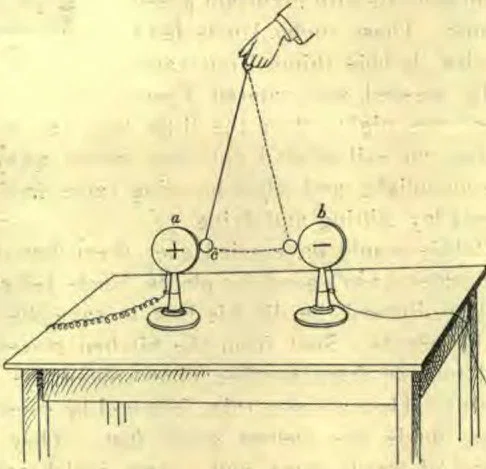
It is a well-known law of physics that “opposites attract, and likes repel,” and so with these. The pith-ball being placed under the influence of the positive (+) electrode, immediately becomes negative (—), and so is attracted to the positive electrode. The moment it touches it, it becomes positively electrized itself, and being the smaller and lighter of the two, is quickly repelled, or thrown off, from the positive ball. The moment it leaves this positive electrode, it is attracted to the negatively electrized electrode, to which it flies as rapidly as it first went to the positive one, being not only attracted to it, but also driven toward it by the one which it left. But it does not remain long in touch with its negative neighbor; for the moment it gives off its load of positive electricity, it, in turn, becomes negatively electrized; and as likes repel, it is thrown off from this electrode, and driven back to the first, only to repeat the vibration, which is kept up as long as the first electrode is positively charged. This simple experiment will be of value in our future study of astronomy, and we trust that none will neglect it.
§ 215. Now let us review a few of the facts we have learned regarding vibration, and put them to a practical test. The lowest, crudest form of vibration is sound. Strike a large gong, triangle, or bell, and you can actually see the edge vibrate; or if the tone is too high to see the vibrations, you can distinctly feel them. Speak into a tin can or basin, and the bottom will vibrate in exact accord with the varied tones and modulations of the voice. Attach a hard-twisted cord or small wire to the center of the bottom of the can, connect the other end of the cord or wire with a similar can some rods away, and speak into the one, holding the cord taut, and the exact vibrations of the voice will be reproduced in the can at the other end of the cord by the mere vibrations of the bottom of that can. This is the most simple form of telephone; but when properly constructed, will do good service for some distance. Parchment, or even leather, forms an excellent drum for such a telephone.
§ 216. In the magnetic telephone—the one commonly in use—the sound-waves, or vibrations, are carried by magnetic impulses that exactly correspond with the vibrations of the diaphragm against which the person speaks. These impulses are carried over the wire, which becomes an extended magnet; and this by its impulses causes the diaphragm at the other end of the line to vibrate in exact unison with the one into which the person speaks, thus accurately reproducing the sound.
§ 217. The phonograph is, as the name indicates, a machine for writing sound. A sharp needle, or point, is attached to the center of the drum, or diaphragm, against which the operator speaks. The point of the needle is caused to rest lightly upon a rapidly revolving cylinder of wax in such a manner as to trace a spiral thread running round and round from one end of the cylinder to the other in the same manner as the threads are cut in a very fine screw, or bolt. As the tone of the voice causes the diaphragm to vibrate, the needle pricks little holes, or rows of holes, in the rapidly revolving body of wax, each hole representing one vibration, and each group, or row of holes, representing one tone. All that is needed to reproduce the sound is to place the needle back at the beginning of the little line of dots that it has made in the wax, and start the machine in motion. The needle drops rapidly into the punctures that it has before made, and in so doing causes the plate to vibrate, and thus produce the same sound that first caused the punctures.
§ 218. When the higher forms of vibration, such as electricity, are caused to pass over a poor conductor, the resistance is such that the vibrations become slowed down, and manifest themselves in the forms of heat and light. When a moderate amount of electricity is used, the conductor merely becomes warm; but when a stronger current is applied, it blazes out in the form of light. The resistance afforded the current by the platinum wire is sufficient to change the vibrations from that of electricity to light in the glass bulbs that afford us light in our homes and offices. The same is true regarding the carbon points in the arc-lamps that light our streets at night. This merely illustrates the change that takes place in the forms of vibration.
§ 219. The reason the electric light is white, having its full amount of indigo and violet rays, is that it is a higher order of light than is the yellow flame of the candle, or light from a poor grade of petroleum. The more refined and perfect the oil, the whiter the light.
Questions
State a universal law of physics relative to attraction and repulsion. Describe the illustration of the pith-ball. When a conductor of electricity is brought under the influence of a positive electrode, what polarity does the object take on, positive or negative? What polarity have the ground, trees, and buildings over which a heavy thunder-cloud is passing? Dry air being a poor conductor of electricity, when will the rubbing of a cat’s back produce the greater number of electric sparks, before a thunder-storm or afterward? Why? Explain the philosophy of a simple telephone. Why will a phonograph repeat the exact words spoken into it? How is the electric light produced? Why is its light whiter than the light of a candle?p. 87
Note
We are sorry these lessons have been interrupted during the past few weeks, and trust our duties in the future will not be such as to hinder their preparation. Having laid the foundation facts, we are now ready to enter upon that most interesting of all studies, “Bible Astronomy.”
Those who have carefully preserved their INSTRUCTORS will now have an excellent basis for this study, and those who have not, would do well to secure these back numbers if possible, as constant reference will be made to the points brought out in the different sections gone over, all of which have been preparatory to the coming study. From letters constantly coming to us from all over the United States and parts of Canada, we know we shall have a large and interesting class, and we shall gladly do all we can to make this important study so simple and plain that the children, and those who have never studied science at all, can not only understand it, but also teach it to the pupils in their schools and families. DR. O. C. GODSMARK.
2005 Magazine St., Louisville, Ky.