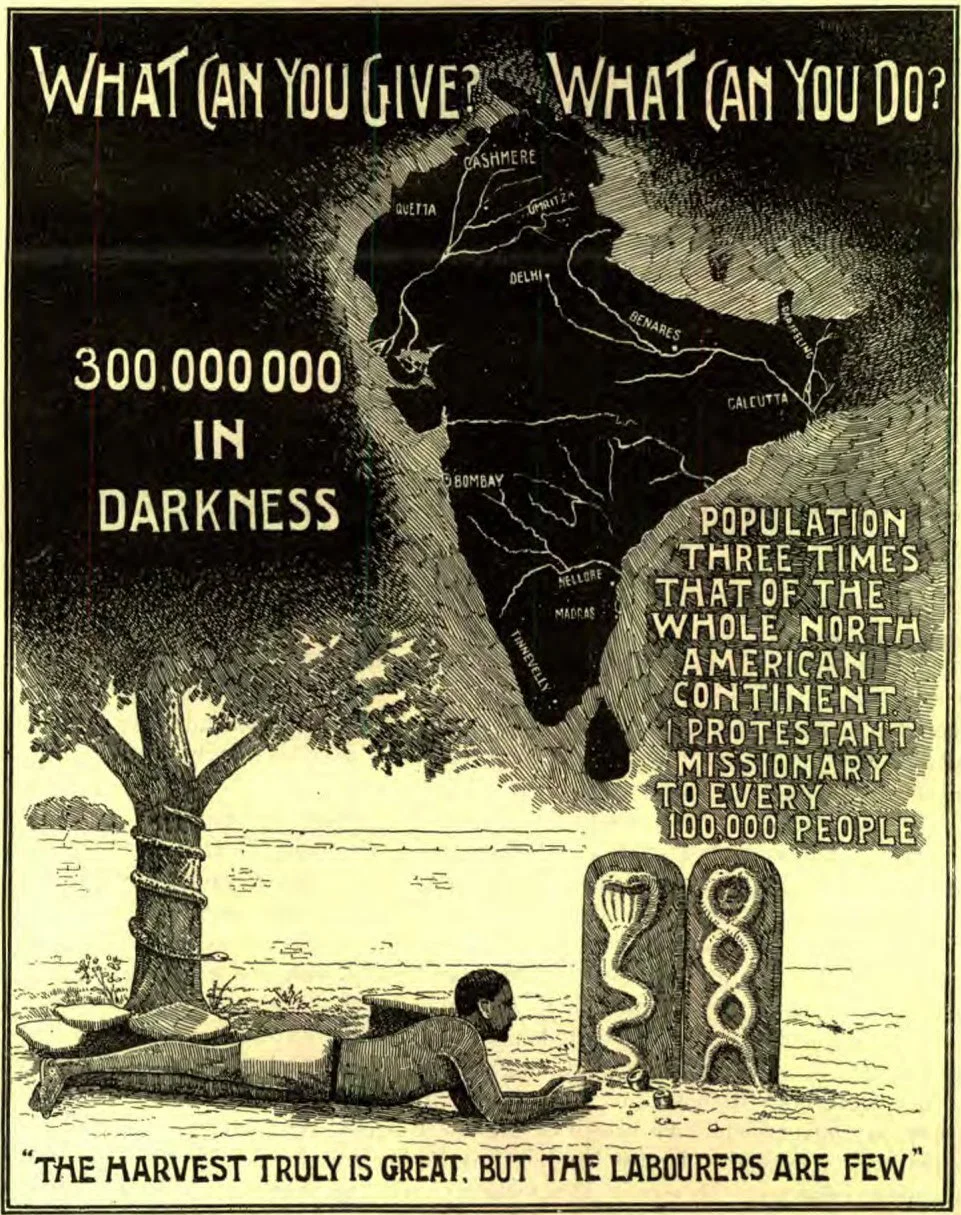
3. Closing Address:— What can you give? What can you do?
4. Closing Exercises:—
Song—“Hymns and Tunes,” No. 103.
Benediction.
SUGGESTION.— Abundant material for the different topics suggested may be found in the following Reviews:—
1902—No. 36, p. 15; No. 38, p. 15; No. 39, p. 16; No. 40, p. 13; No. 42, p. 18; No. 47, pp. 14, 17; No. 51, p. 15.
1903—No. 3, p. 11; No. 7, p. 14.
Other matter may also be found in Missionary Magazine files.
The hymn No. 103 of our “Hymns and Tunes” collection will certainly be sung with a deep spirit of consecration, when we remember that it was written by the first convert to Christianity in India—Krishna Pal.
A reproduction of the illustration on this page, either on a blackboard or on a large sheet of paper, will add very much to the interest of the meeting. It gives a glimpse of the real spiritual condition of India far better than words can portray it. The population of India may be illustrated by drawing a large square, measured off into twenty-five small squares. One of the twenty-five should then be marked off into one hundred small squares. Then draw another large square marked off in one hundred and forty-four little squares. Each small space of this second large square now represents one thousand people, and the entire square represents the smallest square in our first figure. If possible, again mark one of these smallest squares into one hundred squares, each representing one hundred people, and one of these will about represent our own people in India, who number a little under one hundred. This fact alone will be a strong argument in answering the two questions in our illustration.