A slender rawhide or rattan riding-whip can be bought for a very small sum, and will make an excellent base upon which to weave horse-hair. Failing this, the small end of a broken buggy-whip will do nicely. The length should be about two and one-half feet; but if you have a cracker on the tip, it may be somewhat shorter.
The whip will be tapering; so a larger number of threads of woof will be needed at the butt than at the tip. It is best to begin weaving at the large end, as it is easier to drop threads that are no longer needed than it is to take up new ones, and much less work to finish with a small number of threads in the woof than where there are more.
The first thing to do is to provide the whip with a loop by which it may be carried on the wrist, or hung on the saddle-horn when not in use. This may be of leather or of braided horsehair. If hair is used, it should be braided flat, as a square or round braid is so rough that it cannot be carried on the wrist with any degree of comfort. The loop should be not less than six inches in length. That will require twelve inches of braid; and as an inch from each end will be used in fastening it to the whip, the braid must be at least fourteen inches long.
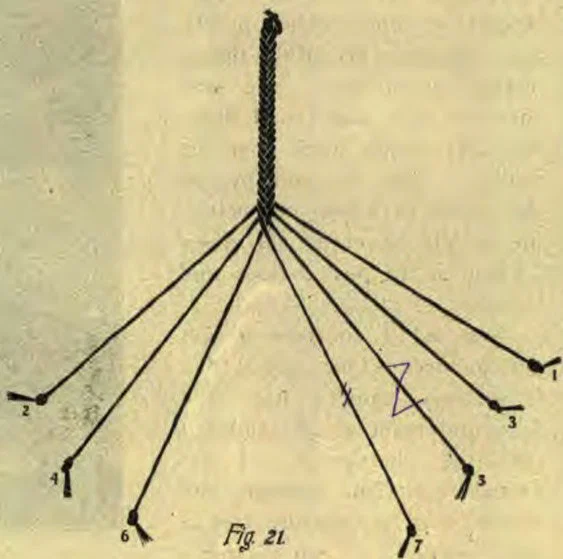
A flat braid can be made with any odd number of strands, but seven will be best for this purpose. The braiding is quite simple, and will be readily understood by referring to Fig. 21. The strands are there numbered in the order that they are to be used; and when all have been used once, they will have changed sides. Take 1 and pass it over 3, 5, and 7 to the other side, where it is left in front of 6. Next pass 2 over 4, 6, and 1, and leave it in front of 7. In their turn the other strands are used in a similar manner until the braid is finished.
To fasten the loop to the whip, let the ends of the former overlap the butt of the latter about an inch, and then wrap them tightly with strong thread. Begin the weaving at this end of the whip in the ordinary manner. Be sure that your woof contains a sufficient number of threads to begin with, as it will be easy enough to drop them out when they get crowded. When it is necessary to drop a thread, skip it, and use the next one. When you come to that place on the next circle of stitches, take the thread that was skipped, and draw it under the warp, just as you would in splicing a thread.

If the whip is to be finished without a cracker, the best way to hide the ends of the woof is to pass each thread through a needle, and draw it under the weaving, and up through the latter about half an inch from the end. What is left of the thread can then be cut off.

If a cracker is desired, the threads of woof can be separated into four strands, and braided around the warp for about two inches. Then bring the end of this braid back to the place where it was begun, to form a small loop, and fasten it securely with strong thread wrapped around and sewed through and through both braids. Now cut off whatever remains of the ends of warp and woof, and cover this place with needlework.
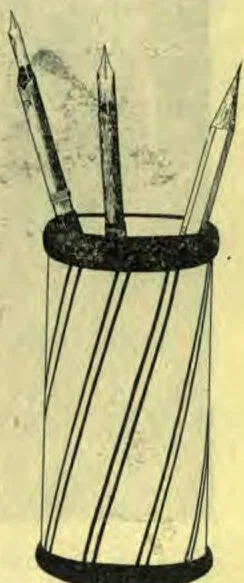
Fig. 22 shows the whip completed, with the exception of the cracker. This latter should be a leather thong about eight or nine inches long, three eighths of an inch wide in the middle, and tapering to a point at each end. Beginning an inch on each side of the middle of this thong, cut two slits about an inch long, pass the thong through the small loop on the end of the whip, and fasten it in the manner shown in Fig. 23, when it will be ready to use.
A Pen and Pencil Vase
A vase to hold pens and pencils is a useful thing on any writing-desk; and when such a vase is covered with horsehair woven in some appropriate pattern, beauty is combined with utility.
The base upon which the hair is woven may be either a tin can or a round glass bottle from which the top has been cut. An ordinary glass bottle will be much heavier than a tin can of the same size, and a vase woven upon such a base will not be as easily tipped over as one in which tin is used. But glass is so easily broken that the advantage is probably on the side of the tin. If tin is used, a coat of dark stain on the inside will improve its appearance.
The vase from which the drawing (Fig. 24) was made measures four and one-half inches in height and two inches in diameter. This will be found a convenient size; but if it was somewhat smaller, it would probably serve the purpose equally well. To cover a base of this size, I used one hundred and twenty-six threads of woof, each of which contained ten hairs. The needlework on the top and bottom of the vase brought the total number of hairs used up to nearly fifteen hundred, with an aggregate length of more than two thousand feet. That would make quite a long string if stretched out in one line; yet the weaving of this vase was by no means as much work as one might suppose from the amount of hair it contains.
This vase contains twelve threads of white hair to two of black, the arrangement being ten white threads, one black, two more white, and another black. This is repeated nine times. The needlework on the top and bottom is entirely of black hair. Of course different patterns may be followed if you choose.
It will be best to begin weaving at the bottom of the vase. When you have woven to within a quarter of an inch of the top, the threads of woof may be passed under the warp, and the latter wrapped tightly around several times, and tied, to hold it in position till the needlework can be put on to hide the ends. J. Edgar Ross.