IN a meadow about two hundred yards from my boyhood home was a dry, well-drained bank, where lived a colony of large red ants. You have seen such a colony, I am sure; but I am going to tell you something about this colony that you may never have noticed. They had a farm about five yards across, and raised grain, too. You think this is queer, so I will tell you how they did it. First, they plowed the ground by working through it back and forth, and cutting it all up fine. They plowed deep, too, and were careful to destroy all grass, and everything that might injure the crop. Next they sowed the seed. There was no regularity nor order about this; but when it came up, there was a good, even stand, after all. Their crop was a sort of short grass, that grew only about a foot high. This was tended with the utmost care. Sentinels were stationed over it at all times, and woe to the luckless grasshopper that attempted to forage in this field! He was278promptly driven off, or killed and taken home.
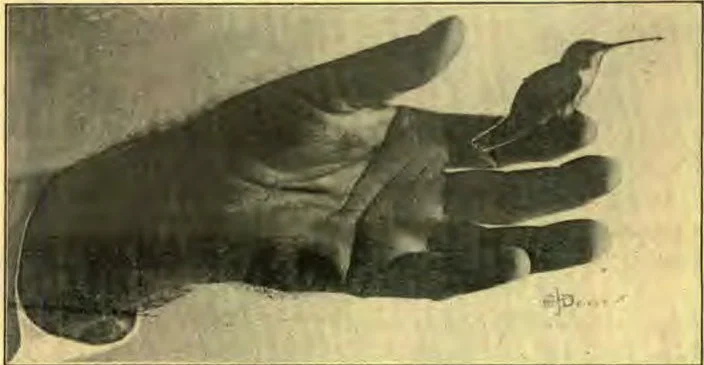
“AND SAT ON HIS FINGER”
In August the grass ripened heads of grain,—pretty white grains that looked almost like small kernels of rice, only they were no larger than a radish seed. Harvest was a busy time. Ants clambered over each plant, gathered the grain, seed by seed, and spread it out to dry in the sun. Before this, storehouses had been hollowed out below the surface of the ground, and had been well drained. As soon as the grain was quite dry, it was stored in these granaries; but as it would not dry in one day, and as dew would dampen it, it was carried down in the evening and back in the morning. Even after it had been stored for the winter, it was sometimes necessary to carry it up to dry after a hard rain.
The granaries were not very large, but there were a number of them,—I did not dig enough to find out how many,—and there were empty rooms, where, in all probability, that mysterious process of turning the grain to a liquid took place; for an ant eats nothing without first turning it to a liquid.
One who watches an anthill will learn some interesting things. Sometimes there are thousands of open doors, and the busy workers are cleaning house. Again, you will find no doors at all, and not an ant is stirring. When danger is near, they usually have all doors closed.
It is interesting to see several ants drag a large grasshopper to the mouth of one of their houses, and find him too large to take inside. First a leg or a wing is cut off and carried in, then another. Finally some general comes, looks the situation over, and touches his horns against the horns of two or three others, and away they all run into the hill. By and by an opening large enough to admit the dismembered carcass into a room is made, and it is dragged to that opening and into the hill. Soon the door is closed so tightly that no one could tell where it had been. Ants build walls and arches of little balls of dirt, which rival the work of a stone mason.
I know only one tribe of ants in Iowa that are farmers. The remainder are hunters, professional warriors, or stock-raisers. The warriors are so shiftless that they will not wash their own babies, or even themselves, and would starve were it not for their slaves, whom they compel to take care of them. They are large, strong fellows, nevertheless, and are terrible in battle. There are only a few of this kind.
There are many herders, and next week I will tell you about them. A large colony of them kept their herds only about fifty feet from the corner of our house. I suppose they would be there yet, had they not stolen so much from our cupboard. As it was, they became a nuisance, and I led a colony of warriors against them. After fighting two days and one night, both colonies were exterminated. The battle was terrible. I never would have started it, had I known its horrors; but, once begun, it was too late. Every chip and stick was covered with struggling ants. They asked no quarter and received none. Ants with their legs cut off still fought whenever an enemy came in reach, and I saw many severed heads still hanging to their enemy with a death-grip that could not be released. Satan rules even among the ants when they go to war. FLOYD BRALLIAR.