There are many species of larkspur native to the United States, although but few, perhaps not more than half a dozen, are usually found in any one locality. The different kinds cultivated in flower gardens have come mostly from Europe, Siberia, and China.
All the larkspurs have leaves of the form known as palmately lobed. The incisions between the lobes are directed toward the apex of the petiole, and not toward the midrib. Leaves of this kind are also palmately veined, the principal veins, or ribs, diverging from the apex of the petiole, like rays from a common center.
The flowers are of various colors, usually some shade of blue, sometimes pink or white, and in one cultivated species from California, scarlet and yellow.
The sepals are colored like the petals, and, indeed, are the most showy part of the flower. In most of the forms there are four separate petals, and from two to five pistils. Others have only two petals, which are united more or less into one piece, and but one pistil. Of this form is the one shown in the illustration, Delphinium Ajacis, or Rocket Larkspur, found in flower gardens.
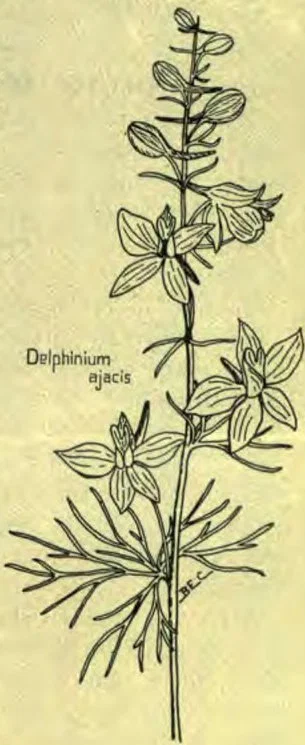
All the species agree in having the upper sepal produced into a long spur, which is sometimes straight, sometimes curved. The popular name is an allusion to the long hind claw so characteristic of the larks.
Several kinds of Larkspur have been reported to the United States Department of Agriculture as plants poisonous to cattle and sheep. Delphinium tricorne, the Dwarf Larkspur, has been reported, especially from Ohio, to be fatal to cattle in April, when the fresh leaves appear. Delphinium geyeri, a common plant of the high prairies of Wyoming and Colorado, is reported to be the most troublesome of all the poisonous plants of Wyoming, causing considerable loss to ranchmen, especially in early spring. Delphinium menziesii, the Purple Larkspur, is found from San Francisco to British Columbia, and eastward as far as the Dakotas, being very common throughout Montana. The botanist of the Montana Agricultural College reported a case of poisoning that occurred in May, 1897, in which over five hundred sheep were affected.
It is advised as an excellent precaution that animals be permitted to graze in pastures containing larkspur only when well-fed, and then only for short periods, until they become acquainted with the nature of the plant.
Questions
Of what form are the leaves of all the larkspurs? What is meant by “palmately lobed” and “palmately veined”? What is the usual color of larkspur flowers? What part of the flower is the most showy? In what special characteristic do all larkspurs agree? What trouble is caused by some of the species? B. E. Crawford.