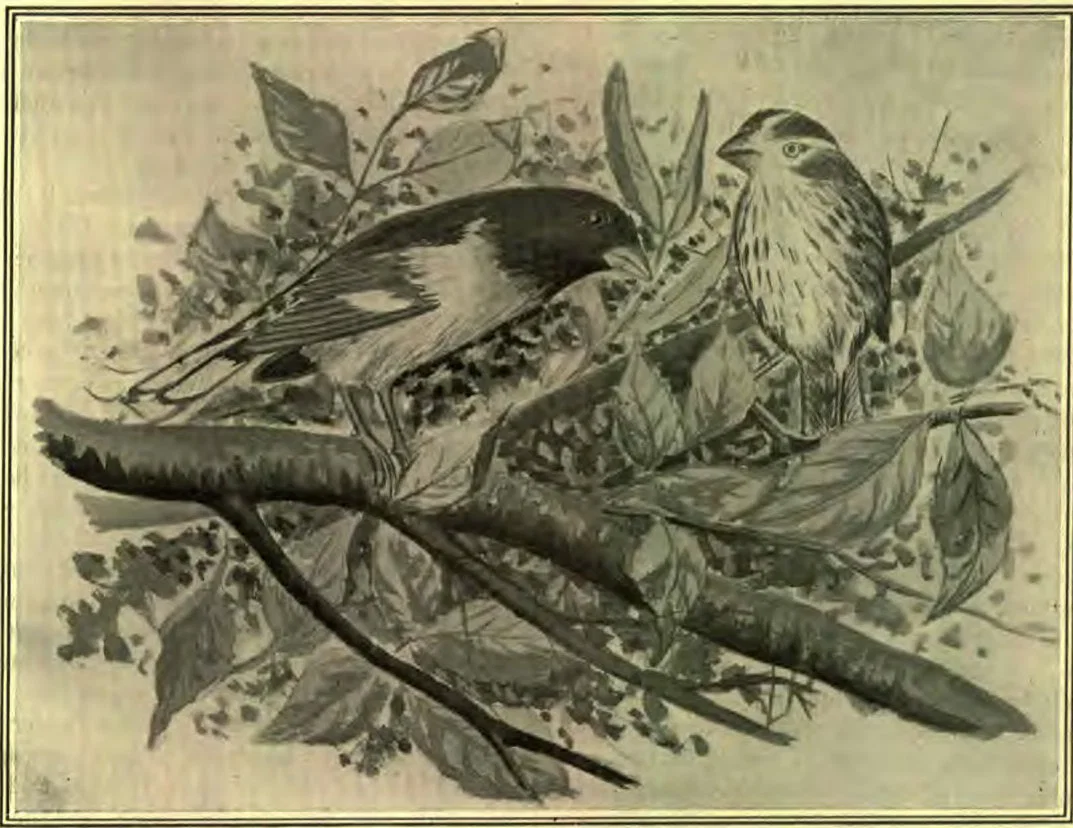
When I was just beginning the study of birds, and for the first time caught sight of the Rose-breasted Grosbeak, I felt that I had made a wonderful discovery. Certainly it must be a very rare bird; for I did not remember ever having seen it before in my life. But this was but another example of the fact that often we do not see what we might easily see if our eyes were open to discover. The Rose-breasted Grosbeak loves the shelter of trees and shrubbery, and for this reason I had more than once, I have no doubt, passed it by unnoticed.
The Grosbeak is a bird worth seeing. He is dressed in black, white, and rose-color, and in the early spring has a song that is worth hearing. In intonation it is much like that of the robin, but this similarity exists only in the form; for as Professor Chapman says, “there is no more resemblance in their voices than there is between the birds themselves.” The song of the robin is often delicate and sweet, but too frequently exceedingly monotonous. Not so the song of the Grosbeak. I have listened, time and time again, for long periods to its pure, glad carols, thanking God for the melody of spring. Florence Merriam calls the jubilee of the Grosbeak a “rich, round pendulum-song.” The figure is an apt one, as those who are acquainted with the song will testify. The bird has a great habit of getting well into the top of a tree, and often, perched in its dense green top, will sing its rapturous melody while the westering sun sinks slowly toward the horizon. If you do not identify the bird by its song, his call note is fully as characteristic, being a distinct but not loud sort of questioning note,—a steely ick, eek, or peek!
The black head, singularly large beak, and the rose-colored patch on the breast are enough to identify the male. The female is more difficult to determine; but her being in company with the male, her sparrow-like coloring, but in size too large for a sparrow, the white line over her eye, and her large or “gross” beak will enable you to be sure of her identity. It is the large beak which gives the bird its name. It is somewhat like that of the sparrows and finches in outline, but is an exaggeration, being built on a large scale. The bill is for crushing the potato-beetle and other insects which largely compose its diet. It also eats a few peas, but its value in destroying “potato-bugs” more than compensates for any damage it may do in this way.
Professor Beal tells of two Grosbeaks which had their nest hidden by a potato patch that was so infested with potato-beetles that the vines were completely riddled. The Grosbeaks visited the fields every day; and when their young were old enough to travel, the whole family appeared on the scene. The young birds stood in an expectant row on the topmost rail of the fence, and their parents flew briskly back and forth, bringing them beetles. A few days later not a beetle was to be found, either old or young; the birds had swept them from the field, and saved the potatoes.
ROSE-BREASTED GROSBEAK
“One of the pleasantest nesting episodes I have ever known,” writes Florence Merriam, “was that of a Grosbeak family. The pretty, pale-blue eggs were laid in a nest of twigs in a pear-tree, close beside a carriage drive, and the trustful birds seemed to realize that they were among friends. The father was most devoted, brooding the nest and feeding the young. All his thoughts seemed to center about the pear-tree; the little home there was clearly the point around which everything in the world revolved. When he came to his nest, it was with a low, sweet greeting; when he left, it was with a soft farewell; if danger threatened, he was on the spot, and his anxious cries filled the air; when all was quiet again, and he had flown away, his cheering song came back to his mate in the nest, as if to assure her that he was near. The rich music that was always ringing about the home, the tender watchfulness and affection of the old birds, and the quiet happiness of the mother of the family on her nest under the green leaves, all seemed suited to the cheery orchard with its mellow sunshine and its ripening fruit.”
The male Grosbeak is not only an ardent lover, but assists in brooding by relieving the mother; and at such times, it is said, often sings while sitting on the nest. L. A. REED.