CLINTON BOWEN FISK, after whom this celebrated institute of learning was named, was born at York, New York, in 1828, and died in 1890. Entering the army, he rose to the rank of a brevet major-general. After the War of the Rebellion he became attached to the Freedman's Bureau as a commissioner, and later assisted in the opening of the institute which bears his name. The work of founding this university was begun in 1865, and it was incorporated in 1867. It was then known as the Fisk school, and was opened for the reception of pupils in the old Federal Hospital Buildings, Jan. 9, 1866.
This opening was a most thrilling affair. The newly emancipated colored people, for whose education it was intended, gathered by thousands about the grounds and upon the streets. “Thousands of ex-slaves were there. One passion animated this dusky throng. To learn to read was the ambition of the bright colored boy, of his sedate but none the less eager sire, and of the veteran grandparent with white hair, and with eyes that must learn the alphabet with the aid of spectacles.”
The first agency, and the most successful, in the perfecting of this grand undertaking was the American Missionary Society of New York City, founded in 1846 as a distinctly antislavery missionary society; but the real worker, the one who was instrumental in bringing the university up to its present standard of excellence, was Treasurer George L. White, who was instructor in music in the Fisk school from its opening.
With a faith in the result, and a courage invincible and unshakable, he organized, from among the male colored students, a band of nine singers, and started out with these in 1871 to raise money for the enlargement of the institution. Only for his faith and courage, and the prospering care of God, the enterprise would have proved a lamentable failure; for the first few weeks of their journeyings was a constant record of loss and discouragement. Mr. White had named his company “The Jubilee Singers,” and they could sing with incomparable sweetness, and with a pathos to melt the stoniest heart; yet as they went from town to town singing their melodies, they were often penniless, and on the verge of starvation. At last they reached Oberlin, and were permitted to sing before the National Council, then in session at that stronghold of the colored man. This turned the tide. Plymouth, Brooklyn, and scores of other prominent churches in the North opened their doors to receive them, and money poured into the treasury.
Crossing the Atlantic, Queen Victoria welcomed them. Germany and France received them, and at the end of seven years they returned to Nashville with the sum of one hundred and fifty thousand dollars, which was expended in the erection of Jubilee Hall, and in paying for the ground occupied, comprising thirty-five acres of what was formerly a slave plantation. The hall itself is surrounded with eight acres of land. There are seven other buildings.
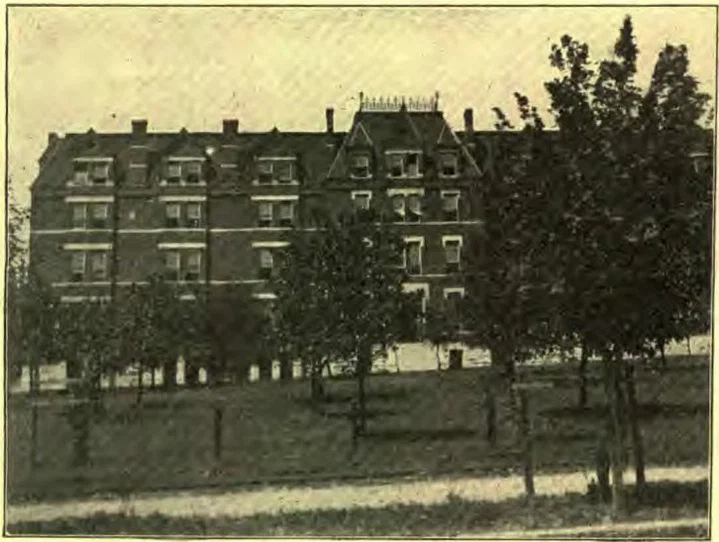
Jubilee Hall was erected in 1876, and cost over one hundred thousand dollars. It is 145x128 feet, five stories high, and contains dormitories for the girls, and the boarding department. The principal of the women's department has the oversight of this building, and an experienced woman is employed to look after the health of the young women, and to give individual advice.
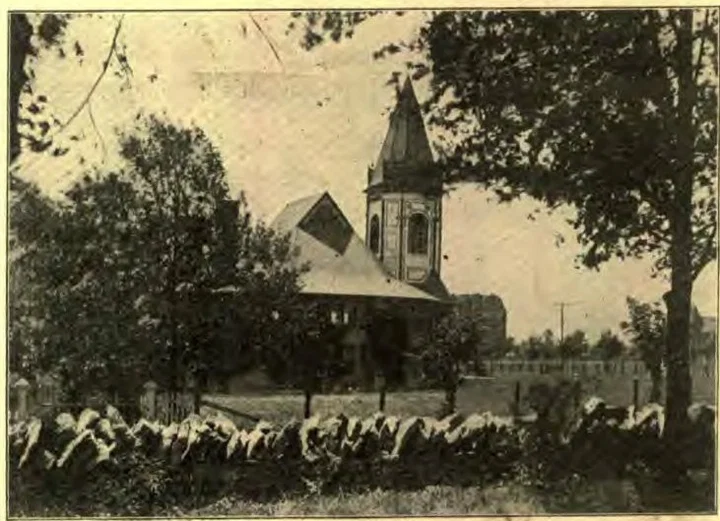
Livingstone Hall, the second of the eight buildings comprising the Fisk University group, cost sixty thousand dollars, and is the gift of Mrs. Valeria G. Stone, of Malden, Massachusetts. It was opened in September, 1882, and contains one hundred and twenty large, well-furnished, and comfortably warmed rooms for men. In addition it has the chapel, study-room, library, museum, laboratory, classrooms, and the president's and treasurer's offices.
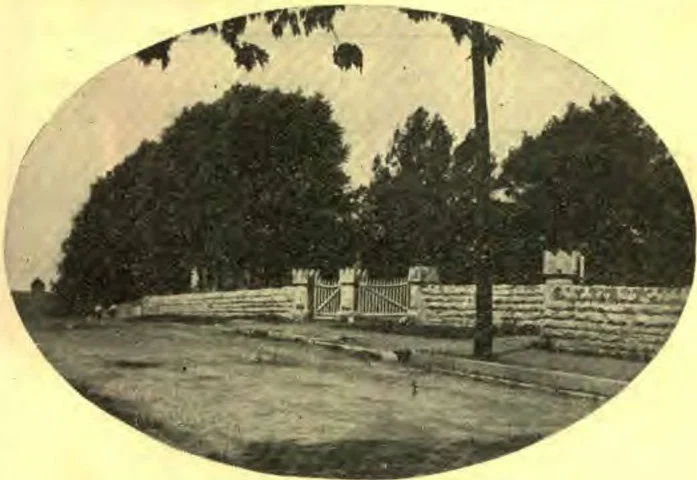
The Gymnasium and Workshop was erected in 1889, at a cost of five thousand dollars, through a legacy of a Mr. Howard, of Philadelphia, and other gifts.
In the fall and winter of 1890-91, a band of Jubilee Singers canvassed for funds for the erection of the fourth building, the African Missionary Association assisting, and in 1892 Theological Hall was erected, at a cost of twenty-five thousand dollars.
In the same year, through a legacy of General Clinton B. Fisk, the Fisk Memorial Chapel was built. It will seat one thousand persons.
The sixth building, the president's house, was built with money contributed by the widow of General Fisk, and Miss Mary F. Penfield, a teacher in the institute, who sold her home for two thousand dollars, and gave the proceeds to the building fund.
The seventh building, the Daniel Hand Model School, was erected in 1895, at a cost of five thousand dollars, the funds being contributed by the African Missionary Association, from the income of the Daniel Hand Fund. It is designed for the instruction of children under thirteen years of age.
Magnolia Cottage, the eighth building, containing four rooms, is the beginning of a hope for a “Department of Music.” It is used for instruction in music.
These eight buildings, with thirty-five acres of ground, and with the apparatus and furnishings, cost three hundred and fifty thousand dollars.
The most formidable obstacle encountered in the work of this institute is the extreme poverty of the colored people of the South; for the income of the institution falls short of its requirements.
The State of Tennessee provides sixty-six scholarships for colored men in the State, and each State senator has the right to appoint two men to scholarships during his two years of service. This scholarship enables a student from any recognized school to enter Fisk University on a credit of $6.25 a month of the total expense for board and tuition.p. 306
The library contains seven thousand one hundred and forty-two bound volumes, and a large number of periodicals, and is catalogued by the card system.
The faculty consists of seven regularly appointed professors, and twenty instructors, graduates of Northern universities.
The aim of the founders and supporters of the Fisk University has always been “to make its students strong, earnest, broad-minded Christian men and women, who shall give their lives to the uplifting and benefiting of their people;” and the result, so far, is that out of four hundred and nine graduates in the college and normal departments in the last twenty-five years, three hundred and nineteen have become college professors, teachers of high-grade schools, principals of normal or grammar schools, ministers, doctors, lawyers, or are still students in professional schools. Only ten remain yet at home, unprofessionally employed. W. S. CHAPMAN.