The physical features of Brazil are indeed of exceeding beauty. Its surface, diversified with mountains, hills, and plains, interspersed with noble rivers, and in some places with lovely lakes, is everywhere covered with a verdure luxurious and beautiful. The greater part of the country consists of high table-lands of an elevation of from one thousand to three thousand feet, limited, to the north and west, by the great continental depressions of the Amazon and Paraguay lowlands, especially those of the Amazon, can be judged from the fact that fifteen hundred miles back from the ocean, an altitude of only two hundred and fifty feet is reached.
Although the table-land of Brazil is often spoken of as being mountainous, it is said by the best authorities to be largely composed of plains, interspersed with valleys and numerous rivers. The real mountains, lying in the eastern and central portions of Brazil, may be regarded as two distinct chains. The eastern, or maritime, chain, extending from the southern extremity to almost the meridional limits of the country, is comparatively narrow, and is separated from the central chain by the plateaus of the San Francisco and the Parana basin. Between the ocean and the maritime chain lies a narrow, low strip of land, much of which is very arid; some of that nearest the ocean is inclined to be marshy.
The rivers of the lowlands are useful as a means of internal communication. Thus, for instance, the great Amazon, with its affluents, alone affords free navigation for over thirty thousand miles. Next in length are the Tocantins, the Parahyba, and the San Francisco. But many of the rivers of the more elevated districts are unnavigable, either wholly or in part, on account of the many rapids and waterfalls found in their courses. The settlers usually build their homes along the streams, large or small, as they depend upon these for their water supply, such a thing as a well being almost unknown in Brazil. I have ridden for hours through the virgin forests, where the land was of the best; but because no stream flowed through that section, there was not a planter to be found.
As to the actual geological and mineral structure of this vast country, it can be said that it is practically unknown. The mountains are largely composed of granite rock, while a species of mica is also abundant; marble is seldom found. Iron ore of a good quality, yielding as high as seventy-two per cent of iron, is found in large quantities, yet little is mined, most of the metal consumed in the country being imported. Gold is found in many of the provinces, with almost all the precious stones known to commerce. Among other metals found are silver, copper, and lead. Extensive coal-beds have been discovered; yet all coal consumed in the country is imported, and is consequently very high-priced, having reached as high a figure as fifteen dollars a ton, in United States money. And this, as you know, is still more in the currency of Brazil.
The climatic conditions of Brazil, though for the most part tropical, vary considerably, the country extending over such a range of territory. In addition to this, the altitude reached in some places—the greatest height being almost thirty-five hundred feet—gives a salubrious and even, bracing climate.
Of the Brazilian flora it is said that there have been twenty thousand varieties classified. Botanists have for convenience divided the country into three zones, the equatorial, the plateaus, and the coast.
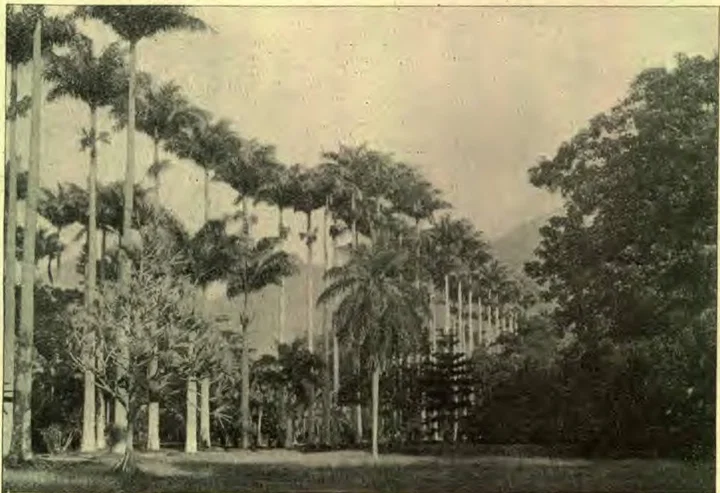
Of this vast flora we have space to mention only a few varieties. The castanheiro, or chestnut tree, known in botany as the Bertholletia excelsa, furnishes the famous Brazil-nuts. It is found extensively in the equatorial zone. Caoutchouc, the gum from which the so-called “india-rubber” is made, is an important article of commerce in the Amazon territory. Of palms there are many varieties, some one or other of them found almost in all parts of Brazil. Many species of useful wood are also found, among which might be mentioned rosewood; a variety of cedars; granna, closely resembling black walnut in color, only much harder; and many others. Coffee and cocoa are also important articles of commerce, especially coffee, which forms Brazil’s chief export. Of aromatic plants there are also a great number, one of the principal being vanilla.
The fauna of Brazil, like the flora, are of extraordinary richness. The wide range of territory along with varied climatic and other conditions, all contribute to making a home for the almost countless varieties of beasts, birds, and insects. Many persons make their living by catching beetles and butterflies for European markets. There are also numerous kinds of fish. Many of the poor people living along the coast subsist almost wholly from the products of fishing.
Wherever man looks in Brazil, whether at objects animate or inanimate, he may read of a wise and all-powerful Father, who is himself love, and who made all things beautiful to show this love to men, thereby to draw them to himself.
To point lost man to this all-wise, all-powerful, and all-loving Heavenly Father, we are laboring here in Brazil. And our daily prayer is for wisdom and power that we may so do our work that some may find him. F. W. Spies.