Volcanoes: Causes of Eruptions and Earth's Internal Heat
By A. Swedberg
Volcanoes
THE wonderful, ofttimes terrible and destructive, eruptions of smoke, fire, and lava from the bowels of the earth, which we call “volcanoes,” are still a mystery as to their immediate causes. It is generally conceded that the greater portion of the earth is a molten mass, surrounded with a hardened crust from ten to forty miles in thickness. In this respect we might compare the earth to an apple, the crust corresponding to the skin of the apple.
The theory that the earth is a molten mass inside is proved by the fact that in digging deep mines, the heat increases as the mine becomes deeper. One man has proposed to utilize this heat by boring two wells near each other to a depth of several thousand feet, and then uniting them at the bottom by an explosion of dynamite. By letting water run down one of these wells, it would be converted to steam by the heat at the bottom, and this steam would rush out of the other well, according to his theory, and could be utilized for industrial purposes.
Some scientists suppose the internal heat is caused by chemical action on a vast scale, due to the action of water on certain elements in the earth’s interior. Others suppose the heat is generated by friction and grinding, as the earth is gradually cooling, and that this grinding motion is severe enough in some places to generate a sufficient amount of heat to cause volcanoes.
Volcanic eruptions generally follow earthquakes, and this has given rise to another theory concerning the cause of volcanoes, which seems more probable. We know that earthquakes often cause fissures in the crust of the earth; and when these happen to be in the bottom of the ocean, large volumes of water rush down with tremendous force into the molten mass in the interior of the earth, and when they come in contact with this, the intense heat instantly converts the water into steam, causing, as we may well imagine, an explosion on a scale utterly beyond the comprehension of man. The tremendous force thus so suddenly developed finds a vent-hole through some already existing volcano, or breaks through the weaker places in the crust of the earth.
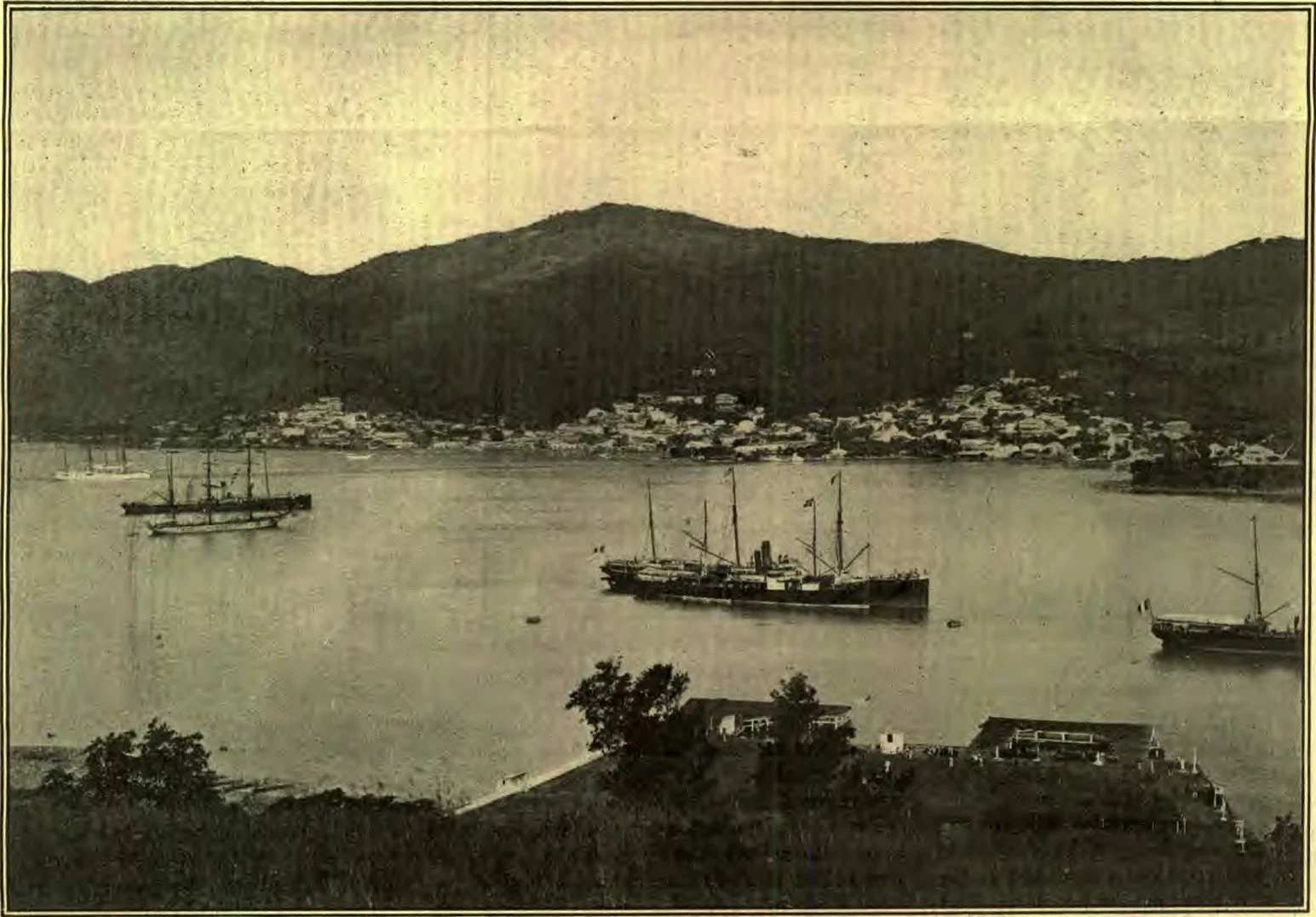
THE THREE HILLS OF CHARLOTTE AMALIE, ST. THOMAS
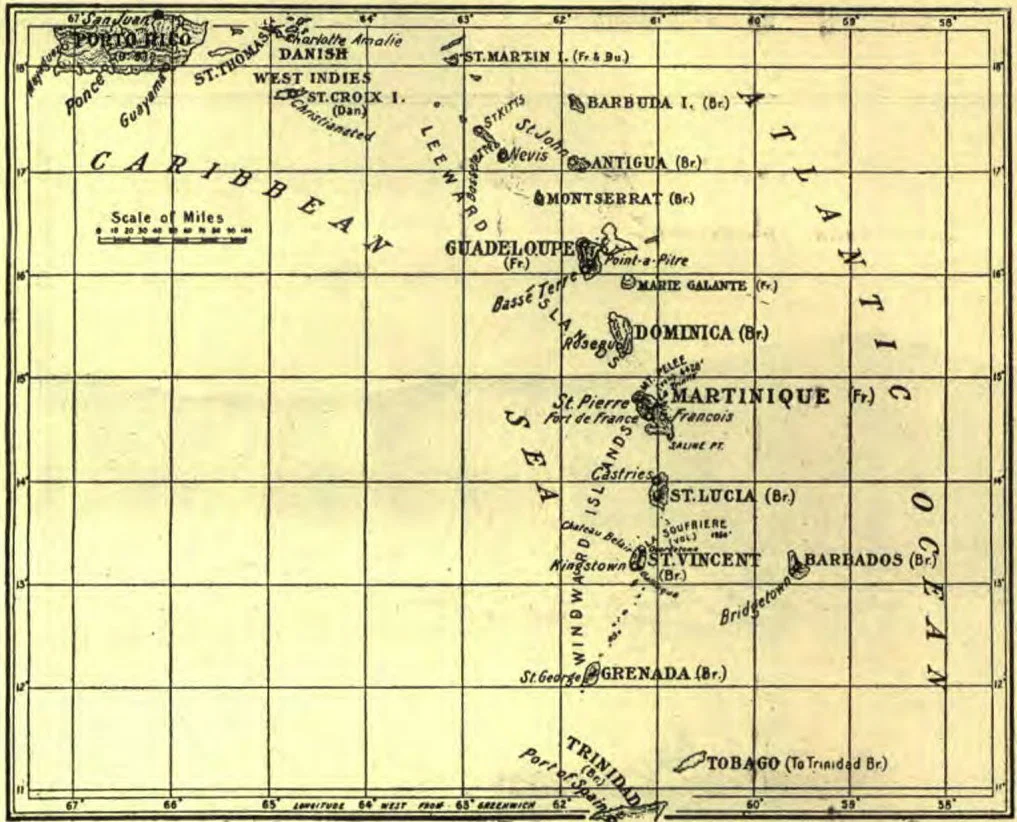
We have already heard of or read about the late eruptions of the volcanoes on the islands of Martinique and St. Vincent. So terrible and destructive have the eruptions from Mt. Pelée on the first-mentioned island been, that they exceed anything of the kind before described in this world’s history, with perhaps one exception,—that of Krakatoa, on a small uninhabited island near Java in the East Indies. In almost an instant the town of St. Pierre, on Martinique, was overwhelmed on the morning of May 8 by a dense volume of suffocating gas, immediately followed by a cyclone of fire, ashes, and stones from Mt. Pelée. Spectators say that the destruction was complete in from three to ten minutes’ time,—a city had been laid in charred ruins, and thirty thousand men, women, and children asphyxiated and burned to death.
An eye-witness gives the following graphic description of this terrible catastrophe:—
“I was in one of the fields of my estate when the ground trembled under my feet, not as it does when the earth quakes, but as if a terrible struggle was going on within the mountain. A terror came upon me, but I could not explain my fear.
“As I stood still, Mt. Pelée seemed to shudder, and a moaning sound issued from its crater. It was quite dark, the sun being obscured by ashes and fine volcanic dust. The air was dead about me,—so dead that the floating dust seemingly was not disturbed.
“Then there was a rending, crashing, grinding noise, which I can only describe as sounding as if every bit of machinery in the world had suddenly194broken down. It was deafening, and the flash of light that accompanied it was blinding, more so than any lightning I have ever seen.
“It was like a terrific hurricane; and where a fraction of a second before there had been a perfect calm, I felt myself drawn into a vortex, and I had to brace myself firmly. It was like a great express train rushing by, and I was drawn by its force.
“Transfixed, I stood, not knowing in what direction to flee. I looked toward Mt. Pelée, and above its apex formed a great black cloud which reached high in the air. It literally fell upon the city of St. Pierre. It moved with a rapidity that made it impossible for anything to escape it.
“From the cloud came explosions that sounded as if all the navies of the world were in titanic combat. Lightning played in and out in broad forks, the result being that intense darkness was followed by light that seemed to be of magnifying power.”
He hurried home, gathered his panic-stricken family, and all rushed to the seashore, and boarded a small steamship.
Continuing his description, he says:—
“I knew that there was no flame in the first wave that was sent down upon St. Pierre. It was a heavy gas, like fire-damp, and it must have asphyxiated the inhabitants before they were touched by the fire, which quickly followed. As we drew out to the sea in the small steamship, Mt. Pelée was in the throes of a terrible convulsion. New craters seemed to be opening all about the summit, and lava was flowing in broad streams in every direction. My estate was ruined while we were still in sight of it.”
ISLANDS OF THE CARIBBEAN. THERE ARE SABBATH-KEEPERS ON THE ISLANDS OF ST. THOMAS, ST. KITTS, ANTIGUA, ST. LUCIA, ST. VINCENT, BARBADOS, AND TRINIDAD.
On this occasion, stones weighing thirty pounds fell in Fort de France, fifteen miles away from the crater. A later eruption is described as ten times worse, so frightening the people in Fort de France, that a general exodus from that place and, in fact, from the entire island, began to be seriously thought of; and even the French government, which has this island under its sway, has taken into consideration the depopulation of the island. The prospects now are that this beautiful island, the most densely populated of all the West Indies, having one hundred and ninety thousand inhabitants on an area only twelve by forty miles, will be entirely ruined and forsaken on account of this terrible revolution in nature.
It was the 27th of August, 1883, that the most terrible eruption ever recorded in history occurred on the island of Krakatoa. This island was only five miles long, situated between Java and Sumatra in the East Indies. For three months prior to the eruption, seismic disturbances had been of frequent occurrence in the regions referred to. On the date mentioned a fissure was caused in the vicinity of this island; and when the sea water rushed down, the resulting steam caused an explosion of such tremendous force that half the island to the depth of several hundred fathoms, consisting of millions of tons of matter, was literally lifted upward in the air to a height of two miles. The fragments descended ten miles away, and formed two new islands, called Steers and Calmeyer.
A column of lava and stones was forced twenty miles skyward, and the explosion was heard at points four thousand miles away, at Honolulu, Cape Town, and Auckland. So overwhelming was the noise, that it surpassed the hearing capacity of the human ear within a radius of many miles.
The immense opening caused by the removal of half the island was immediately filled with the inrushing ocean; but this caused a reaction that forced huge waves back on the islands near by. Many miles of shore-land were inundated by these waves, and thirty thousand persons were drowned. These waves pursued their course around the world four times before they became imperceptible.
The atmospheric disturbances were no less remarkable. The barometer rose and fell as never before, and the wave of disturbance went three times around the world before the equilibrium was restored.
For two years following this eruption there were brilliant red sunsets, such as were never seen before, caused by a gradual settling of volcanic dust, or “cosmic matter,” of which immense quantities had been forced into the upper regions of the atmosphere by this tremendous eruptive explosion.
Such are some of the forces of nature which have manifested themselves in small localities on this mundane sphere. What will it be when the general destruction occurs at the end of the world, when the thin, quivering crust of the earth crumbles all around the whole world, and the inner fires burst forth in one general conflagration, which shall melt the earth with fervent heat, and destroy all the inhabitants and works of man thereon! God grant that we, ere this occur, may have found a safe retreat in the heavenly city with God, our Father, and Jesus, our king.