Rue Anemone
Description. — Corolla absent; sepals five to ten, white or pale-purple; flowers several, forming an umbel, surrounded by an involucre of two ternate leaves; stem six to eight inches high. All the leaves are radical except those forming the involucre, and biternate or triternate, with the leaflets roundish, and three-lobed at the end. Roots clustered and very fleshy.
The umbel is quite a common form of flower cluster. The flowers are all borne on separate pedicels, which spring apparently from the same point at the tip of the peduncle, and diverge more or less so as to resemble the rays of an inverted umbrella. It is this resemblance that has given the name “umbel” to this form of inflorescence.
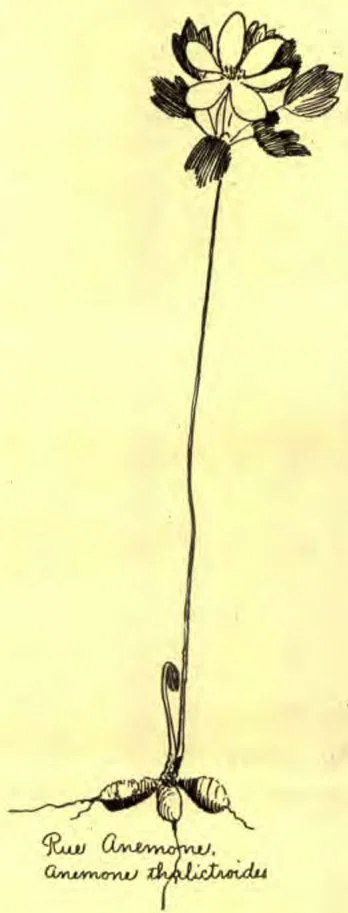
The involucre of the Rue Anemone is apparently formed of simple leaves, usually six in number; but if carefully examined, it will be found that they are united near the stem into two sets of three each, or a third set may be found present in some cases.
As stated in one of our previous studies, a ternate leaf is a compound leaf consisting of three leaflets. If each of these three leaflets is divided into three other leaflets, the leaf is biternate, or twice ternately compound. If the same division again takes place, the leaf is triternate, or thrice ternately compound.
It should be noted that the expression “ternately divided” is used with reference to divided simple leaves, as explained under the heading “Anemone Patens,” while the expressions “biternate,” “triternate,” or “ternately compound,” are used with reference to compound leaves.

The Rue Anemone is a delicate plant of early spring, blossoming in April and May. It grows in the woods, and seems to prefer the neighborhood of the spreading roots of old trees. In appearance it quite closely resembles anemone nemorosa, or wood-anemone, but is easily distinguished by the fact that the flowers are borne in clusters instead of singly.
Anemonella is the diminutive form of anemone, and thalictroides means resembling thalictrum, or meadow-rue. Of the latter there are several species. Some are large plants ten or eleven feet high, while others are only a foot or two in height. They have small, greenish-white flowers, and leaves which are three or four times ternately compound. The leaflets bear a striking resemblance to those of the rue anemone.
It will thus be seen that anemonella thalictroides has been well named, meaning, literally, a little anemone resembling thalictrum, or meadow-rue. B. E. CRAWFORD.