This strange animal is so different from the animals of the northern world, and, indeed, any part of the world, with the exception of New Guinea, Tasmania, and a few other islands of Australasia, that it is an interesting subject for study. It is given the name “marsupial,” meaning “pouched,” from the pouch, or bag, in which the mother kangaroo carries her young, after they are born, until they are able to care for themselves.
Nearly all animals are born in a high state of development, compared with the marsupial division of natural history. Many a farmer’s boy has seen young lambs three or four days old trying to play. Colts and calves run about when very young, but kangaroos and other marsupials are born at an early stage of development, and in an imperfect and helpless condition. When born, the young are only about an inch long, are blind, naked, and unable even to help themselves to the food which nature supplies for them. The mother immediately puts the little kangaroo into the pouch, or cradle, which she carries in front of her, and this is his home for many months.
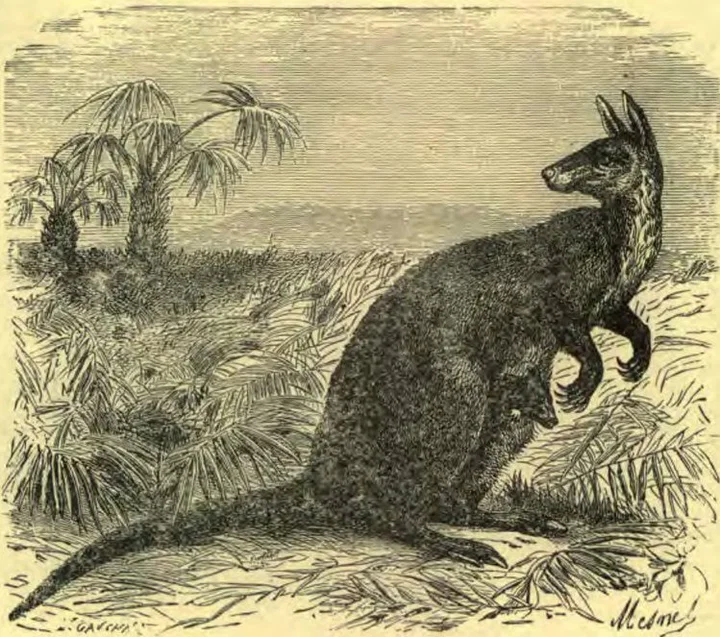
The young one grows fast, and after a time he looks out into the world; when he becomes accustomed to things, he jumps out to investigate for himself, but immediately returns to his safe hiding-place if danger threatens.
With the exception of the opossum, found in the southern part of the United States, marsupials are confined to the countries named. Another curious fact in this connection is that all the animals of these countries, with the exception of the dingo, or wild dog, and a few rats and bats, are marsupials. Even these exceptions are by some thought to have been imported before the colonization of these countries by Europeans. Of course the domestic animals of civilization are all found in them now. Originally, however, kangaroos and wallabies (a smaller species) took the place of the ruminants of other regions. All members of these families are purely vegetable feeders.
In the summer of 1770, when Captain Cook was refitting his vessel at the mouth of a river in New South Wales, a company of his men was sent ashore to procure supplies. On their return they described a strange animal of great size, which stood upright on its hind legs and tail, and progressed by enormous leaps. Great excitement was aroused, and soon a specimen was killed, and taken on board. Sir Joseph Banks, a naturalist, was a member of the expedition, and he wrote a description of the animal, which was the first specimen brought to European notice. It was what is known as the great gray kangaroo (Macropus giganteus). A specimen of this kind is the subject of the illustration.
The name “kangaroo” is said to be of Australian origin, although it is unknown by the natives of the present day except as learned from white men. True kangaroos and wallabies comprise twenty-three living species, as well as several that are extinct. They vary in size from the height of a man to the size of a rabbit, or even smaller. The one in our picture is the best known of all the species. He is called the “boomer,” “old man,” or “forester” of the early colonists. A full-grown one will measure sixty-three inches from nose to root of tail, and weigh two hundred pounds.
The tail is very large and strong; and when surveying the country on the approach of danger or for other reasons, the kangaroo can raise himself on the tips of his toes and his tail to quite a height. The front legs are very short, and the animal seldom touches them to the ground, except when grazing; then he sometimes awkwardly goes on all fours. It is stated, by those who have seen kangaroos, that these large ones jump ten yards at a single leap. The tail helps them much in running. When running in the bush, its measured thump, as it strikes the ground with each jump, is heard long before the animal can be seen.
The young are born in March and April. About Christmas they leave their mothers, and shift for themselves. Young kangaroos are called “joeys,” and it is said that a mother kangaroo will pick up her joey, and throw him into her pouch on the run, when danger is near, and he always lands with his face out, as in the picture. When on the move, these animals invariably follow a leader; and when started, it is impossible to divert a drove.
In the tropical forests of Queensland are found what are called “tree-kangaroos.” Their life being spent in the trees, their front legs are but little shorter than their hind ones. This variety is little known, and has been nearly exterminated by the natives, who regard their flesh as a great delicacy.
There are nine species of what are known as “rat-kangaroos,” none of them being larger than rabbits. These, too, have largely disappeared. Besides the natives, the dingo, or native dog, used to be a great foe of the kangaroo. These dogs were also a great pest to the early settlers, killing their sheep and lambs, and making havoc with the poultry. A vigorous warfare was instituted by the colonists, however, and as a result, the dingos were killed off. As these and the natives disappeared, the kangaroos increased till they, too, became a burden to the farmers. They ate the grass the men wanted for their sheep, and did not hesitate to help themselves to the produce of the gardens. In self-defense the colonists were obliged to invent means for their extermination. Fences were built converging into corrals, into which thousands of the pretty kangaroos were driven, and killed. On one ranch ten thousand were killed every year for six years. Sometimes after a great “drive,” two thousand were killed in a single day.
In a history of what is called the “squatting era” of Australia is a picture of the early colonists leaving their homes to escape a rapidly approaching “bush fire,” the terror of Australian frontier life. In the hurry and confusion, men, women, and children, cattle, sheep, fowls, horses, wild birds, and kangaroos are shown together, all joining in a mad rush to escape the approaching terror.
The kangaroo, like the deer, is an inoffensive animal. He never attacks man, unprovoked; but if brought to bay by either man or dogs, he will fight to the death. He will back up against a tree or rock, and woe be to the first dog or man that approaches him. Rising on his tail, with one kick of his tremendous hind leg, with its long, sharp toe, he will kill instantly any dog that happens to receive the stroke. Kangaroos have been known to pick up dogs, carry them to a pool, and hold them under water till drowned.
Like the black man of Australia, kangaroos are fast disappearing. They have been driven back into the interior, though they are still found in remote places throughout Victoria. Some are occasionally seen within thirty miles of Melbourne. There is a large collection of these animals in the zoological gardens in Royal Park in the northern part of Melbourne. Their odd way of hopping about, their short front legs hanging apparently so uselessly in front of them, always attracts general attention.
H. E. SIMKIN.