Conclusion of Chapter XIII
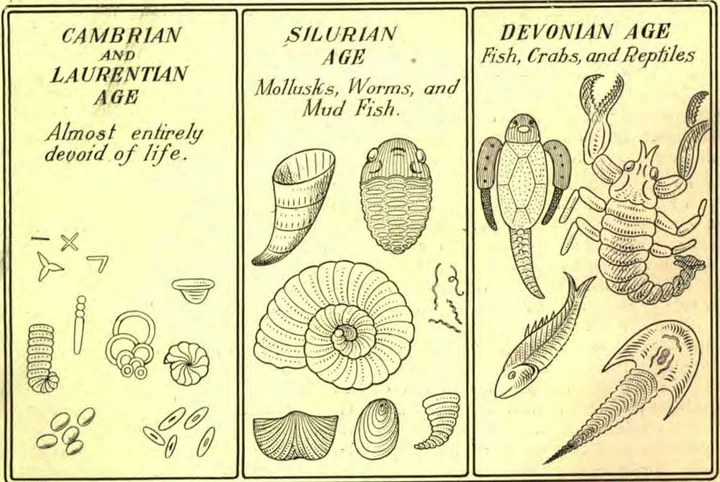
135. The age of rock-formation, as generally accepted by geologists, is wholly a matter of speculation, the basis of calculation being dependent upon the kinds, or species, of fossil remains embodied. A rock containing the lower forms of life, such as worms, mollusks, trilobites, etc., would be said to be millions of years older than a rock containing the remains of the whale, mammoth, horse, etc., purely upon the supposition that these higher orders of mammals were millions of years evolving from the lower forms. As to the inconsistency of this position, see Sections 25–28.
¶ 136. When these later strata of rock—those lying above the granite—were made, and for what purpose they contain these fossil remains, form, indeed, an interesting subject for thought. God “hath made his wonderful works to be remembered;” and it is that we may read his dealings with our race, that the very rocks themselves tell of his greatness and power.
¶ 137. At the time of the deluge, God, for man’s own good, swept him from the face of the earth by the waters of the flood. How earnestly has Satan labored since then to efface from the minds of succeeding generations the knowledge of the terrible overthrow that the subjects of his rebellious kingdom then received from the hands of the Almighty!
The Lord well knew that this would be, and that eventually unbelief in the very fact of a universal flood would prevail among the sons of men; and in order to leave indisputable evidence of this great event, and to show to all coming generations his abhorrence of sin, God caused the elements of earth so to unite with the soil as rapidly to form, amid the washing of the waters of that great deluge, the various kinds of rock we now see, containing within their lasting settings the actual remains of the animal and vegetable life then existing.
¶ 138. The rocks themselves, that were then formed for the very purpose of preserving an undeniable record of the flood, differ according to the various kinds of soil from which they were made. When the fountains of the great deep were broken up, and the briny waters of the antediluvian sea washed their contents out over the land surface, they carried with them great quantities of minute shell-fish, whose remains then formed what now is known as the Cretaceous, or Chalk, strata.
¶ 139. The salt of that sea settled in drifts, or layers, forming salt deposits, or what is now called the Triassic strata. The sands of that sea became hardened into rock, forming the Devonian and Permian sandstone strata. Likewise were the leaves, roots, grass, and trees washed together, forming our present peat-beds and soft- and hard-coal deposits, representative of the Carboniferous strata. Many of these very formations may be seen slowly taking place at the present time.
¶ 140. The Huronian, Silurian, Oolitic, Tertiary, and Recent are merely different layers of soil washed together, and containing different species of remains.
¶ 141. But why do these different rocks contain fossils so different in their structure? The answer is apparent. Not that each separate species lived in a separate, distinct epoch, and required ages to evolve into the next higher order, which lived at a later date. Not by any means. Look at the earth as it is to-day: in Asia there are elephants and tigers; in America, buffalo are found; in Australia the kangaroo has its home. Seals and polar bears dwell in the north; parrots and monkeys in the south. These all live upon the earth at one and the same time, but are found in different localities.
¶ 142. Each locality has its own peculiar classes of birds, reptiles, fishes, insects, animals, flowers, foliage, and soil. And as it is now, so it was before the flood. When the soil in different localities became converted into stone, it entombed whatever animal or vegetable life was prevalent.
¶ 143. One question further, and we think the matter of geological strata will be certainly clear; namely, why is it that in the lower strata of rock, such as the Huronian, Silurian, or Devonian, are always found the lower forms of life; while in the Oolitic, Tertiary, or Post-Tertiary, are found the higher orders? The answer is simple. Let us see if we can not understand it.
¶ 144. In the first place always remember that it is the species of the fossil that, in the mind of the geologist, determines the supposed age, and consequently the classification, of the rock itself. Having accepted as true the delusive theory of the evolution of species, it follows as a natural sequence that all rock containing the lower forms of life should be considered as being the oldest in point of time, and as lying nearest the bottom in the matter of arrangement.
¶ 145. As to the question of the arrangement of the geological strata, we will say that while there is a universal tendency toward the order as given in the illustration presented last week, the exceptions are so many and so pronounced that it requires an almost impossible amount of credulity to believe a rule whose exceptions are so numerous and so marked.
But suppose, for argument’s sake, that all that is claimed by geologists for the strata and their arrangement be true; and that, without exception, they are to be found everywhere in exact accord with the classification given,—is there still an answer to the argument regarding this arrangement’s being a proof of the extreme age of our world?—Yes. And in answering thus, we offer an explanation of any and all phenomena connected with this question.
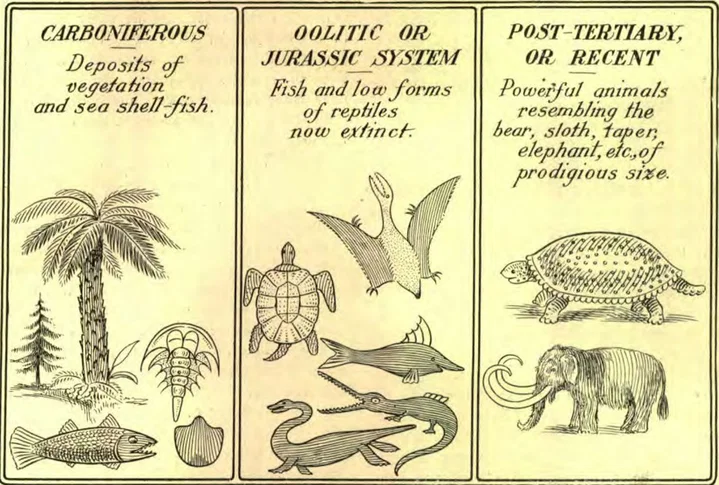
¶ 146. As to the reason for the different strata containing these different fossil remains there can be no question. When the flood burst upon this earth, and the waters were washed in fury everywhere, the heavy, helpless mollusks and shell-fish, obeying the laws of gravitation, sank to the bottom, and so are there found to-day, representative of what is now called the Silurian age. Next above these would naturally come the lazy, logy mud-fish, eels, etc., also the crawfish,p. 396 which, true to their nature, burrowed deep into the mud to escape the danger from the storm. These represent what is termed the Devonian age.
¶ 147. Amid the washing together of the trees and branches which then formed our Carboniferous deposits were entangled many of the less lively fish and other denizens of the sea. Above these, forming the Oolitic or Jurassic formation, is found the stratum of rock and earth containing the remains of such reptiles as, by reason of their superior strength and ability to swim amid the surging billows, were enabled to keep above the washing debris of the buried forests. These succumbed, not to the waters themselves, for many of them were inhabitants of the sea; but to the shock, or concussion, resulting from the bursting rocks and shaking earth. It is well known that reptiles of this class are easily killed by the jar of blasting-powder or earthquake shock.
¶ 148. The last to be destroyed were such prodigious monsters as the mammoth, with elephants, tapirs, sloths, bears, etc.; therefore these remains are found within the stratum of rock and soil claimed to be of more recent date. The accompanying illustrations express the thought clearly.
QUESTIONS
Is the question of geological age a matter of absolute certainty? How has God caused his wonderful works to be remembered? When, how, and for what purpose were the different strata of rock formed? Explain the origin of each rock stratum, as presented in last week’s illustration. Explain why different kinds of animal life are found in different strata. Why does the vegetation differ? State briefly why neither the rock strata nor the fossils they contain prove the extreme age of the world, as generally claimed.
DR. O. C. GODSMARK.
2005 Magazine St., Louisville, Ky.