Few people, even of those who are born there, know or appreciate the immensity of London. The old original city, around which a wall was built, and which was entered at Temple Bar, did not cover a large area; but as centuries have rolled by, the city's limits have been extended until it is beyond human comprehension to grasp the realities of the size and striking features of this grand old city. I say “grand” without any effort to praise London beyond its merits. No other city is like it. It has its own peculiar ways, which have existed for centuries. Every nook and corner is replete with interest to the careful observer. In nearly every street the shadows of a dim and almost forgotten past are blended with the busy hum and whirl of the enterprising, commercial present.
After visiting several of the fine cities on the Continent, I returned to London; and as I sat with Brother Sisley on the top of a ’bus, and went rolling up Fleet Street, I expressed my sincere conviction when I said, “After all the fine things we have seen, there is no place like London.”
With its six and one-half millions of people, spread out through its almost innumerable short, crooked lanes and streets, London seems to the observer a hopeless network. No one tries to learn the names of all its streets.
True, one soon becomes familiar with such thoroughfares as the Strand, Fleet Street, Oxford Street, Picadilly, Cheapside, the Embankment, and Holborn; and could hardly forget, if he tried, some of the curious little streets, such as Bread Street, Milk Street (they are often called Bread and Milk streets), Wood Street, Threadneedle Street, etc. Instead of trying to learn the streets by name and location, people learn the various common centers and stopping-places of the ’buses; and go from one point to another without any regard to the streets. For example: If one were to go from the office of the International Tract Society, 451 Holloway Road, to the Bank of England, which is the busiest point in the city, he would walk two blocks down to Nag’s Head, which is the nearest starting-point for the ’buses. There he would take a ’bus for King’s Cross, which is another ’bus center; then from King’s Cross to Holborn; and from Holborn to the Bank of England. He would find his way back by reversing the order. A little study of the common centers enables one to travel through London with as much ease and with as little confusion as in New York City or Chicago.
London is a great world in itself. It is said that one may hide himself in London as completely as in the greatest forest or the wildest desert. The masses of humanity are so great, the streets are so many and so intricate, the extent of the city is so vast, that one seems as much lost as if he were alone on the wide ocean. “One’s arrival in London is as a thin needle thrust into the surface of a boundless sea. His departure is its withdrawal. Looking to-day among the London crowds to discover a face which you saw yesterday is as vain an endeavor as on a voyage across the Atlantic to try to locate some crested wave which rushed by the ship on a previous voyage.”
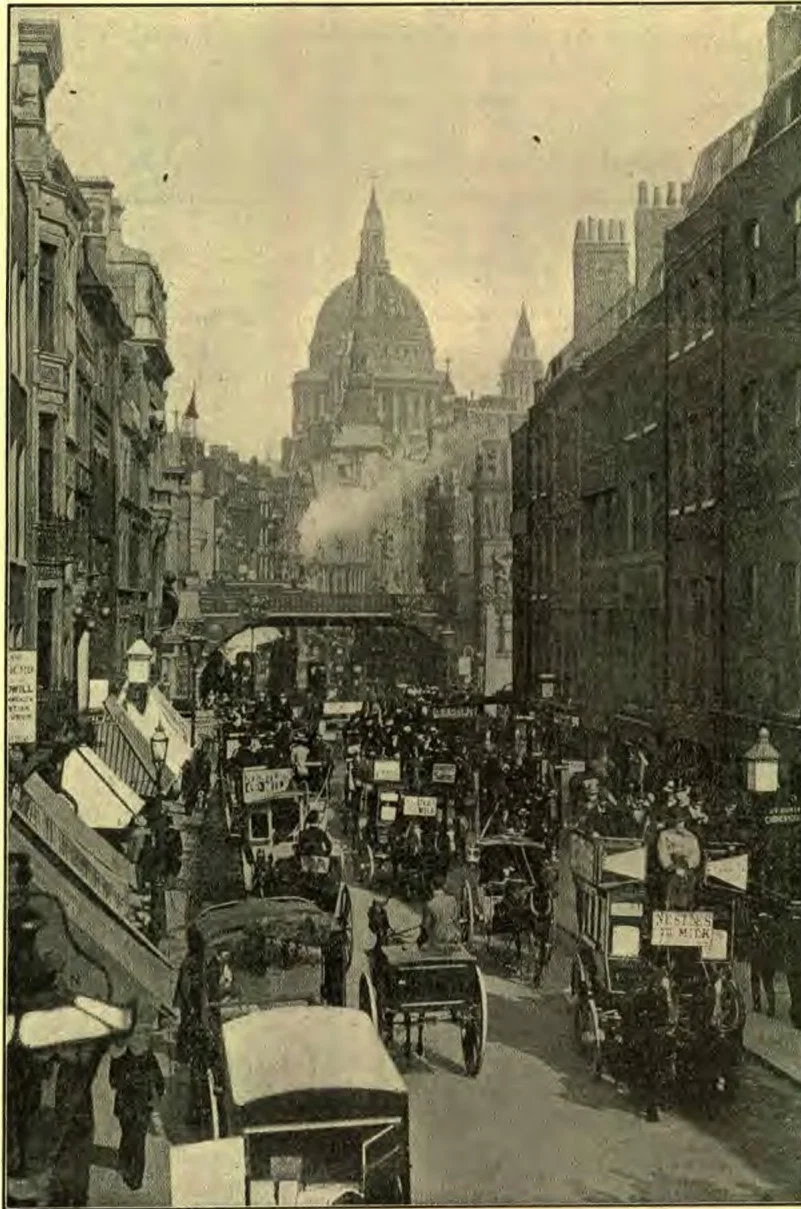
LUDGATE HILL, SEEN FROM FLEET STREET
It is the world’s great center,—the center of its commerce, the center of its wealth, and the point from which its greatest shipping lines radiate. It is the one great circus through which all humanity passes in traveling the wide world. When our missionaries go to Africa, to India, or to any part of Europe, they pass through London. Even when we send missionaries to South America, lying so near us on the South, we send them through London, although when they reach that city, they are fully two thousand miles farther from their destination than when they left the United States. From every point of view imaginable, London is the world’s great center. This fact has an important bearing on the work we have to do in carrying the third angel’s message to the world.
How to See London
If you wish to see London to the best advantage, pay your penny or two-penny fare, and climb to the top of an old-fashioned ’bus. To be sure, there are underground trains and surface trains and underground electric cars, and many persons who are in a hurry use these modern arrangements for transportation; yet, comparatively speaking, the people of London still patronize the ’bus more extensively. Although it is a slow, expensive, and inconvenient mode of traveling, the Englishman clings to it with a persistence which is almost remarkable to a foreigner. Even the busiest Londoner prefers to climb to the top of his “dear old ’bus,” and swing along in the old-fashioned way behind a good pair of horses, thus consuming an hour and a half in going to town, rather than to take the elevator, be lowered into the ground, and whirl along by electricity or steam to his place of business in fifteen minutes. This seems unaccountable at first; but when you have enjoyed a few rides through the streets of London on the ’bus, you will find yourself gradually conforming to the custom, and choosing this vehicle regardless of time, when the weather is fair.
The ’Bus Driver
Get a seat, if you can, close to the driver; for he is an encyclopedia of facts, and from your elevated position he will point out to you hundreds of items of interest which are worth knowing, and which will add interest to your trip. He is the best horseman in the world, and knows it. There he sits stiffly erect, his heavy coat buttoned high under his chin, and his tall silk hat giving the last touch of dignity. When you are tired of looking at the buildings, watch him as he holds his lines steady, and drives with a master hand through the most crowded portions of the busy streets, seemingly running within a hair’s-breadth of everything, and never hitting anything. A friend of mine said that the first time he rode on a London ’bus, he grasped the arm of the driver, and the cold perspiration stood on his forehead all the way down the Strand and Fleet Street.
Although modern civilization is crowding the electric cars and steam cars into London, still2the Englishman clings to his horses. Nearly all the street-cars are still drawn by horses, and they are fine ones, too. Most of them are imported from Holland, and are selected with great care; for the laws of the city are very strict against using poor or lame horses. One may travel through London, and see thousands of horses without ever seeing one that is lame, or poor, or being misused by his master. It is said that a man in London may treat his family cruelly with much less liability of being arrested than if he kicks or whips his horse, or drives it when it is lame.
Ludgate Hill
The accompanying illustration gives an excellent view of a busy street in London. This is Ludgate Hill, seen from Fleet Street. On the extreme right-hand side of the picture is a London ’bus, which we have already described. Just behind the ’bus is a two-wheeled hansom cab. Nearly all the small vehicles have only two wheels, as you will observe. The street on each side is crowded with the great four-wheeled ’buses, with passengers inside and on top. This is London as you see it every day.
The buildings are plain and substantial, as you will observe from the picture. Few buildings in London are higher than these. Seven or eight stories is about the limit.
St. Paul’s
In the center of the picture, on the top of the hill, can be seen the great dome of St. Paul’s Cathedral, which is one of the great attractions of London, and is visited by thousands of persons every day. It was built by Sir Christopher Wren after the great London fire, in 1666, and is the third largest Christian church in the world, St. Peter’s at Rome and the Cathedral of Milan being the only larger ones. The king and queen, and many of the great men of the nation, attend here; and the great Jubilee and Thanksgiving services are often held there. It is the burial-place of many of the nation’s great and honored men, such as Wellington and Nelson.
Bow Church
Bow Church is in Cheapside. All who are born in London within the sound of the Bow Bells are called Cockneys.
A pretty story is told in connection with these Bells. It is said that years ago Dick Whittington, a poor boy who lived out in the country, went to London to seek his fortune. He fared hard; and finally becoming discouraged, decided to return home. He had gone as far as Highgate Hill, and when about half-way up the hill, sat down upon a stone with his pet cat to rest. While sitting here, the Bow Bells began to ring; and to his boyish fancy they seemed to say, “Turn again, Whittington; thrice mayor of London.” Finally, he decided to throw down his cat, and either return to the city or go back to the country, according to the direction which the cat took. The cat started for London, Dick Whittington followed, and, as is well known, years afterward he was three times elected Lord Mayor of London. A stone with a little iron fence around it still marks the spot where he sat on Highgate Hill; and on a window of a public house opposite is a picture of Dick throwing down his cat to see which direction she would take. Near this spot are the Whittington Orphanages.