HAVE you ever planted squash seeds? Did you ever watch one of them to see how the plant gets out of the ground? No doubt every reader is acquainted with the squash family. Very likely you have planted the seeds, watched the vines grow, and seen the fruit a thousand times. At least you have enjoyed the delicately flavored, richly colored Hubbard or other squash, tastily served upon your mother’s table. It may be that you have squash plants growing in your garden to-day. Have you ever observed their growth?
Look at this peculiar, white-coated seed! Is it possible that from this one seed can come a great vine with many branches,—a hundred feet in length, more or less, climbing over walls, fences, and trees; leaves spreading like sunshades over yards of ground; tendrils enwrapping everything they chance to find in their way; and last of all, a half-dozen or more matured fruits weighing scores of pounds? If this were not such a common thing, it would seem a miracle. On one of my walks last fall I came across one of these vines which had managed to cover nearly everything in its vicinity. But the ambitious activity of this plant was not satisfied with its success in going over a fence, and spreading its foliage and fruit over the ground. It had climbed into a tree, and hung up there among the branches a fine squash of about twenty pounds’ weight.
The squash plant is a wonderful worker from the start. I have some seeds growing in a box here in my room, and will tell you, as well as I can, how they act in their growth. Few things have been more interesting to me than watching how the plant gets out of its seed-coat. I have fitted a glass in one side of my box, so I can see the movement of the growing seed. It has a hard, woody shell to get rid of before it can rise out of the ground to spread its two leaves in the sunlight.
These first days of growth are so vividly described by Professor Bailey in a Nature Study leaflet that I will let him tell you the secret:—
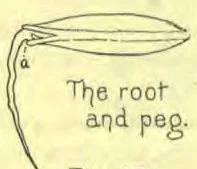
“We are curious to know why one of these squash plants brings its seed up out of the ground, while all the others do not. In order to find out why it is, we must ask the plant, and this asking is what we call an experiment. We will plant a dozen or more seeds, so that we shall have enough to examine two or three times a day for several days. A day or two after the seeds are planted, we shall find a little point, or root-like portion, breaking out of the sharp end of the seed. A day later this root portion has grown as long as the seed itself (Fig. 10), and it has turned directly downward into the soil. But there is another curious thing about this germinating seed. Just where the root is breaking out of the seed (shown at a, Fig. 10), there is a little peg, or projection. About a day later, the root has grown still longer, and this peg seems to be forcing the seed apart. In Fig. 11, however, it will be seen that the seed is really being forced apart by the stem or stalk above the peg; for this stem is now growing longer. The lower lobe of the seed has attached to the peg (seen at a, Fig. 11), and the seed leaves are trying to back out of the seed. Figure 12 shows the seed still a day later. The root has now produced many branches, and has thoroughly established itself in the soil. The top is also growing rapidly, and is still backing out of the seed, and the seed-coats are still firmly held by the obstinate peg. The seed is tugging away, trying to get its head out of the bonnet which is pegged down under the soil, and it has ‘got its back up’ in the operation.”
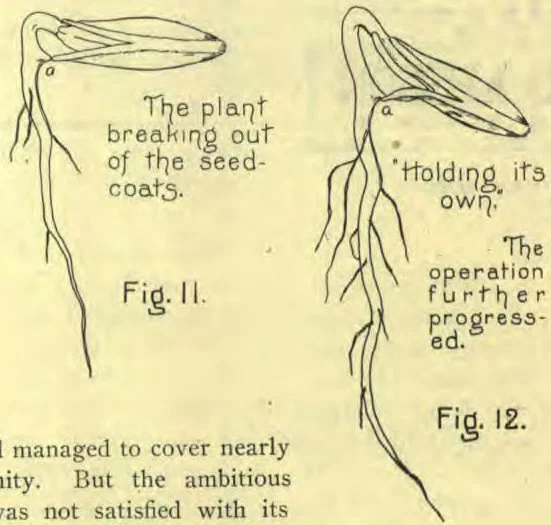
Figure 13 shows one little plant which has failed to leave its seed-coat in the ground because the peg did not “hang on” firmly enough.
The squash belongs to the gourd family—a plant family of seven members. It includes all the varieties of pumpkin, melon, gourd, and cucumber. The plants from all these seeds go through the same peculiar process in getting out of their seed-coats. You can watch this process for yourself by planting seeds in the ground and digging up one each day after germination begins. Or you can place seeds between blotting-paper laid on a plate. The paper must be wet, and kept moist by covering the plate, when it should be set in a warm place. The seeds can be more easily examined in the plate.
While observing the growth of my squash seeds, Paul’s words have come to mind, “Who shall deliver me from the body of this death?” It is the power of God in the growing seed which enables the plant to cast off the seed-coat which would hinder its growth. So it is with us. Only God’s power in us can enable us to cast away the evils that hinder our spiritual growth.
J. C. ROGERS.