Chapter XI—The Sea
§ 108. THE surface of our earth is estimated at 196,800,000 square miles, of which only 51,500,000 square miles is land, leaving a total of 145,300,000 square miles of water; so that the proportion of land and water stands at the ratio of 1 to 2.84. The area of the five oceans is roughly estimated as follows: Arctic, 5,000,000 square miles; Antarctic, 10,000,000; Indian, 20,000,000; Atlantic, 40,000,000; and Pacific, 70,000,000. The average depth of the seas for sixty degrees north and sixty degrees south latitude is about three miles. All together, they are estimated as containing 300,000,000 cubic miles of water.
§ 109. Sea-water weighs 64.25 pounds for each cubic foot, or 1.75 pounds more than fresh water. The amount of salt in each cubic foot of sea-water accounts for the difference in weight. The pressure of the sea at a depth of 31.1 feet is 2,000 pounds to the square foot.
The decrease in marine temperature, as we descend, is decidedly marked. With a surface temperature of eighty-six degrees the mercury lowers to forty-five degrees upon being submerged to a depth of 2,144 feet. As stated before (Section 91), were it not for the extreme saltness of the water, to which might be added its constant movement, the bottoms of our oceans would be one solid floor of ice.
§ 110. There are three general movements of sea waters; namely, waves, tides, and currents. The waves of the sea are merely local, surface affairs, caused by the friction of the winds. The measurements of Scoresby, which are regarded as very accurate, prove that during storms, waves in the Atlantic rarely exceed forty-three feet from hollow to crest, the distance between the crests being five hundred and sixty feet, and their speed being thirty-two and one-half miles an hour. The greatest height of waves on the British coast was of those observed at Wick Bay, so famous for its heavy seas, where they reached a height of from thirty-seven to forty feet. The statement that the waves “roll mountain high” is based more upon fear and excitement than upon actual measurement. In the heaviest storms the waters are disturbed but little below the actual hollow of the wave.
§ 111. The tides, however, are vastly different, every particle of water, to the very bottom of the deepest levels, being disturbed by the attracting force of both the sun and the moon; for the tides are but the manifestation of a most interesting force, which we shall enjoy studying, further on, under its proper heading. The alternate rising and falling of the waters, in the coming in and going out of the tide, follow each other with marked regularity at periods of about six hours each. The moon attracts the tides three times as much as does the sun, and raises the tidal wave correspondingly higher. The highest tides occur at new and full moon. When the sun and the moon are at quadrature, or ninety degrees apart, each raises a tide of its own, thus correspondingly lowering the tide of the other.
§ 112. Tides vary in height according to the depths of the sea and the conformation of the coast. In the open sea the water seldom rises more than two or three feet; but when the channels converge where the tide rushes in, the height of the wave is greatly increased. At St. Malo it exceeds fifty feet. In the Bay of Fundy, where it reaches its highest known point, a wave one hundred feet high rushes in upon the shore.
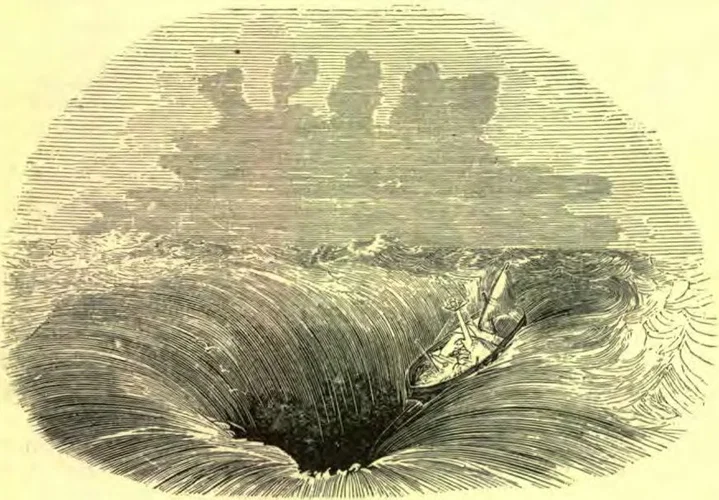
§ 113. As an explanation of some of the most noted tidal phenomenon with which all are more or less acquainted, we quote the following from Guyot’s Physical Geography, page 64: “Differences in level, produced by high tides, cause currents which vary in force and direction with the condition of the tide, producing, in some cases, dangerous whirlpools. The famous Maelstrom, off the coast of Norway, is but a tidal current. Such is, also, the famous whirlpool of Charybdis, in the Strait of Messina, and many others of less note.” There is no such thing as a great hole in the bottom of the sea, as is popularly believed, into which these maelstroms pour their waters. Terrible and disastrous as they are to ships that chance to be caught in their jaws, yet they are but the coming together of two different tidal currents, which flow with different rates of speed.
§ 114. There are two general oceanic movements that affect the whole body of salt water; namely, the polar and equatorial currents. The direct rays of the sun upon the equator so heat the earth’s great body of water that, in expanding, it rises and flows off either way from the equator toward the poles. These currents do not flow directly north and south; but the warm, upper surface water is drawn toward the east, and consequently hugs the western borders of our continents, crowding the cold, lower currents to the westward as they creep along the ocean’s bottom on their journey toward the equator. This being an important point in our future study, we quote from page 65 of the above-mentioned work: “The polar and return currents, were they acted upon by no external force, would move in the line of the meridians, taking the shortest course between the poles and the equator. Both are, however, deflected from this course by the unceasing action of the earth’s rotation,—the polar currents, as they advance, tending more and more toward the west, and the return currents toward the east; and this direction is still further modified by the forms of the basins of the several oceans, and the influence of the prevailing winds in the different zones.”
§ 115. Currents such as the Gulf Stream are nearly as marked in the waters of the ocean as are the streams of water coursing through ourp. 372 lands. The Gulf Stream flows by Florida at the rate of from three to five miles an hour; then on to the northeast, past Sandy Hook at the rate of one and one-half miles an hour; thence past Newfoundland, on to the northeast toward the European shores; then the western portion bends to the southwest, and joins the return tropical current. The eastern portion continues on past the British Isles toward the pole. From the polar region it returns by eastern Greenland, Davis’s Strait, and other passages pressing against the North American coast, throwing cold water into the Gulf of St. Lawrence, and bringing icebergs to the banks of Newfoundland.
QUESTIONS
What proportion of the earth’s surface is land? What proportion is water? Give the estimate of the area of the five oceans. What pressure would a water-tight box, one cubic foot in dimension, sustain if sunk to a depth of thirty-one feet? What effect does depth have upon oceanic temperature? By what three general movements is the sea affected? Tell what you can of the cause and height of waves. What cause the tides? Tell what you can of their height and movements. Explain the phenomenon of maelstroms. What are oceanic currents? Give the different causes of these. What effect does the Gulf Stream have upon the climate of Europe? Are the upper, warm waters from the equator drawn toward the eastward or to the westward as they move toward the poles?
DR. O. C. GODSMARK.
2005 Magazine St., Louisville, Ky.