Our Antipodes

9%

Review and Herald Publishing Company · Battle Creek, Michigan · December 4, 1902

FromThe Youth’s Instructor, Vol. L., No. 48

Read the full edition

Our Antipodes

In many ways the Chinaman, by the mere accident of being born on the opposite side of the earth, seems a being full of contrariety. In forecasting what he would do and say, one is most safe in judging that he would speak and act just the opposite of what we ourselves would. What he says would never occur to us to say, and what we would say would be entirely foreign to him.
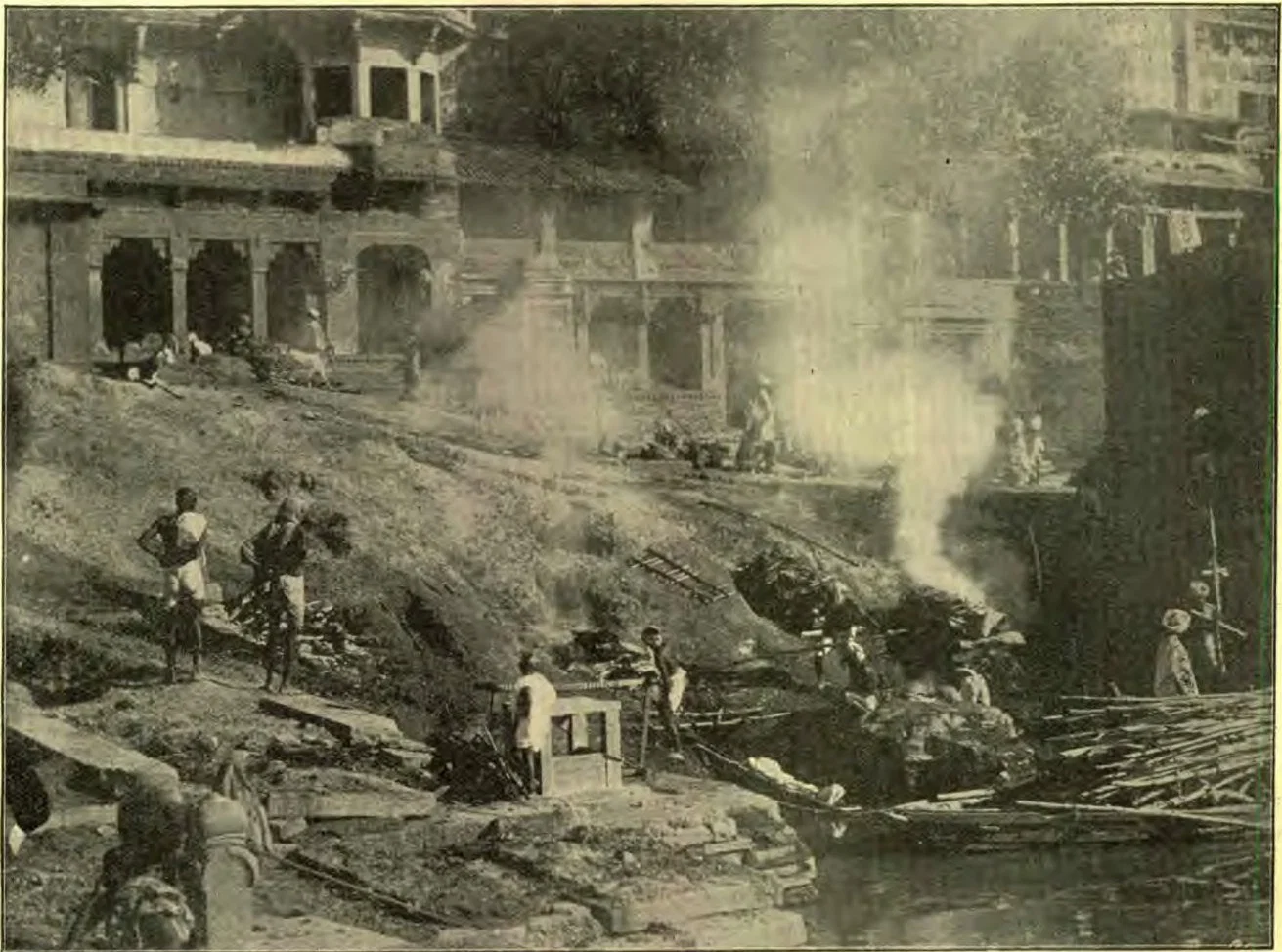
SCENE IN THE BENARES BURNING GHAT
Who of us would think of laughing, as a Chinaman does, when he tells of the death of his father, or mother, or brother, or sister? and what American bride would think of wailing as if for the dead, as does every genuine Chinese bride at her nuptials? We say, “How do you do?” when greeting a friend; the Chinaman asks, politely, “Have you eaten your rice?” and so it may not seem strange that he regards his stomach as the seat of his intellect. Instead of shaking your hand, he clasps and shakes his own; and while you, upon entering, remove your hat, he puts on his to receive you. If he hands you anything, his etiquette dictates that he use both hands. Instead of good-by he says, “Walk well,” or, “Walk slowly,” while the departing guest replies, “Please be seated.”
The Chinese book begins where ours ends, and ends where ours begins. He reads from top to bottom. His “footnotes” are at the top of the page, or in the body of the text, while the title is put into the margin. The edges are uncut; and are supposed to remain so, since the paper is printed on only one side, the interior pages being left blank. In bookkeeping, his debit and credit accounts are not side by side; but one above the other, each occupying half the page.
Neither men nor women wear gloves, but their sleeves are so long, falling over the hands, as to be used as muffs in cold weather, and often so large as to answer for pockets. Both men and women wear their hair long, but the men shave the front part of the head. The women as well as the men wear jackets and trousers. Many men also wear long robes. We blacken our shoes, while the Chinamen blackens only the top and whitens the sole.
Black is mourning with us; with the Chinese, white, gray, and blue. Red is to them a sign of rejoicing, and is used on wedding and festal occasions. Babies are carried on the back, and a Chinese gentleman or lady readily accepts the same position on being landed from a boat through the mud. Most of the small boats are “manned” by women. Women smoke with the men, and men fan themselves the same as the women do.
The needle of the Chinese compass points to the south, and instead of saying northwest, etc., the Chinaman, true to his contrariety, says west-north, etc. His names are turned backward, a surname such as Mr. John Brown appearing as Brown John Mr. He turns his fractions upside down, and reads sixths four, instead of four sixths. With him man is the beast of burden, and a coolie may often be seen carrying a load of pigs.
But with all these differences, seemingly so great, one God is Lord and Father over all. For both the same sun shines, and the same heavens pour forth their blessings. The world's waves of sorrow, sin, and woe beat against them as against us. Our need is theirs—the Son of man, the Saviour of the world. Let us live and act in the consciousness that by creation and redemption all men are the children of God, and that we have a divine commission to seek and save those who are straying from the Father's home.
J. N. ANDERSON.
Hongkong, China.