ANOTHER pretty pattern is made by cutting a solid background into diamond-shaped figures with white lines that are each formed of a single thread of wool. Two of these threads, starting together at the point of one of the diamonds, move around the base in an opposite direction, each following a spiral line till they meet the corresponding threads of the next figure. Then the course of each is changed, and they meet to complete the diamond. These lines may be continuous, as shown in Fig. 19, or the figures may be inserted at regular intervals with a space of black between. The method of working in either case is practically the same.
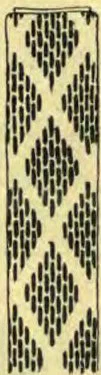
Two white threads will be required for each diamond in a circle around the base. No matter how many there are of these, you will need a sufficient number of black threads to cover the base without them. These white threads are placed in pairs; and when you are ready to begin the first figure, one of the black threads is skipped, and a white one brought up between the warp and the woven part to take its place, just as you would splice a thread of the wool. When you come to this thread again, take the regular stitch with it, and pass the black thread that it has displaced under the warp. Skip another black one, and bring up the remaining white thread to take its place. So far the work has not been different from what has been described in previous articles; but the next time you come to this point, there is something new. Use the first white thread as usual, then pass the black one that was displaced by the second white one under the warp, and bring the other black one (the one displaced by the first white one) up. Now take a forward stitch (see Fig. 18 in last article) with the second white thread, skip the next black one, and proceed as usual. When this point is reached on the next circle, there will be a black thread between the white ones. Take the usual stitch with this; bring up the thread that was passed under the warp on the previous circle; take the black thread that was skipped, and pass it down between the white one and the first black one used, then under the warp; take a forward stitch with the white thread; skip the next black one; and then go on as before. On the next circle these stitches are repeated, except that there are two black threads to be used between the white ones. To this number, another is added with each succeeding circle till the figure has attained the desired width.
I have here described the making of but one diamond-shaped figure; but unless the article is a flat one, which exposes but one side to view, there should be more. Whatever the number, they should all begin at regular intervals upon the same circle of stitches. When the thread of one figure meets that of the neighboring one, the direction of both is changed by taking the forward stitch with the one that was used in the regular way, and vice versa, till the two threads of each diamond meet again.
You may think this a difficult figure to make if you simply read the directions given. But if you take your work, and with the paper before you, carefully follow instructions, step by step, you will have no trouble.
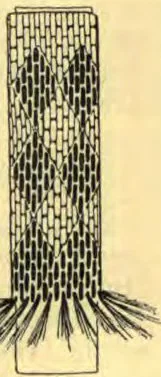
Another effective pattern for either large or small work is composed of solid black and white diamonds that fit into one another, as shown in Fig. 20. Though this pattern contains no complicated stitches, there is more work about making it than the preceding one. To make it, there must be an equal number of black and of white threads, and sufficient of each to cover the base entirely. Suppose the work is begun with black thread; when you are ready to begin the diamonds, take up one of the white threads that have been previously arranged around the base, and skip a black one as when splicing. Take up these threads at regular intervals around the base, and on the next circle take up a second white thread after the first has been used. Continue till all the black threads have been displaced by the white, and then reverse the process.
J. Edgar Ross.
(To be continued)