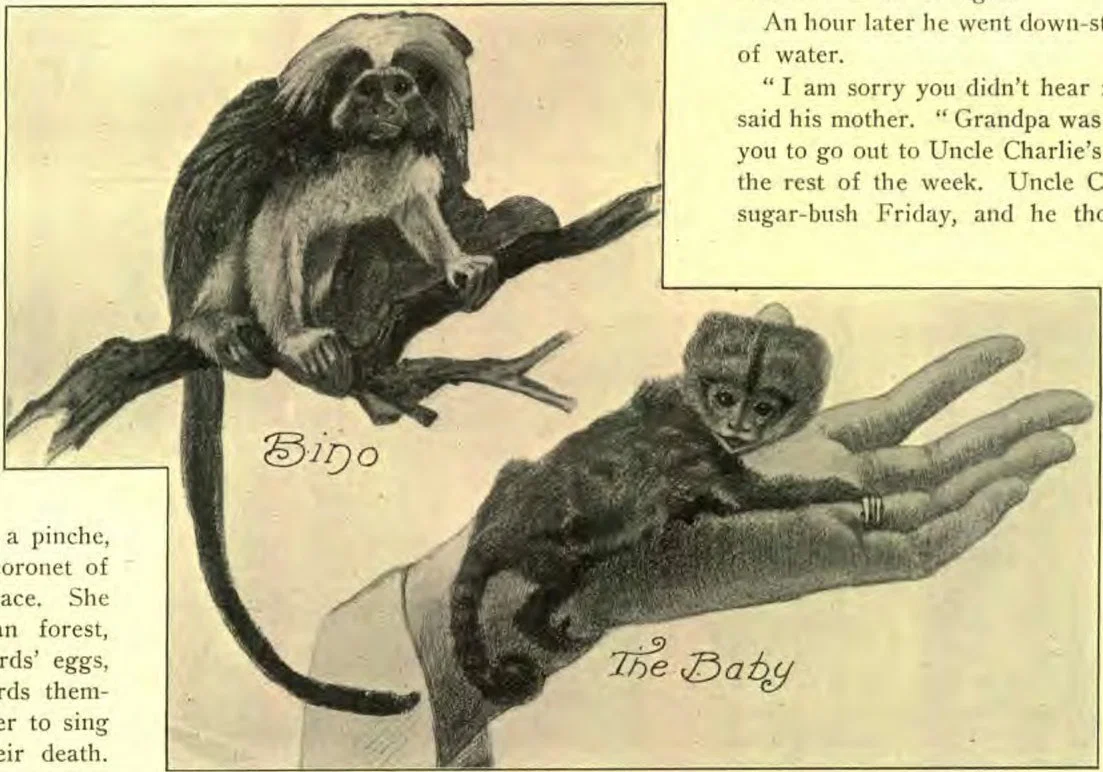
Bino and the Baby

14%

Review and Herald Publishing Company · Battle Creek, Mich. · MAY 1, 1902

FromThe Youth’s Instructor, Vol. L, No. 18

Read the full edition

Bino and the Baby

Bino
The Baby
Bino The Baby
YOUNG folks who really love their pet animals want to know how to keep them in health. Misleading books on this vital subject advocate a diet in which bread and milk predominates, whereas there is nothing so deadly to all animals as bread and milk. Let me take Bino and the baby as illustrations. Bino is a pinche, or cotton-head marmoset; a splendid coronet of white hair rises above her coal-black face. She dwelt in the tree-tops of a Brazilian forest, where she lived upon insects, fruit, birds’ eggs, and, I am sorry to say, the young birds themselves. Nature has given her the power to sing so that she can lure her prey to their death. But when I found Bino, she was tied to the platform of a snake-charmer, in the side-show of a circus. The stifling, peanut-laden air, the banging brass band, the staring crowd, and, worst of all, the snakes twisting about the form of her mistress, and darting hungry looks at Bino, had thrown her into a nervous panic. Her wild eyes and piercing screams went to my heart. I tried to buy her, but her mistress could not make up her mind to part with her then. One day, some months after our meeting, a box came to me by express. In it was poor Bino. She was thin, and her coat was rusty. Four years ago that was; now she is fat, and her fur shines with the gloss of health. This is the way I feed her: bananas always, all the year round, baked sweet potatoes, and every variety of fruit; grasshoppers, crickets, “moth millers,” June-bugs, live bait, and meal-worms, which can be had of most bird-dealers, but not a cockroach nor a croton-bug; eggs both raw and hard boiled, the meat of lobsters and crabs, and every day a scrap of raw beef, mutton, or chicken. But I never give her a crumb of bread nor a drop of milk.
The baby was not Bino’s, nor did it belong to her species; but she loved it, and it was “ride a cock-horse” all day long over the fences and up the trees with the baby on her back. When the real mother cried for her child, good nurse Bino would come skirmishing in at the window to give the baby back to its rightful, loving owner.
Bino, the beneficent, is head nurse in my hospital; she soothes the patients, and whatever it is she says to them, they soon lose their fear of me.
To cage a marmoset is like putting a butterfly in a strait-jacket. I have a basket and a piece of flannel in which they curl up at night; this stands in a cage, and here they sleep fourteen good hours; after their breakfast of bananas I open the door, and off my little fairies go, to scale the walls of my room in winter, and to climb the tree-tops in summer.
In the spring and summer Bino and her brothers are often frisking about in the top branches of a near-by elm-tree. Then, when I call to her, she stops her play to answer, and her white topknot shines out from the leaves against the blue sky. Frequently she responds by her musical call, that seems like a clear and sweet, yet strange, song.—Justine Ingersoll, in St. Nicholas.