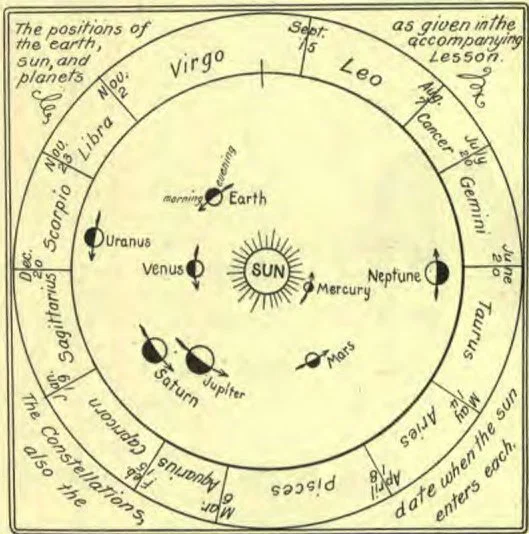
By comparing the accompanying diagram of our solar system as it now is with the illustrations shown in our Star Study for the months of March and April, you will readily see what changes have taken place.
Mercury, in place of being between us and the sun, as it was the first of March, has passed on ahead of us, and is now coming in behind, preparatory to another race with our old earth. Last month Mercury appeared as a morning star, being visible about April 23; but so rapid has been his flight, that he will appear as an evening star about May 28, though our chances of seeing him will not be nearly so good then as they were the first of February.
Mercury is very erratic in his travels around the sun, which, were there not other intervening causes, would make the changes in his seasons so marked and distinct as to be beyond endurance. It is commonly thought by scientists that Mercury is uninhabitable by beings subject to the same physical laws as ourselves, but we do not believe that this conclusion follows.
May 4 Mercury will be at perihelion, or at that point in his journey that brings him nearest the sun; and if, as in the case of our own earth, one of his poles were at that point directed toward the sun, that hemisphere would suffer an extreme of heat as compared with the extreme cold- which would consequently come to that same quarter when it reached its aphelion, or the point in its journey that lies farthest from the sun. The reason the inhabitants of this little world would suffer so much more than we is because the extremes of its path are so great. Its perihelion is estimated to be 28,569,000 miles from the sun, and its aphelion 43,347,000 miles away, making a difference which is considerable when applied to so small a journey as Mercury’s.
Just at present Mercury’s northern zones are passing out of a comparatively mild summer into a mild fall and winter, while the southern zones are coming from a cold winter into a hot summer. These seasons are, however, short, the planet’s whole year being only eighty-eight days in length, making each season only twenty-two days long.
From what we know of Mercury’s reflection of light, this planet has a thin stratum of atmosphere, with few clouds and a moderate amount of heat and light, but possesses the best possible conditions for rapid plant growth. We also learn from the same source that the surface of the planet is somewhat broken and uneven, though not so much so as that of our moon.
DR. O. C. GODSMARK.