Facing the Orient

6%

Review and Herald Publishing Company · Battle Creek, Mich. · MAY 1, 1902

FromThe Youth’s Instructor, Vol. L, No. 18

Read the full edition

Facing the Orient

I WILL attempt to give you an account of our journey as we left home, and turned our faces toward the Orient. Our packing was done at my father's home at Mauston, Wisconsin, and it was from this point we started. Wednesday morning, December 25, found us in Chicago. We had expected to take the train for Oakland that evening; but owing to some misunderstanding, our transportation and baggage privileges had not been secured, and we were therefore obliged to wait for the next overland and tourist train. The interim was spent in calling on old friends and in final arrangements for transportation.
A number of pleasant surprises awaited us in Chicago. Some one had presented a typewriter, an article much needed for our work in China, and this we found waiting for us at the Branch Sanitarium. But this was only a beginning. Through the efforts of the little church at Harvey, Illinois, and of some of the friends in Chicago, a small cottage organ had been secured, with money enough to purchase a kodak. Brethren W. O. Worth and W. R. Donaldson gave us two bicycles. All these articles will be much needed; and besides making us realize that our brethren are greatly interested in the China mission, these gifts made us feel that the dear Lord, who has called us, prompted these kindly remembrances. They seemed silently to say, “Your Father knoweth that ye have need of these things;” and the promise, “My God shall supply all your need according to his riches in glory,” was quickened in our hearts.
Two days later, on the evening of December 27, we left Chicago in a tourist car bound for San Francisco by way of the Burlington and Rio Grande railroads. The car was full, so we were limited to the room our tickets called for,—a space about four by six feet,—the size of one compartment for our party of four. This served for sitting-room and dining-room by day, and for bedrooms at night. When the two seats were converted into one bed, and a berth from above was lowered to form a second, we were really very comfortable. Of course traveling by tourist leaves something to be desired; but as we jogged along at the rate of five hundred miles a day, we thought how much more comfortable we were than the apostle Paul could have been on his first missionary journey.
Nothing of unusual interest occurred on our journey overland; but as it was our first trip across the continent, everything was full of interest to us. This was especially true the third day, which was spent in the Rocky Mountains. The air was soft, and the sun shed a hazy white light over the bare, bold peaks. At first the ascent is so gradual as to be unnoticeable; but presently, having passed the foothills, and come into the range, the track passes along the side of some peaks where we caught a glimpse of the plains far beneath. Then for the first time we realized that we were in the mountains. Now and then we passed a mountain village, where it seemed that all the inhabitants turned out to see the train. Later, the only signs of human life were now and then a rude cottage or dug-out in the mountain. The people who emerged from these, or peered out of the small windows, looked as if they belonged to a different race from those we have known all our days. We were all day ascending the mountains, and all night descending into the Salt Lake Valley.
The city of Mormonism was wrapped in fog as we passed early next morning. A ride of a few hours more carried us over the crest of the Sierra Nevadas, and out upon the slopes that descend into the Sacramento Valley. Here was an absolute change of scenery. Beautiful, well-kept farmhouses, surrounded with orchards of peach and plum, vineyards and orange-groves in fruit, and wreathed in rose-trees in bloom, were everywhere present, in striking contrast with the snow-capped peaks forming the background.
The steamer “America Man of the Tayo Kisen Kaisha,” on which our passage had been secured, was scheduled to leave San Francisco at one o’clock in the afternoon of January 4. At eleven o’clock we went aboard, with all that was left of our earthly possessions. Looking back to the wharf crowded with Chinese of all ages and different social castes, we began to realize for the first time that we were leaving home and native land, to enter a new and strange world, a sample of which was before us. A continual stream of Mongolian orientals,—Chinese merchants richly dressed, returning to enjoy at home the fruits of trade in the States; keen-eyed diplomats and official interpreters, together with a far greater number of the poor, and old, and lame, and blind, hurrying back that their remains might lie in ancestral burying-places,—jostled up the gang-plank, happy in the thought of going home.
A few friends, including Dr. Law Keen, of Fresno, and Charles Holt, of Oakland,—Chinese brethren who are preparing to return to China as medical missionaries,—gathered at the wharf to bid us farewell.
Promptly at one the ship weighed anchor, and began to move. We were scarcely through the Golden Gate when the long swells of an angry sea caught us, and within a few hours the adults of our party were all laid out in the little wooden bunks of our staterooms. O, for one moment of quiet! for time to draw one free, easy breath! But in spite of our most earnest longing, the swinging, rocking, rolling, rising, and falling continued all the way to Honolulu. Miss Thompson was unable to eat or to walk about the entire seven days. No one who has not passed through a similar experience can appreciate with what feelings of relief we sighted the outlines of Diamond Head early in the morning of our eighth day from San Francisco. At eight o’clock the ship had passed quarantine inspection, and was lying at rest, bathed in tropical sunshine in the beautiful harbor of Honolulu.
The bay is deep and clear; and our ship had scarcely come to a stand awaiting the opportunity to make to the wharf, when it was besieged by the divers,—natives who swim out to the boats, and dive for coins thrown from the decks by passengers. Their motions are so rapid and accurate that they often seize the coin in their teeth before it has passed the length of their bodies under water; but if it goes to the bottom, they go after it, and come up puffing and spouting like small whales.
The brethren at Honolulu had had notice of our coming; and as soon as the boat had landed, Brother C. P. Moon, of the Chinese school, came aboard to receive us. It was Sabbath morning,—a bright, clear Sabbath morning in the tropics, with singing birds, smiling flowers, and waving palms, all inviting to worship. My sister was too weak to sit up, and so went directly to the charming little sanitarium in the outskirts of the city. The rest of the party followed our guide past the busy market, where everything edible and many things questionable were displayed for sale; up the street, under the shade of palm, cocoanut, banana, mango, and magnolia; and along the pavements fringed with hedges of dark, glossy green, brilliant with scarlet blossoms. What a fairyland! The place was so dream-like that we were almost startled to see a most up-to-date trolley-car dash down the line intersecting the path of our progress.
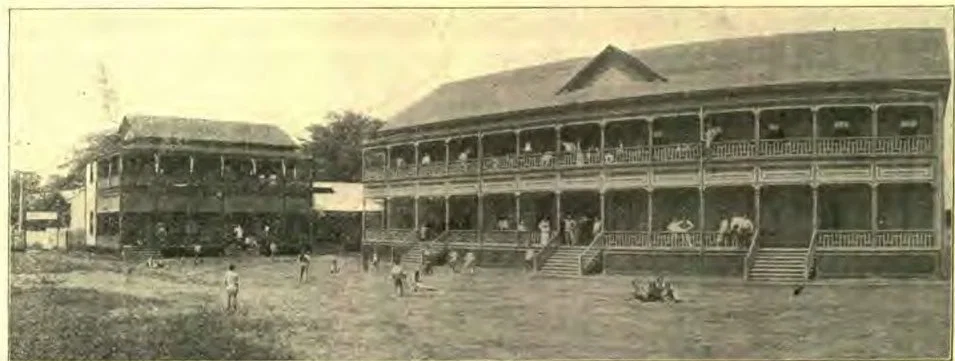
OUR CHINESE SCHOOL AT HONOLULU
Following down the narrowing street, we came to a place where a quiet, small, gray building, almost hidden with the deep, overhanging foliage, invited us by its open doors and cool shade to enter. It was a quiet little sanctuary; and as we took our places among the silent worshipers, waiting the opening of the Sabbath-school, the very peace and presence of God seemed to fill the place. In the afternoon, we visited the Anglo-Chinese school and the sanitarium.
The school is situated in the Chinatown of Honolulu, a location which, on the whole, is most favorable for practical work. The public avenues about the place are narrow, crooked, and irregular passages, which one does not suspect of pretending to be streets till he sees the name on a fence corner. But the buildings themselves are commodious and well furnished beyond our expectations; and the grounds, including the three cottages for the management, are well kept and beautiful. The Sabbath afternoon Bible class was a most interesting sight. Two of the young men have lately become members of the church.
The sanitarium looks as if it had originally been a commodious dwelling in a quiet part of the city, and had been refitted for its present service. The surroundings and atmosphere are very homelike, and under the present management the place is an ideal one for rest and treatment.
Altogether, our Sabbath was one of the most refreshing in our lives. Our hearts went out to the dear people here, who, strangers though we were, gave us so royal a welcome; and we could not but feel that had we been called to this field, to share their opportunities for service, we should be quite content to cast our lot with them. But lying to the westward is the great empire of China, literally wrapped in heathenism; and at six o’clock we gladly moved on, once more facing the Orient. MRS. J. N. ANDERSON.