VII—What Is in a Seed?

6%

Review and Herald Publishing Company · Battle Creek, Michigan · April 23, 1903

FromThe Youth's Instructor, Vol. LI, No. 16

Read the full edition

VII—What Is in a Seed?

HAVE you heard it said that the acorn contains the oak? And did you stop to think what this means? If in this lesson it can be made plain, first, what is in the acorn, and every other seed, I shall be satisfied.
Take a grain of Indian corn. Corn is selected because it is so common, and I want you to have some kernels before you while reading this. I am using some yellow dent while writing. Notice the difference of the two sides of the kernel. One side is smooth and all alike in color. On the other side is a hollow space that looks as if it were scooped out with a rounded ditching spade. This space is whiter than other parts.
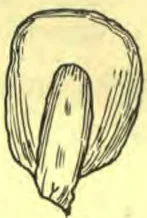
With a pen-knife you can easily remove the hull from this hollow space. “There is life in the seed,” and it is now opening before you. See how soft this part of the kernel is, while the rest is as hard as flint. In the middle of this soft part lies a little round peg (like Fig. 2).
God's Golden Grains.
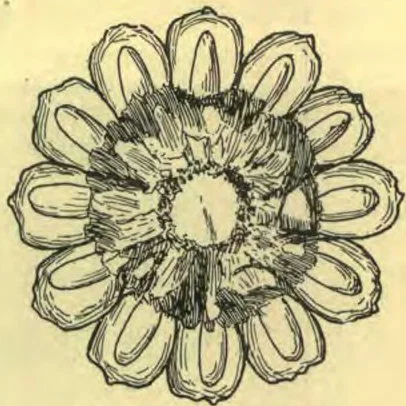
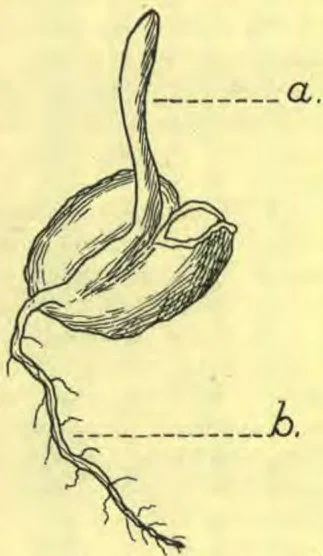
This soft part which we are examining, shown in Fig. 1, is called the “embryo;” and embryo means “the beginning of a living thing.” The part that I have named a peg is usually called the “plumule.” The plumule has in it the beginning of two things; for the first blade seen above ground after planting comes from its upper end, and the first root going down into the ground comes from its lower end. This first root is called the “primary.” Both the plumule and the primary are shown in Fig. 3.
I hope you can get a whole ear of yellow dent corn. Such a piece of God’s handiwork is beautiful to all who look for beauty in common things. See its shape of beauty, its rows of gold, its shades of color! But, especially, I want you to break it in two, so you can observe the perfect arrangement of kernels. As you look down upon the lower part of the ear, the large end, all the embryos face you. As kernel crowds upon kernel, it seems that the soft, delicate life in the embryo might be crushed, had not a protected place been prepared for it. But as it is, the smooth side of one kernel can not press into the hollowed embryo side of the next.
Fig. 1: Indian Corn, showing embryo.
What else is in this seed, or kernel, of corn besides the embryo? One word tells the story,—food. It is, first, food for the plant which is to grow from this seed. As the little root and blade first begin their growth, they feed upon the stored-up food in the kernel itself. It is also a perfect food for man and beast, as it contains one part of albumen and seven parts of starch. It is interesting to know that 2,523,648,312 bushels of shelled corn were produced in the United States last year. If this were distributed among the seventy-six million inhabitants, each person would have thirty-three bushels, or over five pounds for every person each day of the year. This is more than three times the amount necessary for a man’s daily food.
We may now name the parts of our kernel of corn, and having that before us, we see what is in every seed; for all are alike in their general arrangement:—
  1. The outer covering, or husk.
  2. The store of food.
  3. The embryo enfolding the undeveloped plant.
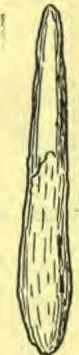
Fig. 2: Enfolded corn plant from embryo. Enlarged seven times.
As in the corn, so in the acorn,—the plant and the tree lie wrapped up in their food-house, ready to come forth at their Maker’s call.
There is almost an infinite variety in form, size, and color of seeds. All contain the life placed within them by God, and that life waits only for favorable conditions to spring into activity and produce another organization like the one from which it came.
The first law of the seed is that it will produce a plant and a seed after its kind,—the “herb yielding seed . . . after its kind.” Gen. 1:11, R. V.
Since it is now planting time, I must give you some lines from an old English author: “In the stealing steps of spring, our quiet, silent, abiding lessons, the deep morals of our natural world, begin. Out of what is committed now, gently, or with careful labor, to the earth’s bosom, come the earth’s character, life, dress, habits, for the circling dance of months and seasons. The time of seeds, looking forward to results, is the time of weightiest, most instructive thought, most solemn warning. Text after text has the divine in spiring Spirit condescended to draw out of this part of the book of nature, rewriting it in the book of grace.”
Fig. 3: A new plant beginning; (a) plumule; (b) primary root.
The selection of seed for planting is important. “Whatsoever a man soweth, that shall he also reap.” As the child resembles its parent in character and appearance, so the grain harvested will resemble the seed sown. Select the best seed of the variety you wish to grow. This is now a well-established principle of agriculture. The superintendent of the seed department at one of our State agricultural colleges said to me, “We are learning more and more to appreciate the importance of selecting the largest and best quality of seed.”
I hope you will sow some seed of your own this year. Plant something for food or for ornament. It will be instructive and interesting for you to care for the seed, and observe its growth. And when you sow or plant, remember to put in plenty of seed. “He which soweth sparingly shall reap also sparingly; and he which soweth bountifully shall reap also bountifully.” The seed has enemies, and some of it may be destroyed. Then there are the birds, the squirrels, and the worms. They all consider that they have a right to their daily bread, and you can hardly convince them otherwise. Plant enough so they may have their share, and you have abundance left. J. C. ROGERS.