The Pulse (Leguminosae) family includes all such plants as peas, beans, lentils, clovers, locust trees, the redbud, or Judas-tree, and many others, which produce that sort of fruit known as a “legume.” By referring to Fig. 3, it will be seen that the legume is a one-celled pod, which, at maturity, opens down both edges, or sutures, while the seeds are all attached along one suture.
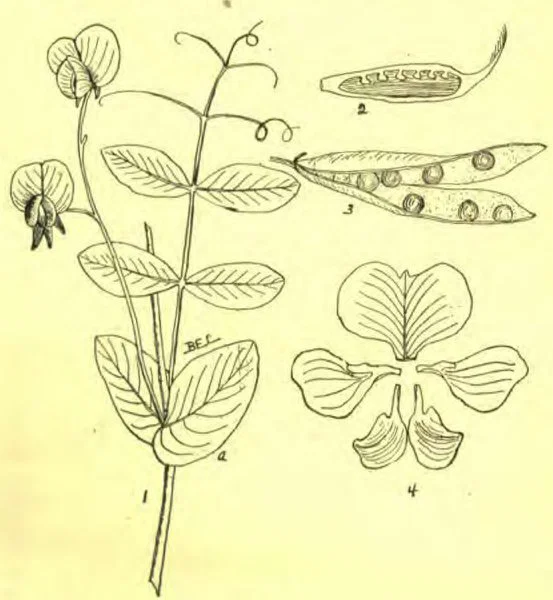
Most of the plants, as all of those mentioned above, have the petals unequal, and usually five in number. (Fig. 4.) This family is noted for the beauty of its flowers, and the great variety and value of its products. Few if any of the plants are of a poisonous nature.
The Common Garden Pea (Pisum sativum) has long been recognized as an important food plant. The leaves are compound, usually with two pairs of leaflets, the common petiole, or leaf-stalk, being terminated by a branching tendril which aids the plant in climbing. (Fig. 1.)
The action of the tendril is curious indeed. If there is no support at hand, it remains straight or slightly curved at the extremity, reaching about in search of some neighboring plant or other object which, when it has found, it grasps eagerly, and twines about it. At the same time the middle portion of the tendril coils up so as to draw the plant nearer its support.
At the point where the leaf-stalk is attached to the stem, are two leaf-like appendages called “stipules.” In most plants the stipules are small or absent, but the Garden Pea has them remarkably large. (Fig. 1, a.) The flowers are large and of various colors.
There are many varieties of the Garden Pea, some only a few inches high, and others several feet, requiring brush or some similar support to keep them from lying flat upon the ground.
In order to insure a supply of fresh green peas throughout the season, there should be several plantings two or three weeks apart, beginning with the earlier varieties about the first of April if the weather will permit. Peas contain much less nutrition while green than when ripe, but are more easily digested. The two forms of dried peas most commonly used for food are the split peas, from which the hulls have been removed; and the green, or Scotch, peas.
The Sweet Pea (Lathyrus odoratus) is nearly related to the Garden Pea, but is cultivated only for its sweet-scented, handsome flowers.
The Common Garden Bean (Phaseolus vulgaris) is another plant of great value to mankind. There are many varieties in cultivation, some of them being twining plants, and growing to a considerable height, as the Pole Beans, while others are dwarf, as the Bush Beans. The flowers are of various colors.
Beans differ from peas in many ways, but noticeably in the absence of tendrils, and in having only small stipules. As to the nutritive value, there is no great difference between peas and beans, although, according to good authority, green peas contain nearly twice as much nourishment as string-beans.
The Lima Bean (Phaseolus lunatus) is a twining plant, with greenish-white flowers, broad, curved pods, and large, flat seeds. As stated concerning the Common Garden Bean, there are many varieties, some of them being known as Bush or Dwarf Limas.
The Common Lentil (Lens esculenta) is a slender plant about one foot high. The leaves are compound, with several pairs of leaflets. The flowers are small, white or purplish, and the fruit is a small, broad pod containing two seeds the shape of a double convex lens. It was the shape of the Lentil seeds that gave the name to the glass lens used for magnifying.
Lentils have about the same nutritive value as peas or beans. All are somewhat difficult to digest, but when properly prepared and used in moderate quantity, can be digested by the majority of persons, and make excellent substitutes for flesh foods. They should be thoroughly cooked, and in general it is advisable to remove the hulls by means of a colander.
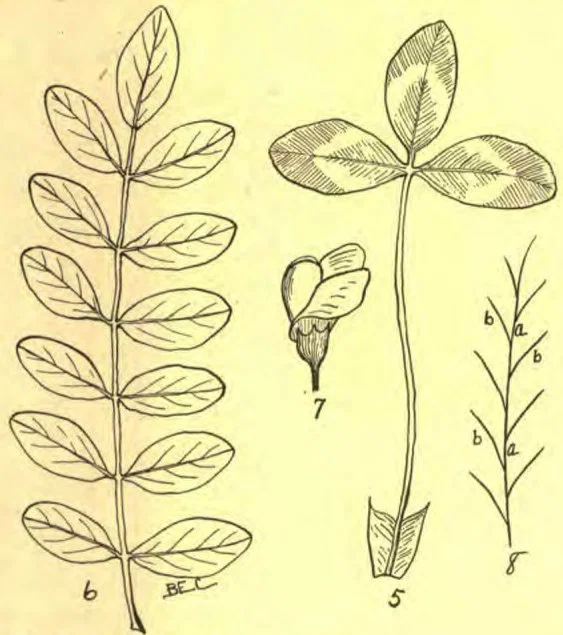
Of the many species of clover, the Red and White Clovers are probably the most common and the best known. The first of these (Trifolium pratense) is extensively cultivated for hay. The compound leaves consist of three more or less oval-shaped leaflets, which are frequently notched at the end, and often have a pale spot on the face. (Fig. 5.) The rose-purple, sweet-scented flowers are sessile, and crowded in dense heads. Each head is closely surrounded by the uppermost leaves of the stem.
The White Clover (Trifolium repens) is common everywhere in lawns, pastures, and fields. The leaves are compound, with three heart-shaped leaflets, having the broader notched end at the apex, and the narrower end at the base, where the petiole is attached. Both leaf-stalks and flower-stalks are long and slender. The flowers are white, arranged in loose heads, with each flower borne on a short pedicel of its own. White Clover is extensively used in grass mixtures for both lawns and pastures.
In this connection should be mentioned Alfalfa (Medicago sativa), which in some places is extensively cultivated for green fodder or for hay.
The Common Locust Tree, or False Acacia (Robinia Pseudacacia), is a rapidly growing tree, which is said to attain its greatest perfection in Kentucky and Tennessee, where it often grows to the height of ninety feet, with a diameter of four feet. Its timber is strong and durable, and largely used in ship-building, and for railway ties and fence posts.
The leaves of the Locust Tree are compound, with numerous leaflets. (Fig. 6.) The large, showy, white or rose-colored, fragrant flowers are borne in loose clusters, each flower having a short stalk, or pedicel, of its own, which is attached to a common peduncle. (Figs. 7 and 8). This form of flower cluster is called a raceme. The fruit is a pod from four to six inches long.
The Honey Locust (Gleditschia triacanthos) may be known by the large thorns, the small, greenish, inconspicuous flowers, and the long, flat pods, from nine to twenty inches in length, often twisted or curved.
The American Redbud, or Judas-Tree (Cercis Canadensis), is a small tree which is very ornamental in spring, when the leafless branches are covered with the small, but exceedingly numerous, pinkish-red flowers. The leaves are large, rounded, heart-shaped, and appear later than the flowers.
Such are a few of the plants belonging to the Pulse family. There are many others of interest, but space will not permit us to describe more of them here. There is one important fact, however, that we must not neglect to mention in speaking of the leguminous plants.
Nitrogen is one of the most important nutritive substances used by plants, and it is abundant in all parts of the world, seventy-nine per centp. 4 of the air we breathe consisting of this element. Since it is so plentiful, one would naturally think that plants never suffer for lack of this kind of food, but such is not the case. It has long been known that plants in general are unable to make use of the free nitrogen in the atmosphere, but must obtain all their nitrogenous food from the soil in the form of soluble nitrogen compounds.
In order to understand what this means, one must understand the nature of chemical compounds, and how they differ from mixtures. If we mix together sand and salt, each of the substances retains its original characteristics, and we have a mixture, but we do not have a chemical compound. When two substances combine chemically, both lose their individuality, and an entirely new substance is formed. In the atmosphere the nitrogen is mixed with oxygen, but not chemically combined. From this it will be understood how the nitrogen compounds of the soil differ from the free nitrogen of the atmosphere.
If the soil is lacking in these essential nutritive substances, plants will not make a vigorous or rapid growth. As each crop that is removed from the soil removes a large amount of the nitrogen, it can readily be seen that if it is not replaced in some way, the soil will become exhausted in a few years.
By careful study and extensive experiments, it has been found that the leguminous plants can make use of the uncombined nitrogen of the atmosphere, which other plants are unable to do, and thus they always have an inexhaustible supply of this substance. Such plants as beans, peas, clovers, and others belonging to the same family, will grow and do well in soil that is devoid of nitrogen compounds.
When these plants are plowed under, as clover and some others often are, the nitrogen which was obtained from the atmosphere, and which has entered into the composition of the plant tissues, is deposited in the soil in compounds which can be utilized by other kinds of plants.
Experiments have recently been made with alfalfa to ascertain its value as a fertilizer. Alfalfa was grown upon the same land five years in succession, being cut for hay each year, so that only the stubble and roots were left in the soil. At the end of five years other crops were grown on the same soil, with the result that each acre produced from eight dollars to twelve dollars in wheat, sixteen dollars in oats, and sixteen dollars in potatoes, more than land which had grown potatoes or grain before. This increase in value was produced without the outlay of a single cent for fertilizers, and is a good example of what may be accomplished by the proper rotation of crops.
From this brief account, a somewhat general idea may be obtained of the importance of the leguminous plants in any system of crop rotation.
The manner in which these plants are enabled to make use of uncombined nitrogen is of considerable interest. When peas, beans, or other leguminous plants are carefully removed from the soil, and the roots washed, there are found on many of the roots small, fleshy tubercles, about the size of a pin-head. If a small section of one of these tubercles is examined under a high-power microscope, it is seen to be swarming with exceedingly minute bacteria, which in some way put the free nitrogen of the atmosphere into forms which can be assimilated by the plants. How it is done is not definitely known.
These tubercles grow sparingly or not at all on the roots of plants that are grown in soil rich in nitrogen compounds, as in such soil they are not needed; and they are not found on very young plants, as it requires a considerable time for their development.
Thus we see that though the soil was cursed and rendered less fertile as a result of sin, the Lord has made provision whereby its fertility may be retained if it is properly cultivated.
B. E. CRAWFORD.