The Catbird is very wary, but can easily be tamed if given constantly kind treatment. Mr. Nehrling tells of a pair of Catbirds that would allow even the children to look at their nest and young without becoming in the least frightened. They knew there was no danger. But once let a stranger approach, and they screamed so loudly, and evinced such noisy distress, that the chickens in the barn-yard cackled, and the old hens hurried to get their broods to a place of safety.
It is said that the old birds begin preparing for the second family a few days after the first has left the nest; but while the female is thus engaged, the male takes care of the first brood. When the second brood are ready to claim the father's attention, the first can easily care for themselves.
The catbird has a peculiar mewing call, resembling in some respects the sound made by a cat; it is also swift and silent in its movements. For these reasons it has received its name. It is also a very gifted singer. Indeed, the mocking-bird, the brown thrasher, and the Catbird rank as the greatest triplet of singers in North America. Like the mocking-bird, the Catbird's power of mimicry is very great. On several occasions I have heard it sing until it seemed as if its little throat would burst with the power of the melody, during which time it interwove into its song, notes from almost every bird that frequented the neighborhood, even those of the whip-poor-will.
It has been complained that the Catbird destroys our fruit, but most such complaints come from parts of the country where there is little wild fruit, which the Catbird prefers to the cultivated product. It will be an easy matter to gain the aid of these birds in destroying insects. By planting wild berry-bearing bushes and trees along the hedges and fences, you will save your fruit from both birds and insects. Of the stomachs of five Catbirds examined, each was found to contain thirty grasshoppers. Fully one third of the bird's daily food consists of insects. Experiments have shown that he prefers red mulberries to cherries and strawberries, and the stomach examinations show that he eats twice as much wild fruit as cultivated. It has been suggested that where he does damage to cherries and strawberries, such crops can be protected by planting the prolific Russian mulberry, which also affords good food for domestic fowls.
The usefulness of a Catbird as a destroyer of innumerable noxious insects can not be estimated too highly. Its service in this particular is of inestimable importance compared with the small allowance of fruit it steals. From early morning until sunset it watches over the fruit trees, and kills the insects that would destroy them or their fruit. If it takes its share, especially of cherries, remember that for one cherry it kills thousands of insects. You may rest assured that where there are no small birds, there will be little fruit.
“The Catbird,” writes Olive Thorne Miller, “is one of the most intelligent birds in North America. He is inclined to be very friendly to man; and where he is well treated, and his confidence won, he likes to nest near our homes, showing himself delightfully familiar, coming around the doorstep, answering one’s calls and talk, and singing by the hour for our entertainment.
“The Catbird is generous and helpful to others of his kind in trouble of any sort, feeding or caring for deserted or orphaned young ones of any species, and always ready to aid distracted parents in the defense of their home and little ones.”
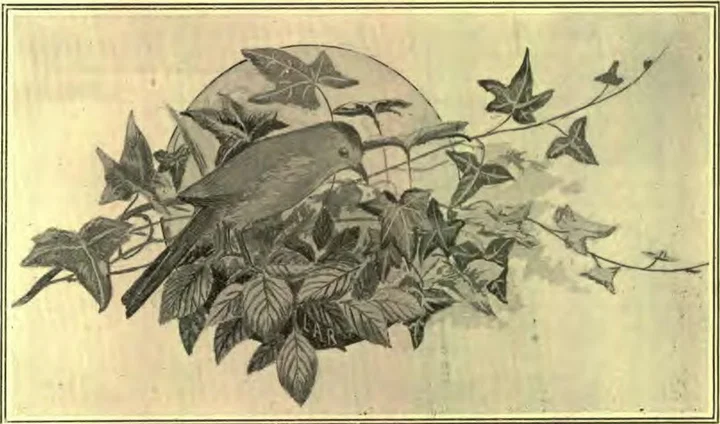
“He is of a lively and restless temperament. He is always tossing upward or spreading his tail, jerking his little body about, now crouching like a cat ready to spring, then straightening himself up very tall; one moment puffing his feathers out until he looks like a ball, and the next holding them closely against his body. He is very playful, full of droll pranks and quaint performances. I know of no bird better worth cherishing than the Catbird.”
The crown and tail of the Catbird are black; under tail-coverts, chestnut; rest of plumage, slaty gray. The picture of course is much smaller than the natural size, as the bird is close to nine inches in length from tip of tail to point of beak.
L. A. REED.