Extracts from a Letter by Mrs. J. N. Anderson
I wish we might do a little more by way of getting the real condition of affairs here before our people in America, but it really seems quite impossible, just at present, so many things clamor for attention. I have laid off everything I can think of to save time and strength for the work, and yet neither seem a tithe of what I ought to expend on it.
Labor is very cheap, compared with prices paid in America, and it is one of the best means of influencing the natives, to keep them in our employ, so we have turned over most of the domestic work to the Chinese, and have cut off everything possible to be dispensed with, to save time and labor. One must wear light clothes in these hot climates; and while Chinese methods are severe on the fabrics, and their results often trying to our patience, still we may just as well resign the laundry to the Chinaman first as last, for it is quite impossible for a European to do this kind of work in this enervating climate. Then, besides, the poor people need the opportunity to earn an honest living in perhaps the only way in which they are qualified to earn it.
At first the idea of being drawn in a jinrikisha or carried in a chair by human beings, my brothers by creation, seemed a shocking one. I never stepped into a gig or chair without feeling that somehow I was trespassing against a brother and offending his Maker. Usually I overpaid them. And when they, suspecting from this that I was new to these parts, followed me with overwhelming arguments for a “come-shaw,” as they call a present, I was tormented with all sorts of scruples. Can you imagine how it would seem to step out into the street, knowing that you could not possibly make the contemplated distance on foot, and find no other means of conveyance except those propelled by human brawn and muscle? You can have your choice—to be borne on the back of an amah (a female servant), or a coolie, as the small-footed Chinese women are often carried; to be trundled along on a clumsy wheelbarrow, as is the case in the north, at Shanghai, and in the interior; to be drawn in the small carriage-like jinrikisha by a muscular coolie, in the hills; or to ride in a more elegant manner in a sedan-chair borne by as many coolies as you care to hire, in as beautiful liveries as you may provide. The usual thing for the level districts is to proceed till you can catch the eye of a waiting “riksha” man, and then signal him, much as you might the street-car conductor of a motor line. Often these men wait in groups at favorable corners, and four or five of them may have observed the signal. Then comes a scramble for your patronage.
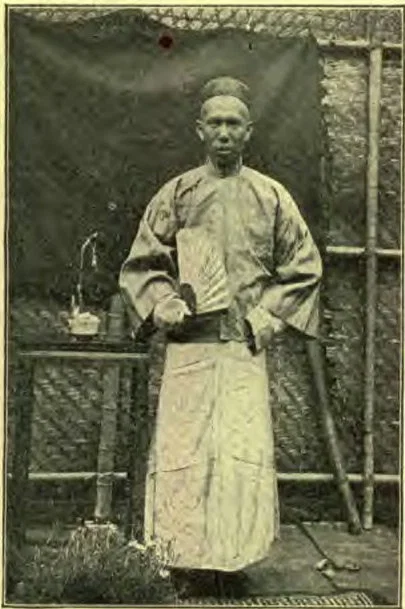
The man you choose will draw up in front of you, and drop down the shafts to allow you to take your seat; then he makes sure of the greasy, slimpsy excuse for a towel with which he expects to dry away the perspiration precipitated by your ride; gives a few twitches to the leather belt that confines the wide top of his loose trousers, to insure its doing proper service for the trip; and, finally, at your signal, starts off with a few easy strokes that soon break into a brisk trot. If it is a rainy day, he will wear a broad-brimmed hat made of bamboo splints and a kind of oiled or otherwise prepared paper, with the curious little peaked crown you see in pictures, and a rain-coat made of palm leaves stitched together at the rib-line to give a sort of cape and skirt effect. The trousers are then rolled to the knees, or more likely, thighs, when, except for the broad hat, you might mistake him for some long-legged water-bird, the tattered edges of the palm-leaves resembling bedraggled feathers. On a very warm day he may offer his services dressed simply in a pair of loose trousers, with the indispensable leather belt. The big hat will be shoved under the strap on the bottom of the conveyance.
The American consul at this place goes about in a fine chair borne by six coolies, with the stars and stripes of Old Glory on the back and shoulders of their uniform. The chair is by far the pleasantest means of conveyance, although slower, as the coolies do not trot, and is necessarily the sole conveyance in the hill district. The outfit of the well-to-do is often quite elaborate, and on meeting several fine ladies in their turnouts, you begin to dream over again the tales of knight and lady told of the days of chivalry.
As I said before, my democratic spirit suffered all kinds of torment at the first. But now I have come to feel quite differently about it; for the facts are that the jinrikisha men are better paid than the men who swelter in sultry engine-rooms and in mechanical work-rooms, and they do not work harder nor longer, while they enjoy much more liberty. To be sure, they must go when called, or lose their licenses; but, if they are too tired to run, they can hide away where they can not be called. There is no enterprise in China. Rich mines are unworked, broad fields away from the villages are uncultivated, and everything is in a very backward state, so men are only too glad for any employment by which they may be able to earn their rice and fish. They are as glad of the help the coin will be to them as I am of the help the muscle of their strong calves and thighs will be to me.
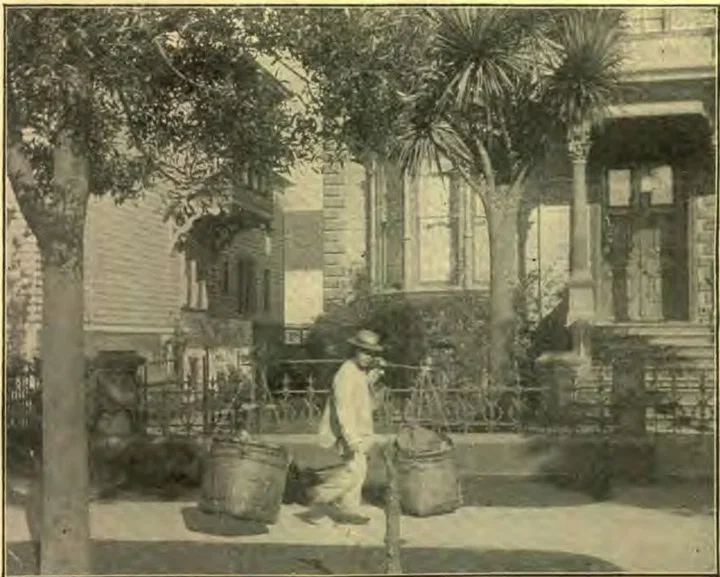
It is quite surprising how very muscular the people are, when we consider that they are fed principally on rice, with coarse vegetables half cooked with peanut or bean oil, and a bit of fish or pork. Two coolies carry quite comfortably a load of six piculs, or about eight hundred pounds, simply by means of a bamboo pole strung on the shoulders. The other day a coolie—not a large one—picked up a barrel of oatmeal, and carried it on his shoulder up a long, steep, narrow flight of stairs, to Brother La Rue’s rooms. It is quite common to see one trotting from the boat docks to the “go-down,” as the warehouses are called here, with five sacks of flour stacked upon his shoulder.
The women, too, are very strong, and carry brick, stone, and mortar up the mountain for building purposes, quite as easily as do the men. Sometimes one sees a woman “packing” an enormous load, with a baby on her back. The women work at all kinds of common labor together with the men.
On the other hand, it is impossible to conceive of a more enervated, flabby piece of human mechanism, than a well-bred, well-to-do Chinaman, unless, indeed, it be his small-footed wife. He shrinks from the slightest exertion in behalf of his own physical existence, even so much as to shut or open a door.p. 2
But the people in general are so simple and so eager to be taught that I find them very charming. Our little house-boy, Akow, for example, is so sunny and affectionate, so considerate of any indisposition, so watchful lest I shall overtax myself, and so jealous of our interest lest his fellow countrymen should take advantage of us in trade, etc., that we can not but love him. This is a very rare combination in a Chinese servant. He is growing into an active, enthusiastic little Christian, too. He is sixteen years old, but not large, weighing less than one hundred pounds. He is getting on with English very much faster than we with the Chinese, but some of his combinations are amusing. For instance, he always inquires if he shall “hurt” the potatoes, meaning, shall he mash them,—I suppose from the fact that a blow on the body is spoken of as “hurting.”
(Concluded next week)