THE “LUCK FLOWER”

9%

Review and Herald Publishing Company · Battle Creek, Mich. · July 18, 1901

FromThe Youth’s Instructor, Vol. XLIX, No. 29

Read the full edition

THE “LUCK FLOWER”

An Allegory
ONCE there was a poor man (so the story runs) who was wandering all alone upon the side of a rugged mountain, when he came to a tiny, trickling stream, flowing from the rocks. He followed its course, and it led him into a wooded glen, where the fresh green grass was growing. On the banks of the stream he found a tiny blue flower. It was so long since he had seen a flower, that he eagerly picked it, and tied it to the head of his staff.
Just as he turned to go on his way, he saw an opening in the rock, which led him into a large cave filled with gold and silver and jewels and precious stones. He threw down the “luck flower” that had brought him this good fortune, and filled his pockets and his arms with all that he could carry of the treasure that he had found. The treasure that he had collected vanished, and not even his staff with the “luck-flower” on it remained to him. He sought in vain for the “luck-flower” that had gained him an entrance to the cave, but he never succeeded in finding it again.
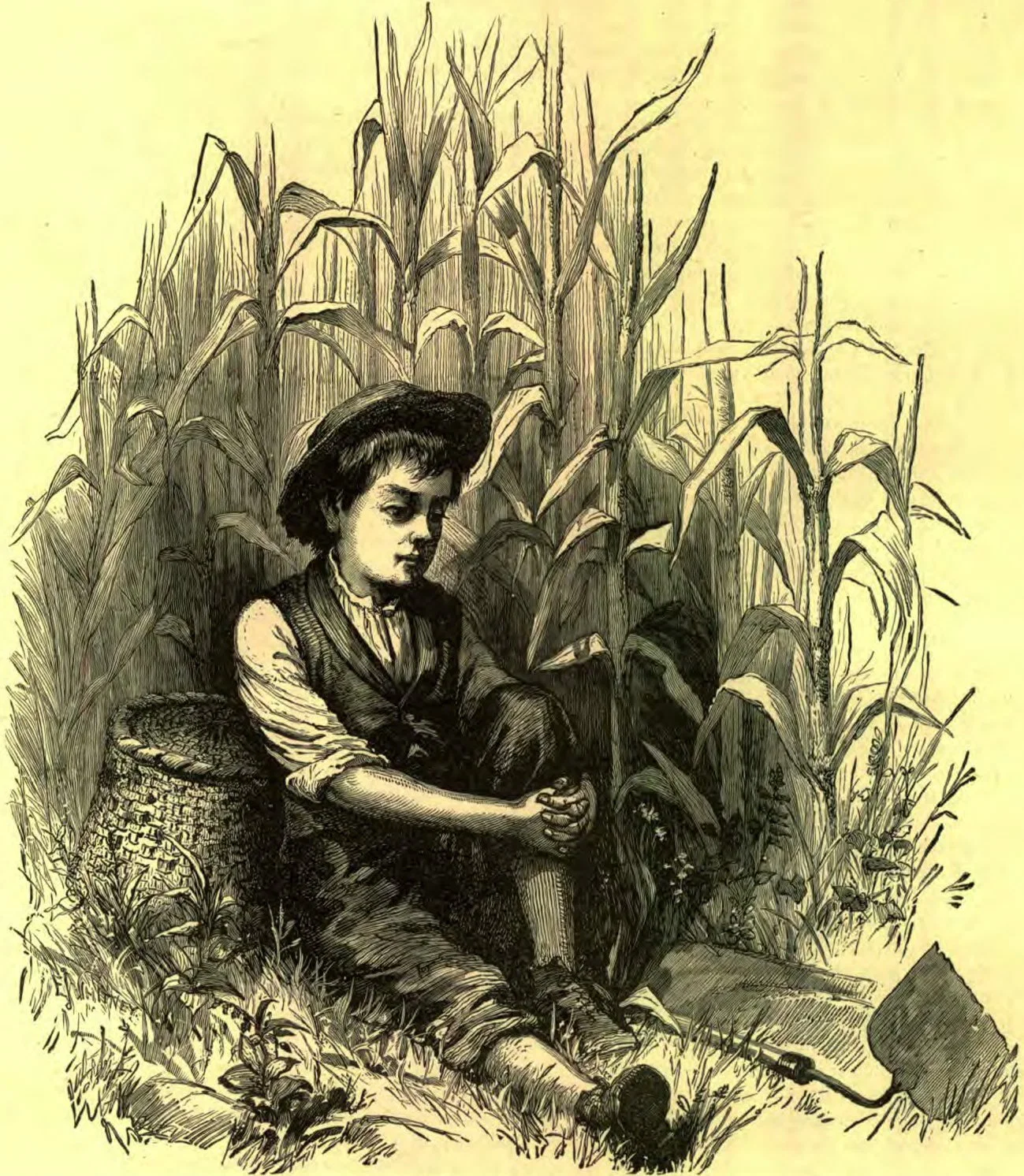
HE FANCIES THAT THE WAVING HEADS ALL BOW WITH COURTEOUS CHARM
You will, I think, see the meaning of this little fable without any explanation. The stream whose course he followed shows how God guided the poor man, in his want and loneliness, to the place where he would find an abundance.
Then the finding of the “luck-flower,” as he called it, which gave him entrance to the cave, showed how God opened the way for him to get wealth. Did you ever hear any one talk about “luck” or “chance”? Did you ever think, yourself, when any good fortune came to you, that it was “a piece of good luck”? There is no such thing. All things are ordered for us, and every good thing comes to us from God.
Then when he forgot his benefactor in his eager, greedy grasping after the treasure it had brought him, he was an example of what so many do,—forget God, and leave him altogether out of their reckoning, in seeking to fill their hands with the riches that he himself has bestowed. Take care, dear children, that you are not so taken up with the good things God has given you, that you forget the Giver of “every good and perfect gift.”
Many think that it is all their own skill and wisdom that bring their good fortune, and to such God says: “Beware that thou forget not the Lord thy God, . . . lest when thou hast eaten, and art full; and hast built goodly houses, and dwelt therein; and when thy herds and thy flocks multiply, and thy silver and thy gold is multiplied; . . . then thine heart be lifted up, and thou forget the Lord thy God; . . . and thou say in thine heart, My power and the might of mine hand hath gotten me this wealth. But thou shalt remember the Lord thy God: for it is he that giveth thee power to get wealth.”
From all his works his sweet voice cries to us continually, “Forget me not! Remember me, the Giver of every good and perfect gift; for my hand made all things.” It is for our sakes that he thus calls to us; for he knows what must be the end if we do forget him. We shall at last find ourselves shut out from his presence, with all the things that we have allowed to take his place faded from our grasp. We shall be left empty-handed, like the poor man on the bleak mountain-side.
How much better it is to remember God, and love him, even though we have no earthly treasure, than to have all the riches of earth, and forget the source from which all our blessings come! EDITH E. ADAMS.