LET us glance over the crowd of leaves that unfold before us in the spring, noting that even under the individual peculiarities of families, we can trace some seven or eight broad lines of action, to which all more or less conform.
The first to attract our notice are plants which hold their leaves aloft, and uncoil them, flag-like, in majestic manner. The stem bearing each leaf is continued as a strong rib up through the leaf, and round it the leaf is wrapped as a flag is furled. In one of these we recognize the arum lily, a stately plant, which, in its warm and comfortable quarters, can well afford to be imperial in its bearing; for it has none of the struggle which such a plant as the primrose knows when it bravely faces the snows of February and the bitter winds of March.
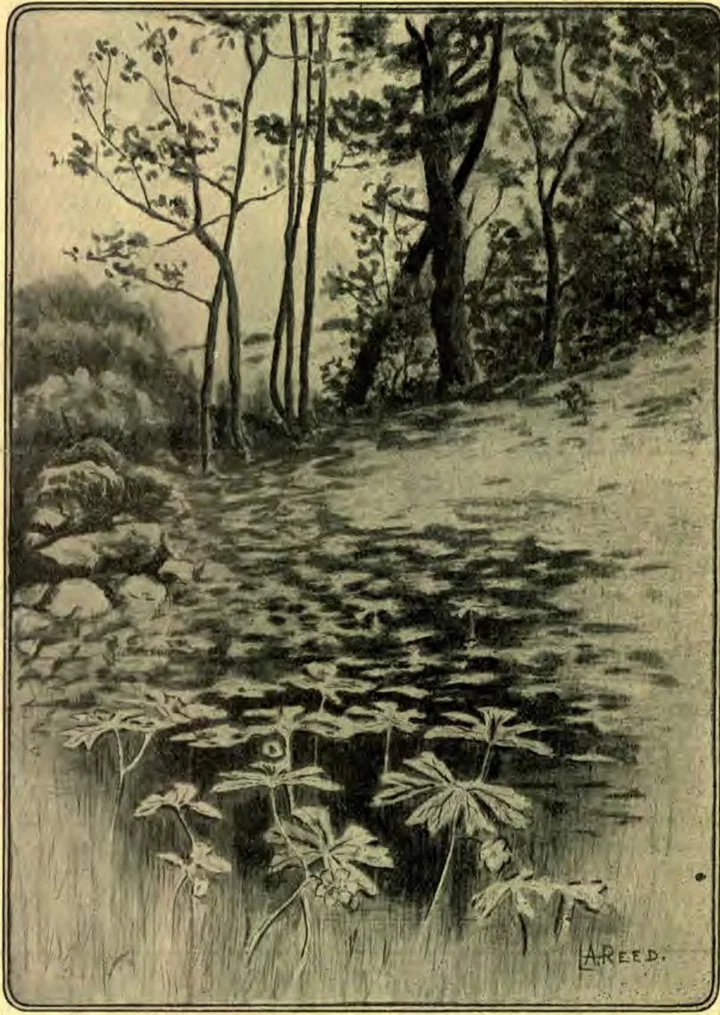
And the primrose leaves bear evidence of the struggle in their very attitude. They are not held aloft like the arum flag, for the cold would nip them through and through; but instead, each little leaf, putting a brave front on the matter, only appears on its face as a stout rib of lightish green. But turn over the baby leaf, and you will find two little tight rolls of delicate green tissue wrapped away snugly on its back behind the rib. The more fragile parts of the leaf naturallyp. 2 shrink from the cold wind, and curl themselves up, and shelter behind the more robust parts.
Pick up leaves of older growth, taking them in their various stages from youth to maturity, and you will see how gradually the little tight coils enclose as the baby leaf grows, and becomes more able to bear exposure, helped, too, in its development by the softening influence of approaching spring. The rolls unwind, moving farther and farther from one another, and the face of the leaf broadens at either side, until at length the full-grown familiar primrose leaf lies before us. The crocus and the large dock leaves are among those that follow the example of the primrose in curling themselves backward in their youth.
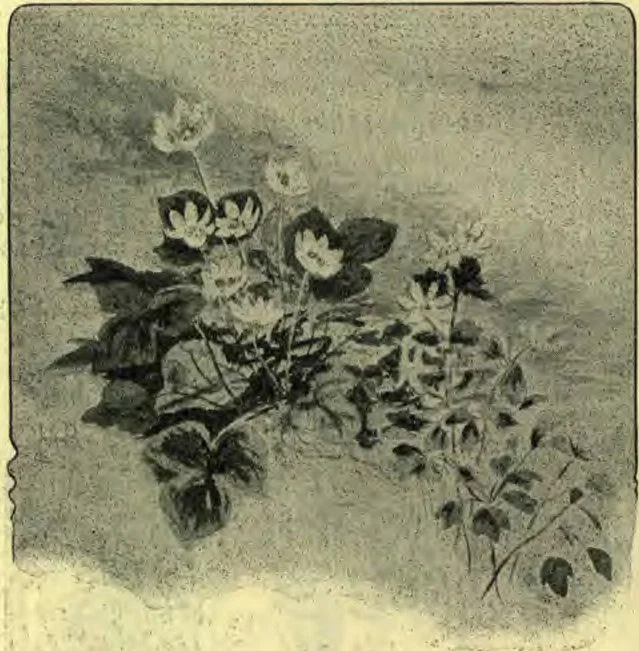
Other leaves start life rolled up in much the same way, but forward, not backward, and thus at first carefully hide their main central rib. As they grow, the coils roll back, like curtains, on either hand, and show the face of the leaf. The violet is a good illustration of this habit, and so, too, are the leaves of the little pink begonia.
The pear leaf rolls up on its face also, but quite differently from either the violet or begonia. Its long, straight, sausage-like rolls loosen, rather than unroll, until the edges just touch one another.
For a contrast to the neat little rolls of these leaves, turn to others, of which the delicate green columbine is an example. The columbine's way of doing things is much like a conjuror's. First a crumpled ball of green tissue, then a larger ball of endless edges and pieces, shaking out gradually from chaos to order, until an elaborate system of leaves appears, a stem, too, on which three branches arise, and on each branch many leaflets—all hidden, till now, in the little crumpled ball.
The roses and the wild elders arrive at the same result, but in a neat and precise way, which leaves no room for sensation, or doubt as to what will happen. There is in them no ball of crumpled possibilities to awaken curiosity, but instead each tiny leaflet is, from the very beginning, neatly folded in half by itself, and all are laid carefully one on the top of the other, in the most orderly way. As the days pass, the leaflets lift themselves one from another, and spread out a little, and at the same time each begins to open, the stalk lengthens, and, all in order and due time, the leaf arranges itself.
But all leaves are not neat and orderly in their unfolding. Many are simply crumpled up at their birth, and only smooth out as their development progresses. A baby geranium or poppy leaf, for instance, is a rough, crumpled little ball, folded up higgledy-piggledy, and covered with hairs. Still, as is the case with many an unpromising beginner, time smooths things over, and by degrees the creases disappear, the crumpled folds fall into place, and though the rough surface never becomes really smooth, yet the leaf takes its place as a decent member of plant society, and does its work no worse for its lack of polish.
The leaves of the cherry and the peach are simple, undivided, and oblong, and their upper surfaces are rather delicate to begin with, so each begins life folded in half like a book, the middle rib being the back of the book. So exactly are the halves placed one on the other, that it is often difficult to tell that there are two layers and not one; moreover, sometimes the halves of the leaves are stuck together with a sticky substance during the earlier period of their development. Thus folded, then, they grow until they are almost full size; then, like a book, they open.
In contrast to the simple method of the cherry, notice the dainty way in which the beech folds up a very similarly shaped leaf. The ribs of the leaf run out parallel to one another from the center rib, and play the part of the sticks, while the pale-green tissue between the ribs is as delicate as any silk or gauze which fashions a fan. Just as a fan unfolds, so does the leaf; the pleats open out gradually, the ribs stretch apart, until finally the leaf, like a fan, is a plain, unpleated surface. In many other trees besides the beech this fan-like unfolding may be traced. The horse-chestnut, for instance, pleats each of the finger-like parts of its leaf, and then places them all together more or less tidily, like a bundle of sticks.
One very curious unfolding—the unfolding of the ferns—must not be overlooked in our brief survey of leaves. Instead of rolling themselves up from side to side, as do almost all the other leaves which adopt the rolling action, they coil themselves from apex to base. At the very beginning of their life, the whole main axis is wound up tightly, like a watch-spring; as development progresses, the coil gradually unwinds and straightens out. And now it can be seen that every little branch is wound up in the same peculiar way, and all are unwinding as they grow.
A few leaves do not have any manner of folding in their youth; some come up sturdily, straight through the ground in their natural form, only trusting to a thick skin for protection; such are the daffodils and the iris. Others arise on the branches, perfect leaves in miniature, simply growing larger and larger until they attain their full size.
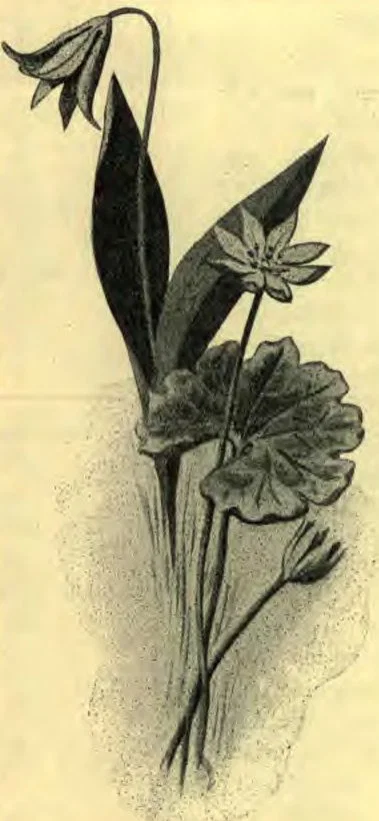
But the majority are folded, rolled, or crumpled. They may be folded in half, or fan-wise, or arranged to fit one on to the other; they may be rolled from side to side, or from apex to base, or in double rolls forward or backward; they may be merely crumpled, or they may adopt a modification or a combination of several of these methods, and in this they show their individuality.
The strawberry leaf, for instance, has the same method of folding as the roses, but, to make protection doubly sure, has combined with it the pleating of the beech, and then added a coat of hairs for further warmth.
The convolvulus shows its individuality in a very quaint way. A glance at the ends of the young shoots recalls irresistibly to mind a toy monkey climbing a stick. Each little leaflet clings tightly round the parent stalk, and not until it is well grown does its clasp relax, and then it throws itself back to face the sky, and begin its work.—G. Clarke Nuttall.