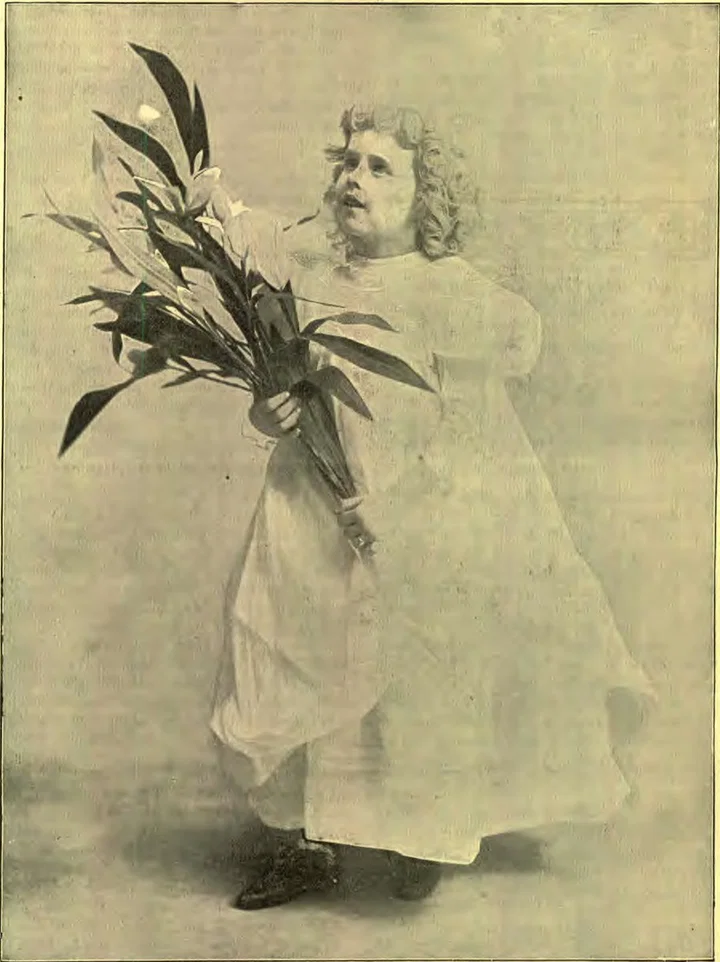
“But how do you fool them?” asked Margy. She was a very little girl,—not six years old,—and she looked up to Edgar, who was twelve, as an extremely wise person.
“You make ’em think things are different from what they are,” said Edgar. “Only, of course, you don’t tell fibs. And when they find out they’re tricked, you call, ‘April fool!’ It’s lots o’ fun.”
“It must be,” said Margy, eagerly. “I mean to try it.”
Edgar looked at his sister. Some way, although it was “lots o’ fun” for him, he did not like to think of Margy teasing her friends, and laughing at their disappointment.
“Oh, you’re too little,” he said.
“Mama told me one wasn’t ever too little to help others,” Margy declared.
Edgar was so puzzled by this speech that he made no further remark.
When the Wheaton family came into the dining-room, on the first of April, mama was saying:—
“I am so tired of that baked apple every morning, and I don’t care for oranges any longer. I do wish, either that it was time for berries, or that Dr. Mason had not told me to eat fruit for breakfast.”
Margy danced along by her side, listening and smiling to herself. As Mrs. Wheaton caught sight of the table, she gave a cry of surprise. There sat a plate of strawberries beside her napkin.
“April fool!” called Margy. “I bought ’em myself, mama, down to Mr. Snyder’s. And you thought you were going to have baked apples again. April fool!”
The rest—her father and mother, Jamie and Edgar—looked at one another over the little girl’s innocent head.
“That is a sweet way—to trick one with something nice,” said mama.
“Why, what other way would there be?” asked Margy. “Nobody would do mean things to people—not on any day in the year.”
A merry voice called “April fool!” after papa, whose hat and coat, all neatly brushed, lay upon the hall table. And the same cry followed Edgar’s usual search for his scattered school-books and his finding them strapped together, lying beside his cap. A sprig of geranium from Margy’s cherished plant was pinned upon the lapel of Jamie’s overcoat, and “April fool!” he heard, as he hurried into it.
Ellen, the second girl, went out to the butler’s pantry later, and discovered the silver from breakfast rinsed and dried and laid in its proper baskets. “April fool!” piped Margy.
“What are you doing, child?” inquired Miss Wilkinson, opening her window to question the little girl in the garden next door. Margy looked up, brightly.
“I’m going to April-fool the birds,” she said, “with this plate of crumbs. They don’t expect a thing, you know. They’ll be so surprised.”
Miss Wilkinson gazed down into the radiant little face: “You’re a good child,” she said, quickly, and shut down the sash more gently than was her wont.
Margy ran into the house, and told her mother how Miss Wilkinson had April-fooled her, “because she never said I was a good child before.”
When the scrubwoman, who was working next door, went home that night, Miss Wilkinson astonished Maria by giving her a basket of cold pieces. “April fool!” said her employer, smiling in a grim way, and Maria smiled too.
“Thank ye kindly fer foolin’ me,” said she.
Mr. Wheaton had not been writing long in his office when an acquaintance came in who wanted a dollar for some charitable object. The face of his little girl came up before her father. He handed the man five dollars, and said, “April fool!” and they both laughed.
Jamie was one of the older pupils in the high school, and a favorite and leader among the big boys. Miss Forman, the timid, nervous Latin teacher, always dreaded that half-hour she had to pass with mischievous Jamie Wheaton and the comrades he incited to whispering and nonsense. To-day those on the back benches in the Virgil class behaved as well as the girls upon whom she could depend. They behaved so well, in fact, that she stopped them on their way out of the room, and thanked them for it. Jamie looked up into her face with merry, twinkling eyes: “We April-fooled you, didn’t we?” he asked.
Jack Watson, who had quarreled with Edgar, had played a horrid trick upon him. The two sides of the room led the march from it, in alternate days. On the thirty-first of March Jack had improved the opportunity to drop a spoiled applep. 6 into Edgar’s overcoat pocket. Edgar was very angry. To-day Jack had good reason to look out for something in return. To tell the truth, Edgar had actually brought in a box a dead mouse from the trap at home, with the full intention of tucking it snugly into Jack’s pocket as he passed the overcoat on his way down-stairs.
“Nobody would do mean things to people,” Margy had said. Jack had been mean to him. Yes; but his little sister thought him her wise, good brother, above such revenge and spite. Her shining eyes, when she called “April fool!” after him, as he found his books in the hall, seemed to look down into his very heart. He could not deceive their trust.
At noon he ran down-town. When Jack, very cautiously and fearing the worst, peered into his pocket that night, a rush of shamed surprise crept over his cheeks. He saw a big juicy orange, and a slip of paper that read “April fool!”
“I’ve had such a lovely day,” sighed Margy, sleepily, as her mother tucked her into bed that evening; “I’ve been busy every minute—most. And I’ve fooled lots of folks. Wouldn’t it be nice if they came oftener—April Fool and Christmas day, I mean. They seem a good deal alike, you know.”—Ruth Hall, in the Independent.