There are so many of them, and so many races represented by them, that one must classify “the children of Africa,” to give a clear idea of the little folk of that far-away land.
First, naturally, come the real “children of Africa,”—the little black people, with their jolly faces and careless joy. Of course the black children of the Colonies are not true representatives of the native children of the interior, because of their environment and the restrictions of civilization; but there is enough of the “native” left in them to afford a foreigner endless amusement and interest.
The thing that most impresses one who first steps upon the wharf at Cape Town is the amazing number of black faces everywhere in sight. All the way up through the streets, from the wharf to the center of the picturesque old town, remembering only an occasional black face to be seen in the home-land, the query presses upon one, “Where do all these pickaninnies come from?” Where, indeed! This is their home, and you are the foreigner this time.
The accompanying picture of native children is remarkable because of the perfectly natural attitudes which the artist was fortunate enough to catch. These children were called at random, just as they played about a back street in a Cape Town suburb. They swarm in every alley, they over-run the back-yards, they number ten black faces to one white one on the street; for this is their own Africa!
The boy on the front row, so prominent for the whiteness of his teeth and the originality of his apparel, is the truest type of the real African of any in the group. His garment, dignified by the term “trousers,” lately did service as a coalsack; his “suspenders” are not just the kind that may be purchased at the great “shops” on Adderley Street, but he finds their questionable style no drawback to his happiness, as his jolly face bears witness. As a specimen of a perfectly satisfied mortal, “look no further.”
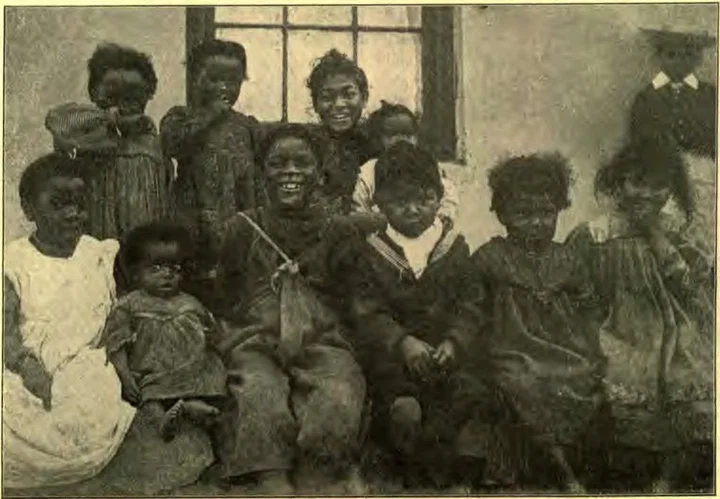
The little English-garbed lad at his left is not so fortunate. He is not purely African. The misfortune of his life is that somewhere in the annals of his ancestry is a strain of white blood, which will curse him as long as he lives. He will go through life despising the blacks and despised by the whites—literally “a man without a country.” The little girl wearing the white “pinafore” is another unmistakable African. Years may sometime weigh upon her; but care, never. The little girl at the right, on the end of the first row, who preserves her embarrassed little self-consciousness with a wee, grimy hand, and her little brother behind her, notable because of Eton collar and irreproachable English clothing, are also of the unfortunate class of nondescripts.
Often children like those shown in the picture live in the homes of the whites, where their mothers are employed as cooks, chambermaids, or general servants. Under such circumstances the care of the younger children of the family seems to fall naturally upon them,—a tax levied to pay for the food they eat, I think. I once boarded for many months in a home where the cook’s little daughter, a tiny girl of five, was made responsible for the well-being of “Master Harold”—the landlady’s four-year-old “darling.”
Now this diminutive Englishman had had breadth of experience sufficient to understand quite clearly that Potsi was his “servant.” He was also fully possessed of the idea of “the right of might.” Therefore, with keen satisfaction he would pommel poor Potsi with his little booted heels, and beat her with his fat little fists, when his breakfast didn’t agree with him, or when he didn’t feel easy in his mind.
The first scene of this kind which I witnessed came near wrecking my standing in the community. I was overwhelmed with a desire to seize that young autocrat, and promptly submerge him to his eyes in the water-tank, and keep him there until he promised to treat poor little Potsi with proper respect. I also thought of making him stand and observe while she ate a pound of “sweets.” The distance between my door and the scene of the one-sided combat was not far, but it was far enough to allow me time to reflect. I decided it would be more politic, and, moreover, more peaceful, simply to carry out my good designs toward Potsi, and leave the boy to the fate that always overtakes bad children.
Potsi smiled brightly as I strolled up, and winked bravely to keep back the tears of pain; for she was thin, and he was thick, and every blow of his chubby foot counted. I held out my hand invitingly; and she, trembling little mortal, put her own tiny black one in it. My fingers closed firmly over the wee digits, and I started off, leaving the young “master” sitting flat upon the ground, speechless with amazement. I led Potsi across the yard, and into my room, and entertained her royally. Her satisfaction was somewhat marred by her anxiety for the young master. Presently he sulked across the wide veranda, and gave the door a vicious little kick. I stepped to the door, and told him that while it would be very pleasant to have a nice little boy come in and have a good time with us, we could not think of admitting a little boy who kicked little girls.
“I on’y ticked Potsi,” he said, with a surprised stare; but I calmly shut the door, and proceeded to show Potsi more pictures.
“Massa Harold, he so little boy, missus,—he good boy, but so little,” said this tiny martyr in ebony, looking sadly out of the window, where a little red-coated figure strolled over the lawn in dreary solitude. The effect was highly satisfactoryp. 2 . Indeed, Master Harold developed such a degree of humility as might have caused me some remorse, had I not had reason to believe his wonderful revolution of demeanor was timed to fit the occasions when he was sure of being under observation.
Dear little Potsi! If she could only have known that somebody cared! But it is supposed to spoil servants to show much appreciation. Her mistress once told me that Potsi could “manage” Master Harold a good deal better than she could.
Sometimes on holidays—and they are legion—my friend and I would go “awheel” far back from the towns. In this way we had opportunity to get at least a glimpse of real native life. Once, on such an expedition, away up in the hill-country, close to the Basutoland border, we had an amusing experience. We were riding leisurely along, enjoying the cool morning air, and following the footpath, beaten hard by generations of barefooted natives in their wanderings, when by a sudden turn we came full upon an extensive kraal (or group of native huts). The huts were built on the rounded top of a hill,—little round huts with high-peaked, thatch roofs,—and so placed that they formed a circle. A high palisade of pointed poles fenced the whole.
Not a sound of life did we hear, and we concluded it was a deserted kraal, and were indulging in fanciful “wonderings” of the life and fate of the one-time villagers. However, we were but fairly past the kraal, and again facing the vacancy of the country ahead, when from behind us there came a queer jargon of sounds, which we were not long in understanding to be native voices. A backward glance revealed a funny sight. Down the path we had just traveled came a long line of half-clad little native boys, jabbering excitedly as their fleet feet sped after us. Faster and faster they came, but there was no laughter in their voices,—just the peculiar tone of “dead-earnest” which no mortal can assume on occasion so well as an African.
“What do those children want?” said I.
“Perhaps they want to ride,” said my more discerning friend.
To be sure,—how stupid not to have thought of it,—and I hastily dismounted, and faced about, extending a hand invitingly.
Did you ever watch the interesting process of “shunting” in a switch-yard? The engine puffs and pants aggressively, and starts down the line with a determined air, indicative of its being quite useless to dissuade it from heading straight for “Land’s End.” Suddenly it seems to reconsider, and starts back after something it appears to have left behind. Then you remember what happens to the poor freight-cars in its wake,—how they creak and groan and double up,—that is like unto what happened to that earnestly pursuing line of little black boys.
As soon as they could pick themselves up from their involuntary “down-sitting” (a term well known in the vernacular of the country), they headed for the kraal at a greater speed than they left it. My astonishment at this unexpected “turn.”—I use the word advisedly,—soon gave place to a spirit of mischief, and I sprang on the wheel, and started after them. But the wild whoops of terror that this action evoked would have drawn pity from a harder heart than mine; so I desisted, and sat down on a deserted ant-heap, and laughed till I cried. All along the top of the palisade on the hill could be seen the little woolly heads, whose rolling eyeballs looked down upon us from that safe retreat, evidently congratulating themselves upon a marvelous escape. I believe those children, who had probably never seen a vehicle on wheels, much less a bicycle, were fully persuaded that two great snakes had us in thrall, and were making off with us, and had promptly planned a chivalrous rescue, but had reckoned unequally with the terrors of actual encounter.
I can not remember ever seeing a native child play with a doll, or any substitute for that dear delight of civilized childhood. I think the superabundance of real babies rather more than satisfies them on that point. The babies are bound upon the backs of the older children by the folds of some sort of cloth, and from morning till night the poor little nurse must bear this wee mortal about, and be thereby hampered in the full delights of “leap-frog” and “shinney”—games not answering to those names, to be sure, but “what’s in a name”?
But the baby, too, has sorrows of his own. It is not altogether bliss to be fastened on some one’s back so tightly you can not wriggle, and have your head left unsupported so that it bobs about like the tassel on a schoolboy’s cap. But he takes his lot philosophically, and seldom cries.
In a pretty town around on the Indian coast, I once boarded with a family where the cook of the household was a woman who came in every morning from the “location” (the Kafir village outside every English town), and returned to her hut at night. She had two children,—a child of five and a baby of a few months. The baby was deposited unceremoniously in a box of old rags in the wood-shed, with the little sister to “mind” it until after the breakfast work was cleared away. Then the mother, who had had no time to attend to baby’s toilet before leaving home, would take it to the back-yard, where a “tap” connected with the city water-works was attached to a post under a peach-tree; below the tap a little hollow had been washed out in the sandy soil by the dripping water. The one garment of the little mortal was plucked off, and it was set down in the accommodating puddle without any ceremony, while its mother stolidly turned on the water, full force; there followed a shower bath of many virtues, if not all modern conveniences.
When her judgment dictated, she would turn off the water, pick up the child, and sit down with the little dripping creature in her lap, and wipe it dry with the capacious folds of her kitchen apron. A dish of “mealy-meal” (corn-meal) was then administered, and the “tending” of that youngster was over for that day.
But those whose work and experience lie only in the Colonies know little of the life of real natives. Now that we have a mission of our own right in the heart of Africa, we may hope to be told of the life and habits of natives who have never come in contact with the “civilization” of the towns of the foreigners,—a relation more detrimental than helpful it often proves.
But there are other “children of Africa,”—sweet little blossoms of humanity, little transplanted English flowers. At 8:30 in the morning—the world-wide school-time—the streets are full of them, as they go merrily to school, swinging the inevitable school-bag, and chattering gaily. The garbing of the little English school-girl would be quite incomplete without the dainty white “pinafore,” renewed each morning with scrupulous care by a thoughtful mother, while the little boys are prominent in the points of virtue covered by spotless Eton collars and shining “boots” (shoes). Those Eton collars!—they change not in cut or texture summer or winter. I think it must be the boys’ fathers favor them, remembering their own school-days, or perhaps some tradition handed down from the famous old English school of that name makes them particularly desirable for schoolboys’ wear.
“My mother says if Johnnie comes to school without his collar, you’re to please send him right home after it,” was the message a small maid delivered one sweltering January morning,—the “dog-days” of Africa,—and she smoothed her own very correct little flounces, stiff and uncomfortable with an abundance of starch, with the air of one who knows what is due the interests of “good form,” and will do her duty at any cost.
Johnnie, sensible youth, did come without his collar. Maternal edicts are not to be despised, and therefore it happened that he was soon wending his way homeward to don the offending article; but before I sent him, I managed to let him know by certain clandestine little “pats” where my sympathies in the matter lay.
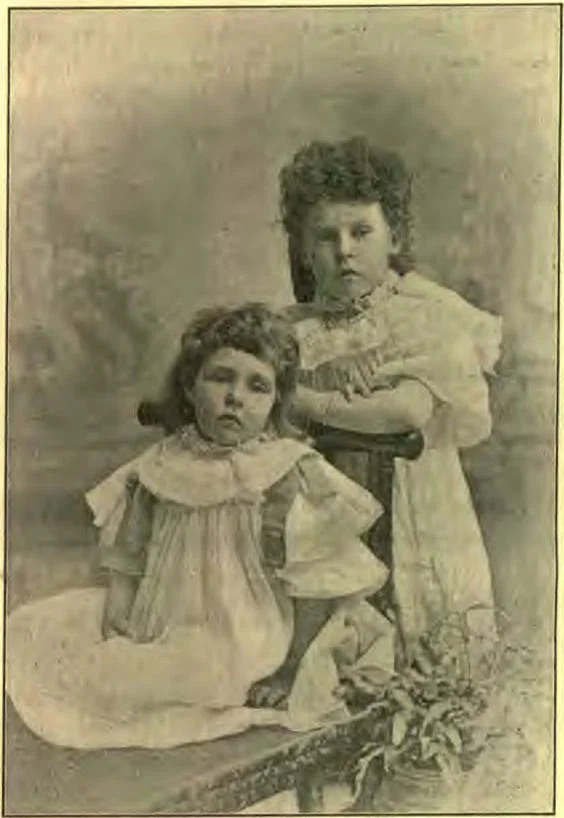
In the accompanying picture are shown two little English schoolgirls, whom it was my happy privilege to know very intimately. Blessed little blossoms! Although thousands of miles of land and water lie between, the distance can never be wide enough to blot from my memory their sweet faces and gentle ways. They are children of a home of culture and refinement, a home so filled with courtesy and kindness that there is no room left for things that are unlovely.
Then there are the little Dutch (Boer) children, usually round of form, and flaxen-haired, with tranquil eyes the color of an old-fashioned sky-blue tea-cup. Occasionally, however, one will find a little Boer child who is a descendant of the long-ago Holland and French refugees, and then there is spark and flash in his black eyes.
Nor must we forget the little Malays, with their bead-bright eyes,—the girls with their long braids of shining black hair, which are always glistening and odoriferous with an abundance of coco-oil hair dressing; and the boys with the little red-felt caps, shaped like an inverted cake-pan, which fit down tightly over their close-cropped little heads. A tiny black stem an inch long stands up importantly from the center of the crown. What it is for I can not tell, but it is always there. Possibly it was originally intended as a sort of “handle.” Sometimes, on the caps of the boys of the richer families a pretentious black silk tassel takes the place of the stem. Little Mohammedans they are, who know the name of Jesus only as a street-word.
The games of the children of Africa sound very strange by name to a foreigner, but he soon finds that they are the same dear old games of the home-land under an unfamiliar title. Except about the Cape there are few “woods” in which to ramble when the sweet spring-time comes (in November), but it is amazing to see what beauties a bevy of school-children out for a walk will find on what looks to be only a dull, barren veld. They are remarkably quick of perception, and appreciate form and color instinctively.
One gray morning in July, I thought, as I walked to school, “If I were in America, I should say it would snow to-day.” Then I smiled at the fancy; for had not the old man at the corner store assured me that it had been “twenty year” since a notable day when they had had a mere flurry of snow—the only one ever known! But the frozen ground clinked under a footfall, and a tiny icicle hung from every water-tap. Be it remembered that there are no arrangements made for heating living-rooms or public buildings in South Africa. If a cold spell comes, you must just “stand it” till it warms up.
Only about twenty brave but shivering little mortals, very much bundled and gloved, came to school, and I suggested that these wraps be retained. During the first recitation a dear little fellow at the end of the class next the window suddenly dropped that interesting tome, “The Royal Reader,” to the floor with a bang, and ejaculated, “It’s rainin’ flour.” Such a stampede! It had been years since I had seen snow, so I was almost as excited as the children. I forthwith proclaimed a holiday, and turned them all loose in the playground. Faster and faster fell the snow, and the ground was speedily covered.
Does anybody deny that young ducks need no instructor in the art of swimming? Let me affirm that children know instinctively how to make ap. 3 snow man. They began him after the most approved method—rolling a ball of snow until it assumed proportions suitable, and then patting and smoothing it into shape. He was then clothed in garments appropriate to the season, and the shrieks of delight that went up as the merry little people danced around him were good to hear.
For twenty-four hours he stood in rigid dignity, but gradually succumbed to the climate as the “cold spell” passed.
Blessed little people of Africa! I love you.