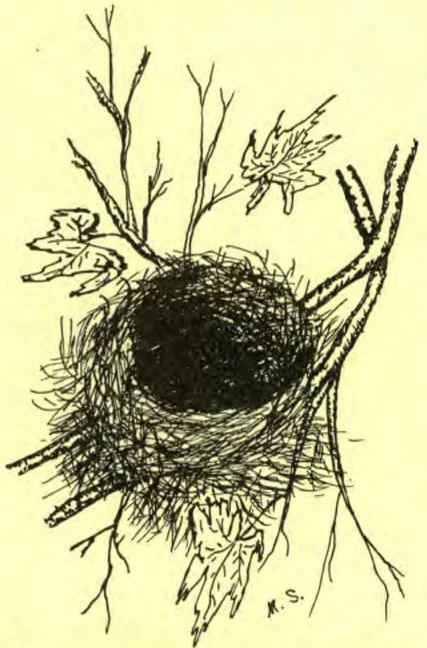
After a summer of hard service, most of the dwellings of Birdtown had arrived at a state where repairs must be made if they continued to be inhabited, although the majority of the owners held the opinion that it is always better to build a new house than to repair an old one. The young birds proudly dressed their lately grown plumage, and practised their newly acquired accomplishments of flying and chirping, holding themselves in readiness for whatever might come next, without troubling over the condition of the dwellings; but as summer was nearly over in Birdtown, the state of affairs made it very necessary that all its inhabitants make their plans for the winter.
“AFTER A SUMMER OF HARD SERVICE.”
One night a chilling wind blew from the north, making all Birdtown feel the change from summer mildness. Next morning as the birds warmed themselves in the sunshine, most of them decided to escape the coming cold. They knew a land never reached by nipping winds, where trees were green and flowers bright in winter as well as summer. It was within flying distance, too, and the birds made up their minds that, when the weather began to grow too cold to be agreeable, they would abandon their summer homes, and take a few days’ journey south, to remain for the winter.
The Thrushes and Warblers, who lived in strict seclusion in a retired portion of Birdtown, were among the first to leave, in company with their less aristocratic if more showy neighbors, the Orioles, Bluebirds, and Finches. Being delicate little creatures, they shrank from the least suggestion of cold, and to avoid it, flew away as soon as their summer work was done, and in a few days were enjoying themselves, each in the summer resort most popular with his family.
The Jays seemed loth to leave their native clime at all, and many of them stayed all winter long, screaming from the tops of the naked trees, as if remonstrating with frost and famine.
Unlike the Jays, the Wrens said nothing of their intentions in the matter, nor expressed their views upon it. Swift and silent as the winter wind, these cautious little fellows came and went as they saw fit, without taking all Birdtown into their confidence. All at once they disappeared, and if they were glad or sorry to go, no one ever knew. And it was the same way when they returned in the spring. In this respect they set a good example for some people I know, who are always telling their plans, and airing their opinions. Indeed, the Wren’s motto, “Act, not talk,” is a good one for many a community besides Birdtown.
Robin Redbreast did not enjoy travel. Like many persons of real worth, he loved home better than any other place, and at first seemed determined to remain there in spite of winter’s cold, cheerful and happy as ever while he lingered. To be sure, he knew that most of Birdtown’s population had sought their southern homes, and to be strictly in fashion, he should follow suit; but Robin does not care a chirp for fashion, unless one that suits his tastes and inclinations. In this he differs from many human beings who would grow indignant at the mere suggestion of a comparison between them and Robin Redbreast in the qualities of common sense and personal independence.
But finally every unsheltered insect had perished from cold, and the snow covered the seeds and berries with a thick blanket. With untiring energy, Robin found it hard to pick up a square meal, while the snow chilled his feet, and hampered his movements; so hunger, doing what mere cold could not, forced Robin also into southern exile for a time.
More than any of the others, the Blackbirds seemed to enjoy the prospect of a southern trip, and made great preparations for it. As soon as summer duties were over, they gathered their children together, and went to meet their kindred in cornfield and meadow. Here they assembled till the ground and fences were black with them, all chattering and calling to one another in great excitement. And when at last their preparations were complete, away they went, in great, merry, social, family parties, bent on having a good time, and enjoying every foot of the journey as well as the delights succeeding it.
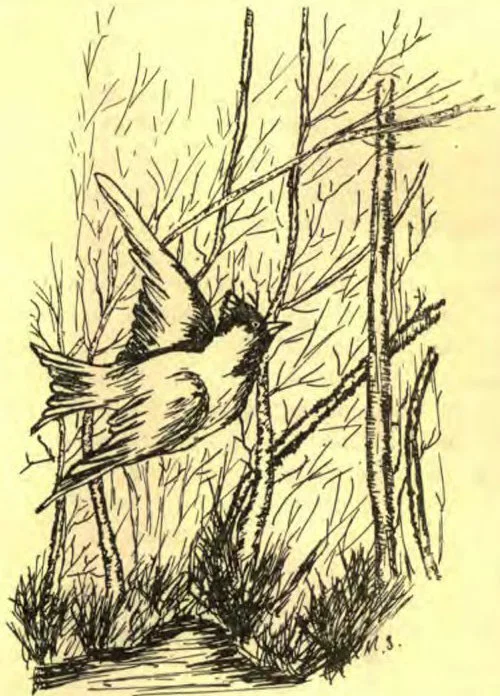
IN THE MARSHY PLACES A REDBIRD DARTING
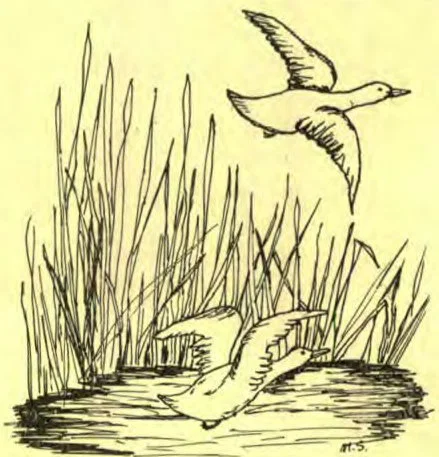
The Ducks and Wild Geese, who lived on the lake-shore in Birdtown, getting their living from the lake, loved the cold, and were dressed to endure it. Their thick down cloaks and hoods were all they needed for protection in the severest weather. But as the season advanced, ice began to show on the surface of the lake in the mornings. At first it was so thin it caused no trouble, but day by day it grew more and more substantial until at last one November morning, there was so firm a crust all over the water that no flapping of wings nor strokes from yellow bills could break it through; so, in order to find a breakfast, the Wild Geese and Ducks were obliged to fly away to warmer regions, where streams and lakes were still unfrozen. In small groups they set out, though half reluctantly it appeared, and as they winged their way across the sky, they kept up a dismal “Konk! konk! konk!” “Quack! quack! quack!” as much as to say, “We shall come back! we shall come back!”
And sure enough, whenever the weather grows warm in winter, so that the ice thaws in the northerly watercourses, the Wild Geese and Ducks fly back toward their homes; and when it turns cold again, they return to the south while it lasts. Consequently we in Missouri are in the habit of saying, whenever the waterfowl are flying, “It will be warm to-morrow; for the geese are flying north;” or, “It will be cold; for ducks are going south,” as the case may be.
And as the fashion of going south in the autumn prevails with most of the Birds, when mid-winter arrives, the number of feathered folk remaining with us is small. A few English Sparrows and Chickadees pick up seeds and crumbs around house and barn; a few sky visitors from still more northern climes flit through the evergreens now and then; a lonely crow sometimes happens along for a few days, alighting on the stubble or in the feed lot; while in the marshy places, on gray, dreary days, one can occasionally catch a glimpse of a Redbird darting among the bare twigs, like a bit of fire bright enough to warm even the chilly landscape.
But for the most part the birds are absent until the approach of spring brings them flocking back. We always look for them with perfect confidence. We know they are as certain to return as the spring itself, while some of them even come a little in advance of it. They never disappoint us, nor make a mistake in calculating the proper time to repopulate Birdtown, but come and go year after year, with unvarying regularity, following their universal fashion of spending their summers in the north and their winters in the south.
When next you happen in a community inclined to boast of its travels; when you hear any one talk of “my northern summers” and “southern winters;” where, as often occurs, traveling is made a popular fad, as if, as in most earthly fashions, its mission were only to answer the whims of vanity and pleasure,—then remember the birds as they come and go, spring and fall, and know that such travel originated in no human caprice, as a measure for frivolous enjoyment, but, founded on the motives of comfort and necessity, is a fashion set by God himself in the minds of the little birds.