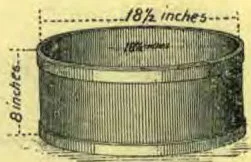
LET us answer the question at once. The United States standard must contain 2150.42 cubic inches. This is its exact shape (see lower illustration), drawn to the scale of one-eighth. The measures given are, of course, inside measures, and capacity is accurate down to the size of a peppermint. Or, if you prefer a basket, let it be of this shape and these dimensions, which will be a trifle large, to the extent, perhaps, of a piece of lump sugar; but we will throw that in.
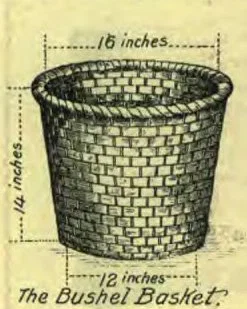
The cut first given, the United States standard, is known as the Winchester bushel, and dates away back to Anglo-Saxon times. Winchester, within seventy miles of London, was not only the place for the crowning of English kings, but also for the crowding of English traders, and wise King Henry the Seventh quieted their market clamor, and laid down the law that the standard for corn, wheat, etc., should be the Winchester bushel of 2150.42 cubic inches. According to Dr. Brooks, this original bushel is still preserved in the Winchester museum, along with the same king’s original yard. The English colonists naturally used the measures of the mother country, the Winchester with the rest; so that when we became independent, it still prevailed with us.
In 1826 Great Britain changed her standards, and took a larger measure (2218.192 cubic inches), which she called the imperial bushel. We did not follow her, and thereby doubtless added mightily to the confusion, especially where we encountered her in the custom-houses. On the contrary, in 1830, our government reaffirmed its choice of the Winchester bushel and all the rest, and by way of soothing the feelings of the distracted officials, Uncle Sam sent to all the State governors, and to the custom-houses, beautiful complete sets of the standard weights and measures as then adopted. In 1881 he was even more generous; for he supplied them to all the State agricultural colleges that had grants of land, at a cost of two hundred dollars a set. That may seem a large price to pay for a lot of yardsticks and market and grocers’ measures, but the committee did not think so; for they claimed to have done the best they could “under the limitation of cost imposed.”
But standards can not always secure immediate uniformity. There is still diversity in this great country of ours as to bushels. For example, the good sixty bushels of potatoes which a farmer might send from Pennsylvania over into Ohio would count for only fifty-six bushels there. In 1878, according to a report sent to Congress, the bushel had one hundred and thirty different sizes in this country, and none of them were the same as the bushel of England, our largest trader. Vermont has a law, which was in force as late as 1896, at least, “that one bushel and three quarters of a peck shall be deemed a bushel.”
Taking the bushel as a type of capacity measures, another unit comes into question. What is the size of a gallon? The United States has its own very definite notions here, too, and says that a gallon shall contain just two hundred and thirty-one cubic inches. Now we see why we have two sorts of quarts and two sorts of pints. A quart of beans or peas or of any other “dry” thing is, or should be, the 1-32 of a bushel—some 67.2 cubic inches; but a quart of milk or kerosene or any other liquid, agreeable or otherwise, should be one quarter of a gallon, or 57.75 cubic inches,—not quite so large, you see.
The government has now two highly exact systems of weights and measures, and runs them side by side. For it has not only supplied itself and all the States with complete sets of the English, or “customary,” standards; but also, as we have seen, it has taken immeasurable pains to secure for itself and for its immense family, sets of the French, or “metric,” system, all of them instruments of precision as fine and accurate as it is possible for modern wisdom and skill to construct. Furthermore, it publishes for the use of its officers in custom-houses, the navy, the army, the post-office, and all other places where measurement is needed, tables giving the equivalents of each system in terms of the other, so that kilograms can be put into pounds, or liters into bushels, etc., at a glance.
Let the boys and girls take heart; for the good time is coming when there will be no need to burden the wits with pounds, ounces, scruples, troy, avoirdupois, furlongs, quarts, bushels, and all the rest of it; but the metric system will make everything easy, and will save the time and nerves of all of us for something better.—Prof. Albert B. Carner, in Well Spring.