Mr. Fulton and myself, with our little son George, recently took a trip to the famous island of Bau. Although one of the smallest of the group, Bau is the most historic island of Fiji. More people have been killed and eaten on it than on all the other islands of the group combined. The Wesleyans have had a mission there for many years, and a white missionary resides there permanently.
Bau is also the home of the high native chiefs. Ratu Able, of Bau, the greatest chief in Fiji, died last February; and according to Fiji custom, a great feast was held in Bau this month of May in honor of his death. As many natives expected to be present from all the surrounding islands, Mr. Fulton thought it would be an excellent opportunity to distribute tracts and papers among them.
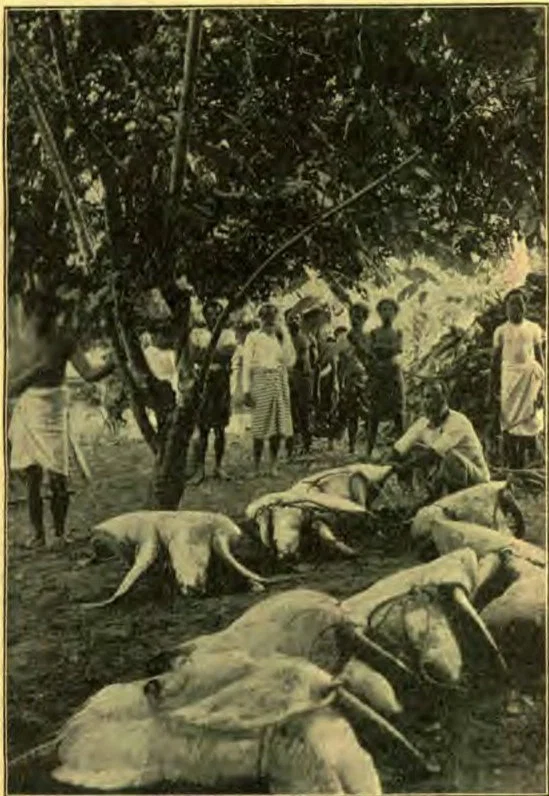
TURTLES FOR THE FEAST
Ratu Ambrose, a high chief, and his wife, who is also of royal birth, and who are now earnest Sabbath-keepers, went to Bau with us. We went up the Rewa River in a little steamer, having our own small boat in tow. The first stop was made at Nukulau, a small island used as a quarantine station. Here we found eight hundred Indians, who had just arrived in a large ship from India, and were awaiting inspection. They were a dirty but happy-looking crowd; and judging from appearances, their clothes had not been changed since leaving their native land. At Wainibokasi we left the steamer, and walked a mile or more through rice-fields and sugar plantations to the native village of Drobutu. Here we were met by our three natives with the boat. To show their respect for Ratu Ambrose and his wife, several women of the town came down to the river's bank, and gave us five or six vakalolos. These are native puddings made of taro, sugar-cane juice, and cocoanut milk, and baked until they are of the consistency of an English plum pudding, then tied up in large leaves. They are very nice, and will keep for several days.
Leaving the main river, we set sail, reaching Bau just at dark. A large number of canoes, small boats, and cutters lay anchored along or near the beach, whose occupants had come to attend the feast. We anchored our boat near the house of the “Buli”—a title given to one of the native officers having charge over the different districts into which Fiji is divided. The Buli’s wife came out, gave us a cordial greeting, and urged us to enter her home.
We went into a large room, forty-five feet long, twenty-five feet wide, and thirty feet high in the loftiest part. Three immense doors and four large windows furnished ample ventilation. The entire floor was covered with native mats, many of which were several yards in length and width. In two corners of this room were two elevations about two feet high, ten feet long, and six feet wide, covered with several layers of mats. These are the family beds; but according to Fiji custom, the family usually sleep anywhere but on the beds, which are as a rule reserved for visitors. A table and a chair, used only by the Buli for writing purposes, a large deck chair, several trunks and boxes, some biscuit tins, and other odds and ends useful only to Fijians, completed the furniture. The kitchen was a short distance from the house.
After resting for a few minutes, Ratu Ambrose, who had spent his boyhood in Bau, conducted us to the center of the town, where the feast was in progress. We found most of the food all cooked, much to our disappointment, as we wished to see the cooking process; but we had the satisfaction of seeing it before it was all devoured by the hungry multitude. As the night was dark and cloudy, we could see only by the light of our lantern, and a few other lights scattered here and there among the vast crowd. Hundreds and hundreds of Fijians were sitting cross-legged on the grass, waiting to be served. Great quiet prevailed, except for the occasional low hum of voices. We passed around among the crowd, who looked up at us, wondering where we had come from at that late hour of the night.
The first thing that attracted our attention was the great number of large swine roasted whole. (The entrails had been taken out, cleaned, and replaced in the carcasses before roasting.) There were immense baskets containing hundreds of baked taro and yams. Two of these baskets were specially large, each containing one thousand yams. Upon measuring one of them, we found it to be six feet high and thirty feet in circumference. As I am rather short in stature, Mr. Fulton had to lift me up so I could look into the basket. The yams used at a feast are usually quite large, measuring from one to four feet in length, and from five to twelve inches in diameter. There were vakalolos by the dozen; and scores of huge turtles lay on their hard backs, waiting to be devoured. Immense bundles of yangona root were lying about, which were to be chewed by the young men, then placed in a bowl, and mixed with water for the favorite native beverage, commonly known in the South Seas as “kava.”
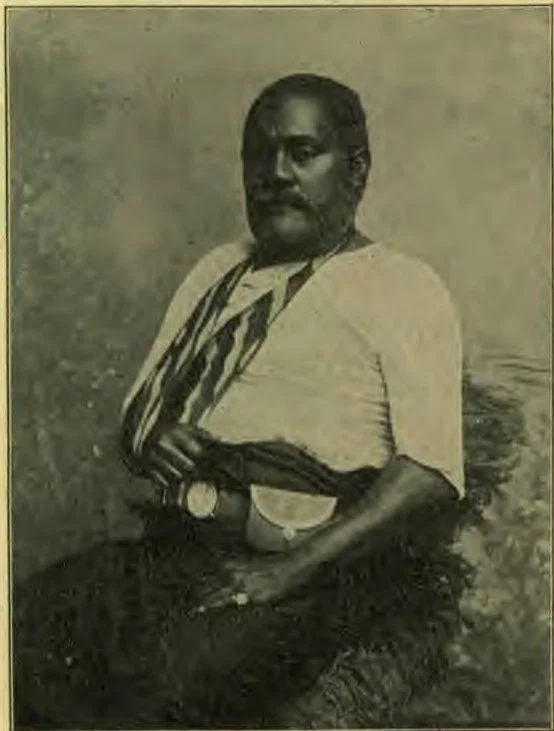
RATU TANOA — KAKEBAU'S FATHER
There were preaching services that evening in the large native church near by, at which a newly arrived minister from Australia was to speak. Those interested in spiritual things repaired thither, when the lali (a hollow log) was beaten; and the building, which is about forty by one hundred feet, was filled to its utmost capacity, the people sitting, according to Fiji custom, on the floor. The chiefs, however, did not attend, as they were more interested in the feast. The food was at last apportioned, those from different towns receiving a certain amount, which they took and ate by themselves, or else took to their boats and carried home. The eating and drinking continued till late in the night, and as morning dawned, the greater number of the feasters boarded their cutters, boats, and canoes, and sailed for their respective towns.
The next morning the chiefs came to Mr. Fulton, and requested him to preach in the evening. He accepted the invitation, but did not preach in the native church, as the white missionaries have commanded the natives not to allow us to preach in any of their churches. A large building belonging to the natives, and used for business meetings and councils, was obtained, however, and was crowded. All the chiefs were present. The subject presented was “Christ the Light of the World,” to which excellent attention was given. After the meeting, privilege was given to ask questions, and the people responded freely.
The274following day we distributed hundreds of tracts and papers, which were eagerly received.
We slept at the Buli’s house, and the following morning started out to look at the famous historic places of Bau. The first man we met was old Mr. Berrick, an American negro, commonly known as Black Bill. He is eighty-four years old, but does not appear to be over sixty, and jocularly claims to be one of the first white men in Fiji. He has scarcely a white hair in his wool. He told us many interesting things about the history of Bau, having himself been King Kakebau’s advisor in cannibal times.
We saw the famous stone against which the heads of victims were smashed before being roasted. This stone is now kept inside the Wesleyan church. Ratu Ambrose pointed out to us a large, heart-shaped hole, which was formerly used as a vat for dead bodies.
We passed a large, rusty anchor of a ship, leaning against the foundation of an old heathen priest’s temple, which Mr. Berrick told us had belonged to a ship from Manila, that came to Bau years and years ago for a cargo of sea-slugs for the Chinese trade. The crew got into trouble with the natives, who killed and ate all but one man, and brought the anchor to shore as a trophy. In former times, when Rewa (the second town in importance in Fiji) and Bau were at peace, this anchor would be taken to Rewa; but as soon as a quarrel sprang up, the Bau men would go for the anchor, the Rewa people of course refusing to hand it over. Then war would follow, and the victorious party would seize the anchor. Many hundreds of natives thus lost their lives.
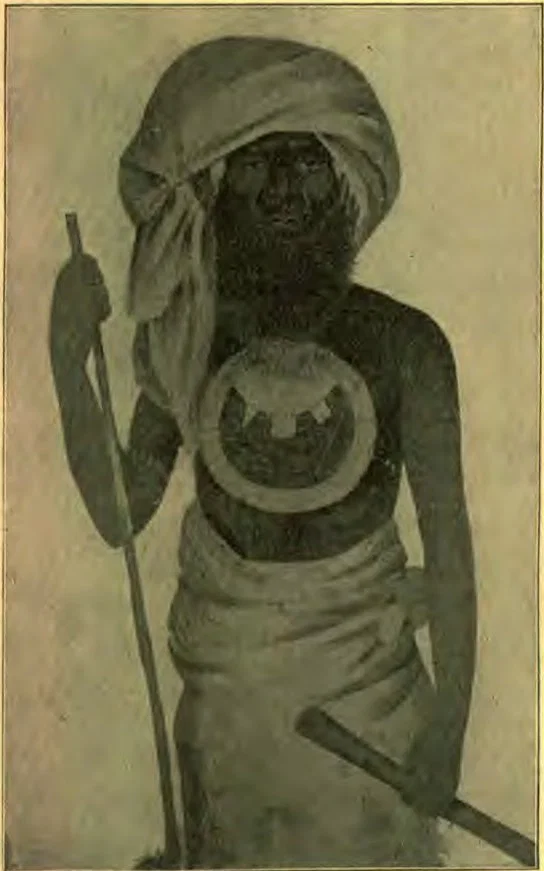
RATU EPEH
We also saw a native oven made, and a huge turtle, five feet long and four feet broad, cleaned and roasted, with a lot of yams, in the oven. These ovens are circular pits in the ground, filled with wood, on top of which stones are heaped. The wood is ignited; and when the rocks are red-hot, the burning wood is removed. Then the rocks are leveled, and native vegetables, such as taro, yams, breadfruit, and sweet potatoes, are thrown upon them, and covered with a thick layer of leaves. The turtle was placed, stomach down, on the leaves, and covered with earth till nothing could be seen but a huge mound of dirt.
It was interesting to watch the turtle being prepared for roasting; for even after he was dead, and his entrails had been removed, he kicked vigorously with his paddles, or legs, when touched. After his intestines had been cleaned, they were broiled on the hot rocks, and rolled up in a ball. These, with all the fat taken from the entrails and also broiled, were taken to the houses of the chiefs and served as a special dainty. The men who were doing the cooking, broiled the liver, and ate it themselves before putting the turtle in to bake. Turtle flesh is a kingly dish in Fiji; none but the chiefs are supposed to eat of it without special permission. A man of low rank can not eat a turtle that he captures, but must first present it to his chief, who disposes of it according to his will. The present government still recognizes this old native law, and fines all transgressors.
Taking leave of our native friends, we left Bau feeling that we had been profited as well as interested by our visit. And we hope that the word spoken and the literature distributed will prove as seed sown in good ground.