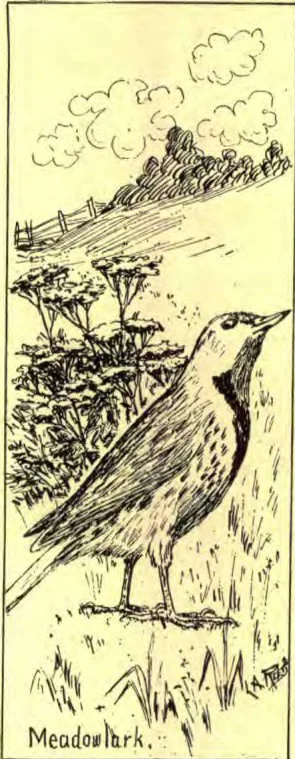
On your strolls, did you ever find the nest of the Meadow-lark? If you did, you have good eyes, and are to be congratulated. It is a difficult thing to discover. It is made on the ground, and is a very cozy, snug little home. It is not an open, cup-like nest, that one can easily glance down into. Instead, it has an arched roof, and a covered walk, so to speak, leading into it. The roof is made by drawing the stems of grasses over, and weaving them together. In this way the nest is well covered from rain and prying eyes; and being hidden in the deep, tall grass, is not easy to discover. If any of you find one this spring, I wish you would write to me or to the editor of the INSTRUCTOR, and tell all about it. But don’t molest the eggs or young, nor scare the old birds.
The Meadow-lark is not a lark at all, but a relative of the blackbird and the crow. The bird lives in meadows and pastures, and walks about on the ground; when he feels especially jubilant, he gets up on the fence or upon a stone or a hummock of earth, and sings for a long time. Some think his notes sound like, “Spring o’ the year! spring o’ the year!”
The Red-winged Blackbird
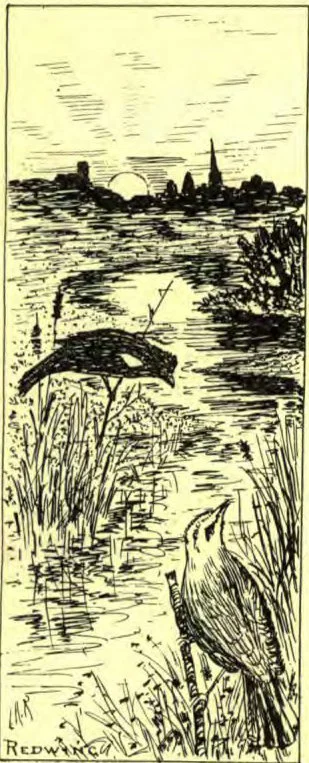
When I first hear the conker-a-kee of the Red-winged Blackbird, I feel certain that spring is here; and when along with it there comes to my ears the peeping of the frogs, and I catch sight of the first spring wild flower, all fears of winter weather vanish; for all these are unmistakable signs.
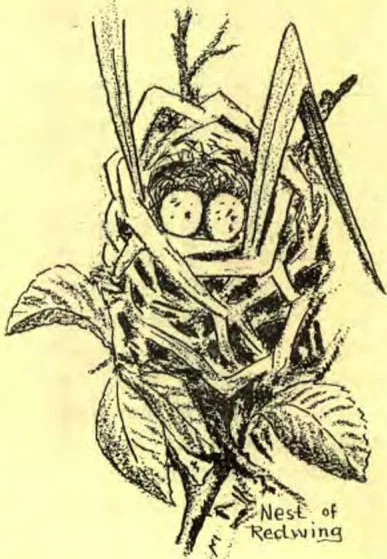
The nest of the Red-wing is a rude affair, as is shown by the picture. It is composed of coarse grasses, weed-stalks, and the like, lined with finer grasses and rootlets, and attached to low bushes or reeds.
Olive Thorne Miller tells some interesting things about a young Red-wing: “The young Red-winged Blackbird is a droll fellow, and has decided notions of his own. Mr. Keyser tells a story of one he picked up. He was put in with some other young birds,—meadow-larks and cat-birds. They were all babies together, and all used to being fed. So when the little Red-wing got something to eat, they would open their mouths, and beg for it, in the pretty bird-baby way. At first he fed them, though he wasn’t much more than a baby himself; but they liked it so well that they coaxed everything away from him. He soon got tired of that, and at last refused to feed them at all.
“This little bird liked to play jokes on the sober young Meadow-larks. His way was to seize one by the wing or tail, and dance around the floor, dragging his victim after him. The young larks scolded and held back, and at last they learned to stop his pranks. They did it by throwing themselves over on their backs, and holding up their claws ready to fight.”
“In spite of this naughty fun, the young blackbird was really fond of them. The larks slept on the ground, and at night, when the little fellows settled down on the floor, the Red-wing would often leave his perch, and cuddle down by them. This must have been for company only; for it was his way to sleep on a perch.”
The Kingfisher
I suppose you have already met the Kingfisher. He has been fishing along the streams and lakes since about the first week in April. I think you will agree with me that he is rather large and chunky. You have doubtless many times seen him splash into the water after fish. Then he goes back to his perch, and beats the fish to death before he swallows it. He does not stop to chew it,—not he! Perhaps he can’t. Anyway, he swallows the fish whole and head first. He is wise to take it head first; for if he swallowed it tail first, the fins would surely stick in his throat. This bird can take a large fish. A Kingfisher was once shot, and it was seen that the bird had swallowed a fish so large that the tail stuck out of his mouth, and he could not get it down.
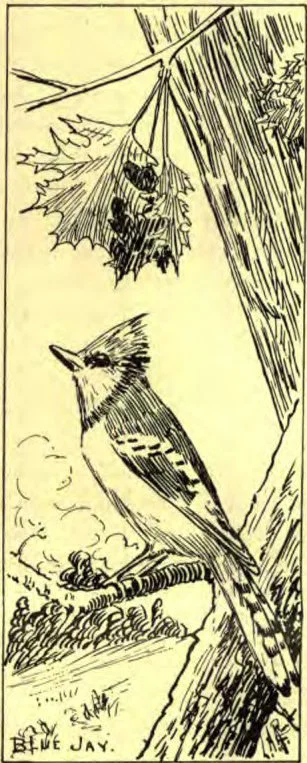
Do not confuse the Blue Jay and the Kingfisher. I have known people to do this. Both birds are blue, and both have crests. But the Kingfisher lives by the water, and catches fish, and makes a queer kind of rattle when he flies. The Blue Jay is here and there through the trees, and is shrieking wherever he goes.
L. A. REED.
The Loafing Song-Sparrow
I SAT on the porch one afternoon, lazily and dreamily watching the busy world of little things in the grass in front of the house. There were plenty of grasshoppers, and the chickens and turkeys, which had been turned out from their yard for a feast, were making havoc with them. After a while the chickens scattered farther off into the meadow, and several little wild birds from the woods came in for their turn at this particular grasshopper patch.
But all my attention was presently taken up with two song-sparrows. I soon found out that the relationship between them was that of father and son. There was no way of telling it at first glance, for they were both full-grown cock-sparrows; but as soon as they settled down to the grasshoppers, the young fellow, instead of going to work and hunting for himself, began to trail around after his daddy, and to beg for grasshoppers. He was fully as large as his father, and could fly just as well, and had the same kind of tools for catching grasshoppers; but the big loafer was too lazy to work, and so he chirped and begged, and every little while the father would take mercy on him, and give him a grasshopper.
In the course of the half-hour or more that I watched them, the father sparrow fed that youngster seventeen grasshoppers by actual count, and the lazy youth did not kill one for himself. The insects were very thick, and he would almost step on them sometimes; but he never saw them, because his eyes were all the time on his father, and his thoughts were taken up with getting a meal through some one else’s work.
As I watched the little drama, I thought to myself that there is a great deal ofp. 170 human nature in a song-sparrow. I have seen boys and girls of just that stripe—young people with health and a good education, able to do fair work at many things, and yet hanging around, loafing on their parents or grandfather, or some uncle or aunt, wanting somebody else to catch the grasshoppers for them.
As I watched that loafing sparrow, I did wish that the father would stop feeding him, and let the young rascal get good and hungry once, so that he would learn to hunt for himself. I have often seen parents who were spoiling their children by not teaching them to rely on themselves. Boys and girls, no matter how good-looking, or how well-educated, or nice-mannered, are, after all, only respectable loafers if they depend on somebody else to do everything for them, and are not ready and willing to do their own work in life.
The old knights, in the days of chivalry, used to send their bright young boys away from home to grow up in some distant castle, among strangers, so that they would become strong and valiant and self-reliant. They feared that if they kept them at home, they would be too easy on them; let them sleep too late in the morning; let up on them concerning the training and hard discipline required to make a strong and brave knight. It is possible that these old knights went to an extreme; but I am sure that, in our day, we go to the other extreme, and that many young folks coming up into manhood and womanhood are first cousins to that loafing song-sparrow, who wanted all his grasshoppers to come to him on the end of his father’s bill.
Hardihood is a great virtue. Real strength of body can never be had without exercise and hard work; power of mind can not be had without study; and a trustworthy moral character, which can face temptation and come off pure and clean, can be won only by self-relying, honest effort. A loafer in this live, vigorous world is a blot on its beauty.—Young People’s Weekly.