THE accompanying diagram presents a comprehensive view of our solar system; that is, of our sun and his attending planets, as they will be related to one another about March first. Bear in mind that all the worlds are revolving about the sun in the same direction, but not all at the same rate of speed.
Those nearer the sun than Earth (Venus and
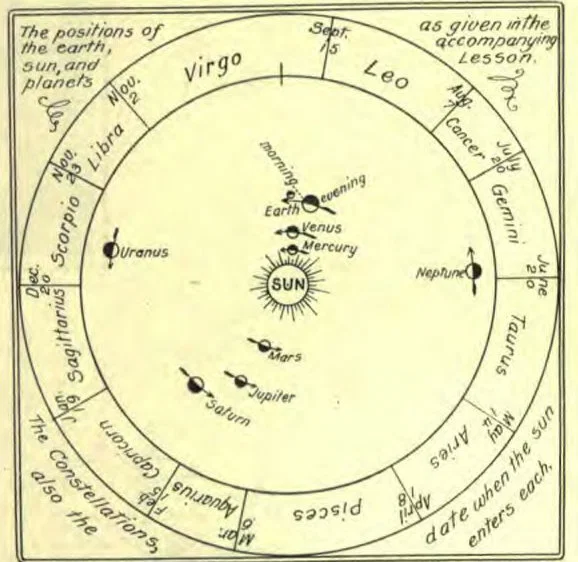
Mercury) not only have less distance to travel to complete their yearly journey around the sun, but they travel in their respective circuits more rapidly than Earth. Consequently their years are correspondingly shorter, according as their paths lie nearer that orb. The worlds whose paths lie beyond the course of Earth travel correspondingly slower in their journey about the sun, as their distance from the sun is greater than ours.
We should become so familiar with these worlds, not only as represented on the chart, but in the heavens themselves, that we shall know just when to expect their visits, where to look for them, be able to recognize them by name when we see them, and tell which way they are traveling, and how long they will stay with us.p. 67
While we can not, with our other duties, promise a study of this kind exactly on time each month, we will try to prepare these diagrams from time to time, so that our class may keep up with the changes constantly going on in the heavens, also to help you obtain some of the rudiments of this, the most beautiful and ennobling of all sciences.
In the early evening, stand facing the south, and so hold the accompanying diagram that if you were really standing on the sphere marked “Earth,” at the point indicated by the dotted line marked “Evening,” the sun in the diagram would be at your right hand, or to the west, which is actually the case.
Now how many of the other planets are you in a position to see? Uranus is certainly out of sight; for the whole earth is between you and him. Mars, Jupiter, and Saturn are all in the far distant west, millions of miles beyond the sun, and so also out of sight. Venus, which twice during the past winter so beautifully bedecked our evening sky, has, in company with Mercury, passed in between us and the sun, and now sinks in the west even before the sun withdraws his shining; so we can not see either of these planets. Neptune alone is above our evening horizon; but unfortunately Neptune, like Uranus, is so far away from our little world that without a good telescope we need not expect to make his acquaintance. Thus we have nothing whatever to see in the planetary line from our evening point of view. But this will not long be the case; for “the world moves,” and so do all the other worlds. Lay the diagram carefully aside until March 15; then get up just before daybreak, and observe the eastern heavens. If you are sharp-eyed, and the weather is clear, you will be rewarded by getting the first glimpse of Venus as she begins her rôle as a morning star. You may also catch a glimpse of Mercury, as he will be at his greatest eastern elevation above the sun, March 16. It will pay you to watch for him, as he is so near the sun that but few have ever obtained a good look at him. He is in too much of a hurry to stay long, and you will have only four or five chances to see him before he leaves.
Venus does not travel so fast, and also gets farther away from the sun, so we can see her plainly. March 20 she will be at her brightest.
In making your morning observations, hold the diagram so that you may imagine yourself standing on the earth at that point marked “Morning,” with the sun to your left, or in the east, and you will see where to look for these worlds of light. If you are acquainted with Saturn, you will see him also, very low down in the eastern sky, just before the sun rises; but he will look much smaller than when we saw him last as an evening star. This is because he is so much farther away than during the summer evenings.
Dr. O. C. Godsmark.