DIVISION I — GEOLOGY

5%

Review and Herald Publishing Company · Battle Creek, Mich. · January 2, 1902

FromThe Youth’s Instructor, Vol. L, No. 1

Read the full edition

DIVISION I — GEOLOGY

Chapter XV — The Animals before the Flood
§160. WERE it not for the fact that the actual remains of immense monsters, such as this world knows no more, are being continually found in nearly all parts of the world, we would naturally discredit the possibility of such creatures ever having existed. When God first made these monsters to inhabit both the land and the sea, they were harmless in their nature, and in perfect subjection to Adam; but when man rebelled against the government of heaven, God allowed Adam’s subjects to rebel against man’s authority.
§161. Only a powerful, gigantic race, like that which lived before the flood, could have withstood the terrible fury of those monsters. It was in mercy to our rapidly degenerating race that the Lord caused these ponderous creatures to become extinct. The animals, as well as man and the vegetable kingdom, have dwindled to a mere nothing in comparison with what they originally were.
§162. At present there are in all Asia but two species of living reptiles over fifteen feet long; in Africa, but one; in all America, but three; and not more than six in the whole world. The length of the largest living reptile of the present time does not exceed twenty-five feet. The elephant and the whale are the two largest living animals now known; while the condor, of the Andes, is the largest bird of flight. And the expanse of this bird’s wings rarely exceeds twelve feet. When we compare these mere pigmies that we see to-day with the animals that lived before the flood, whose remains bear undeniable evidence of their size, species, and habits, as well as to their numbers and location upon the earth, we get some idea how the animal kingdom has degenerated physically under the blight of the curse during the past six thousand years.
§163. In the British Dominion there are found the remains of four or five species of dinosaurs —a gigantic, lizard-like monster, which was from twenty to fifty feet long; and ten or twelve species of the crocodilians, which were from ten to sixty feet long. These were certainly somewhat larger than the crocodiles and lizards of our time.
§164. Whatever Job’s “leviathan” (Job 41) may have been, we are not ready to say; but we do know that there were certainly, at one time, monsters of the deep; for we find their well-preserved remains. The mosasaur, which was a swimming, snake-like reptile some eighty feet in length, was one of these. Its body was covered with overlapping, bony plates; its four paddles had regular finger-bones, like those of the present whale. The remains of fifteen of these reptiles have been found in New Jersey; six or more in the Gulf States; and over twenty in Kansas.
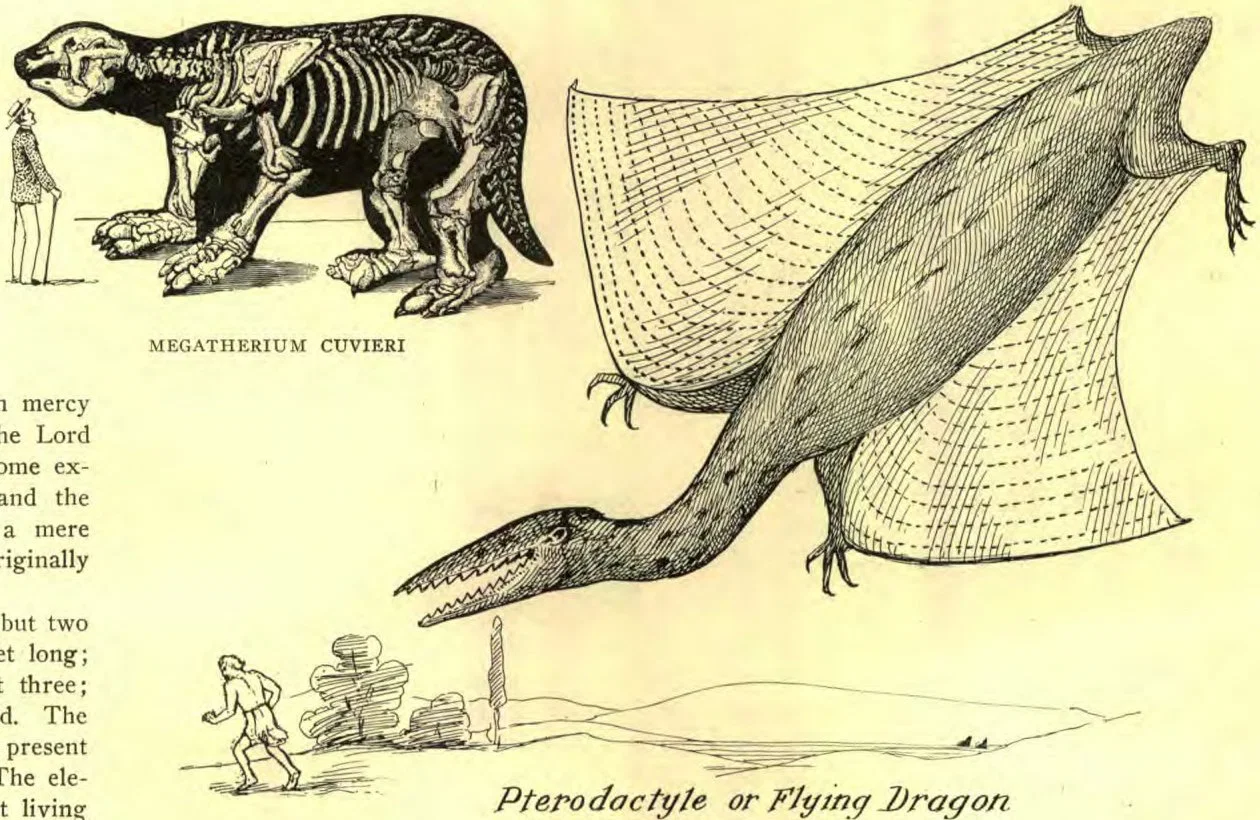
§165. So far as known, the most formidable, though not the largest, creature of those times was the pterodactyl, or flying dragon, of which the remains of more than a dozen specimens have been found. They resemble a gigantic bat, or vampire, with strange, dragon-like wings, extending, in some instances, twenty-seven feet from tip to tip. In most of them, the nose extended like the snout of the crocodile, and the jaws were armed with conical teeth. From the upper angle of their wings projected fingers, terminating with long hooks, forming a powerful claw. Their eyes were of vast size, enabling them to see well at night. They were equally qualified for flying or swimming, and could also walk upon the ground. The fabled legends of armed knights fighting with dragons during medieval times were undoubtedly based upon the finding of the remains of this reptile.
Pterodactyle or Flying Dragon
§166. The turtles of those days were frequently eight and even nine feet in length of shell; and according to Cope had a breadth between the tips of the extended flippers of more than fifteen feet, and in some instances an estimated weight of fully a ton. In Nebraska, where in some places they lay imbedded by the hundreds, they give evidence of having been washed there by the waters of the great deluge.
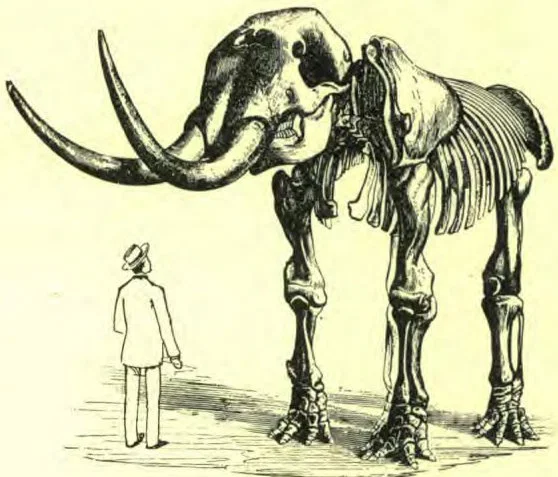
§167. The mastodon was the elephant of the tropics,—not an elephant in the true sense; but very similar, as will be seen from the skeleton that appears in the accompanying illustration. The remains of this animal are found plentifully in North America. A monster of this kind was exhumed near Bellevue, west of Battle Creek, Mich., a few years ago in a fair state of preservation.
§168. In the summer of 1845 the remains of a mastodon were found in a swamp in Newburg, N. Y. Its length was twenty-five feet; height, twelve feet; length of tusks, ten feet. The skeleton was purchased by Dr. J. G. Warren, of Boston, and weighed two thousand pounds. In the place where the stomach lay were several bushels of bruised and chopped twigs and leaves,—the remains of his last meal. These animals wore a heavy coat of dun-brown hair from two to seven inches long.
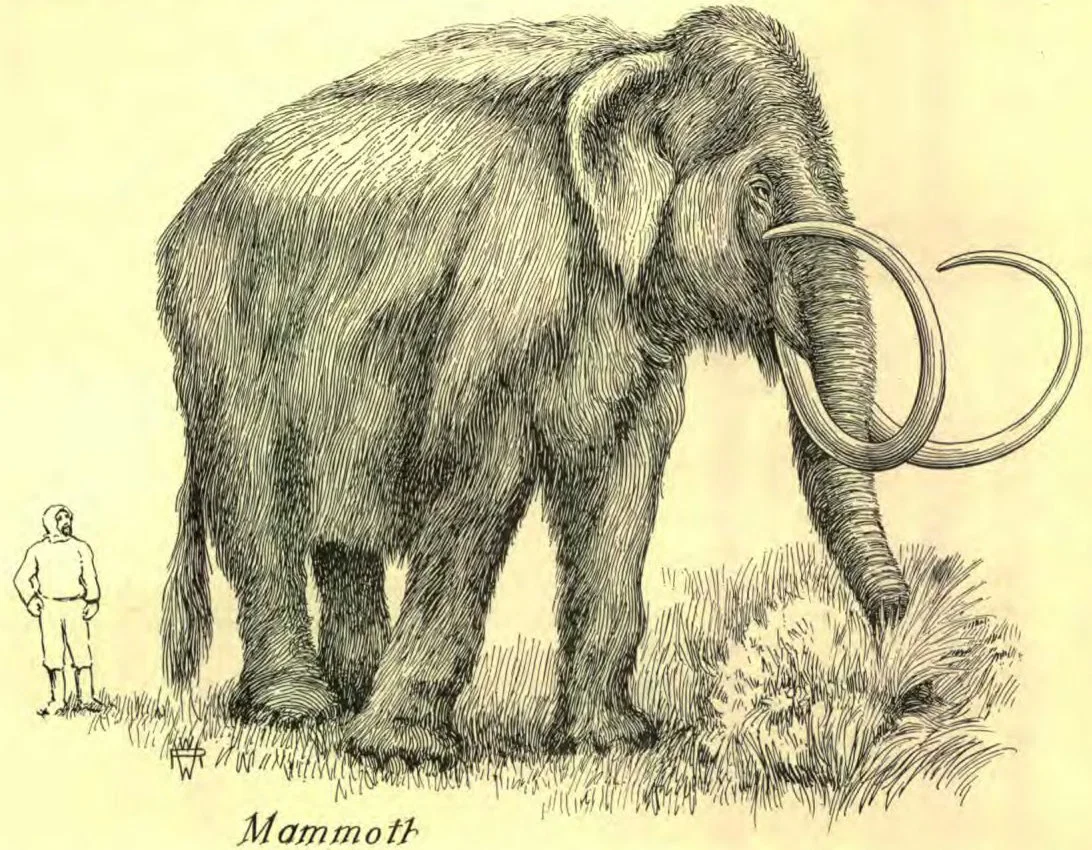
§169. The mammoth was the largest of the land animals, and inhabited the polar regions, living upon the dense foliage of spruce and cedar trees that then grew there in abundance. It is estimated to have been about five times the weight of the modern elephant. These animals roamed in vast herds where the British Isles are now located. In proof of this we have but to state that between the years 1820 and 1833 the fishermen in the neighborhood of Norfolk brought ashore no fewer than two thousand grinder teeth of the mammoth, besides great tusks and numerous portions of skeletons.
The cliffs of frozen earth that line the arctic coasts of Siberia contain such vast amounts of the remains of extinct animals that when the ground is upturned, it exhales a strong, disagreeable odor, like that of a well-filled graveyard. Captain Kellet also says that at Eschscholtz Bay the fossil bones of animals are so abundant that huge tusks and horns not unfrequently project through the soil. He brought from that locality the remains of the mammoth, horse, moose-deer, reindeer, bison, musk-ox, and others. In northern Siberia, where the ground remains frozen the year round, entire carcasses of the mammoth are frequently found in a high state of preservation. In 1799 one was found near the River Lena, being but partially exposed to view. In 1803 the ice had so melted that the enormous carcass became entirely disengaged, and fell down upon a sand-bank below. The tusks weighed three hundred and sixty pounds. The body was covered with long, wiry hair, intermatted with a thick body of reddish wool. The pupils of the eyes were plainly distinguishable, and the flesh was so perfectly preserved that the people in that vicinity carried away immense quantities, and fed it to their dogs. The skeleton was taken to St. Petersburg. So numerous were these animals, that in Siberia the collection and sale of their tusks constituted a regular business.
Mammoth
Mammoth
These animals, though so great, were little less to be feared by the powerful human race that lived as their contemporaries, than are the venomous insects and reptiles, and the fierce denizens of the jungles and forests, of to-day.

QUESTIONS

Before man’s rebellion, what spirit pervaded the animal creation? What change took place in the animals at the time of the fall? What lesson should the race learn from this? Why did the Lord cause these powerful animals to become extinct? Why were their remains so fully preserved? What besides man has deteriorated in size? Measure upon the school-yard the dimensions of some of these extinct beasts and reptiles, and compare them with those of the present. Does this look like a fulfilling of that much-vaunted law of infidel science known as the “survival of the fittest”?
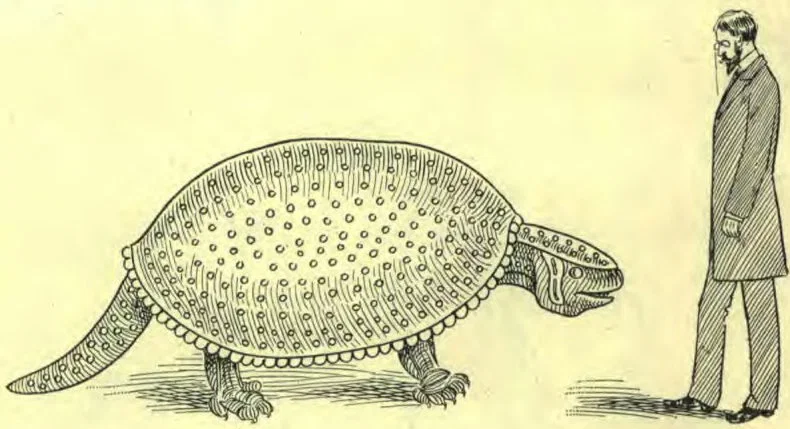
Glyptodon Clavipes
Glyptodon Clavipes
DR. O. C. GODSMARK.
MASTODON AMERICANUS
MASTODON AMERICANUS