The African Boy

6%

Review and Herald Publishing Company · Battle Creek, Mich. · July 3, 1902

FromThe Youth’s Instructor, Vol. L, No. 27

Read the full edition

The African Boy

EVERY boy has in him the making of a man,—the African boy as well as his brother in other lands. In common usage, the full-grown African who works in the colonies, or serves on plantations or as a carrier in the interior, is called a “boy.” I am speaking, however, of the genuine African boy.
The man is very often spoiled in the making. This is true of every land. The fact is, though, that the African boy, bright-eyed, clear-faced, has small chance of learning much that might be helpful to him in getting ready for a useful life. His readiness to be taught—whether for good or for ill—is the thing that appeals to our hearts.
We shall be able to get better acquainted with the African boy in the next few years. Seven or eight years ago we became acquainted with two or three through the reports of our missionaries on the Gold Coast. Then sickness drove the workers away, and in the meantime our boy friends must have grown tall and strong; and all these years we have heard them appealing to be taught. One has now made his way to England, where he is studying. I hope when he is done with school, he will remember the needs of his home land, and be ready to help in the work. We surely must soon have a mission in West Africa again.
Later we learned of the Matabele boy. A few weeks ago our missionary journal printed a letter from one of these boys, “Jim,” now a teacher himself, telling of his gladness at the good things he had learned in the mission school from the word of God. That text, “God so loved the world,” he said, was a sweet message to him, and he appealed to us to send more teachers to carry the same word to the millions who do not know that there is a God who loves people. At eighteen or twenty these boys expect to be out teaching others the way of truth. They may be ignorant of many things, but when they know that Jesus Christ is a Saviour from sin,—their Saviour,—they have a message to bear that angels would rejoice to carry.
Now we shall learn of the Nyassaland people, through the mission just being opened. I have seen letters written by one or two of these Nyassa young men,—written in fairly good English, too. Already keeping the Sabbath, a number of young people are waiting for a thorough training in Bible truth, when they can go among the tribes as heralds of the coming Christ.
The knowledge of English brings temptations to these boys. Brother Booth told me that one young convert who was receiving about twelve dollars a month as a worker in the mission was offered fifty dollars a month by an official if he would work for the government as an interpreter. The offer made quite a stir in the mission circle.
It was wisely left for the people themselves to decide—whether the higher salary would justify accepting a position apart from God’s work, and one in which the Sabbath could not be kept.
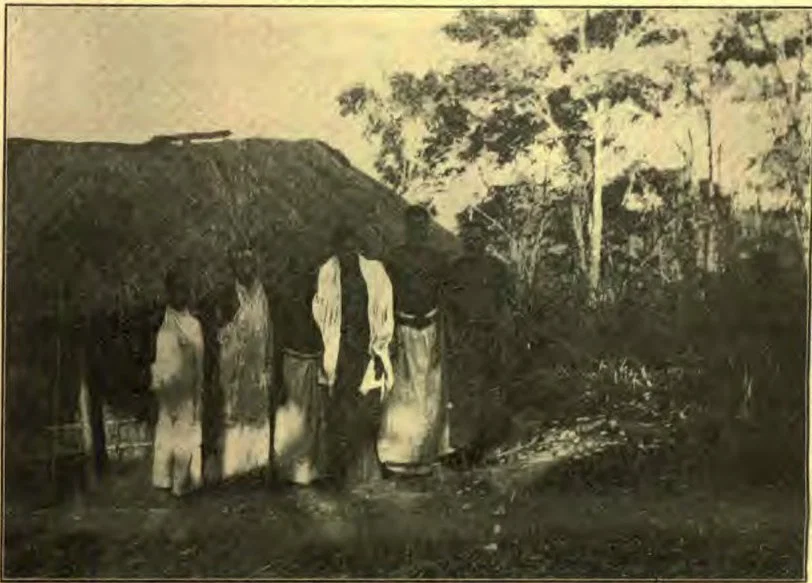
SIX OF TWELVE BROTHERS, SONS OF A CHIEF — NYASSALAND.
As these believers went over the problem, they decided that their baptism signified that they were ready to give their lives as Jesus did, if necessary, to be true and loyal to God. They had decided that twelve dollars was sufficient for an African teacher in Nyassaland to live upon. They therefore sent word to the official that they did not worship money, and that money could not buy their service from the missionary cause.
This temptation will meet the African youth continually, as European influences increase. It is so in all mission fields. Our own young people at home must every one be prepared to choose God’s call to service, as soldiers ready to endure hardness, as against the world’s offer of the higher salary and the apparently easier way. We are to teach people to be ready to forsake everything for the truth’s sake; and how can we so teach, unless our all is surrendered?
But a true heart beats in many a breast in Africa. The year 1886 is not so far in the past. There were sad and yet triumphal scenes enacted in the land just above the Nyassa country in that year. The king of Uganda, who, with some of his people, had favored Christianity, had just died. His son, M’tesa, tried to root out the truth from his kingdom. Many were slain for their faith, and many turned back to heathenism when danger appeared. Among those put to death were a number of young boys who had been associated with Mackay, the Scottish missionary, learning to read the Bible in their own tongue, and catching, also, the spirit of the martyrs of old. Refusing to give up their faith, they were tied to posts above piles of dry faggots. As the flames leaped upward, they took up the song of praise which they had learned to sing with the heart in their own Luganda speech:—
“Daily, daily, sing for Jesus, Sing, my soul, his praises due; All he does deserves our praises, And our deep devotion, too.
“For in deep humiliation He for us did live below; Died on Calvary’s cross of torture, Rose to save our souls from woe.”
Thus they sang, away in the heart of darkest Africa, until their tongues could no longer frame the words. Oh, there is power in the love of Jesus to make the young strong for service, and constant and true always!
Is it nothing to us that in the dark lands abroad, young people, with hearts like these, are asking for teachers? If the love of Jesus,—just that one thing, that greatest thing,—is but allowed to flame up in the hearts of our young people at home, we shall see the grandest missionary crusade that has ever carried light and blessing to darkened hearts in the Regions Beyond. We have every incentive to be true and loyal to God’s cause to-day. W. A. SPICER.