THERE are a number of different wrens in the United States. The bird is so small, and the different species so nearly resemble one another, that some care is needed to distinguish individuals.
In the Northern States in summer, the House Wren is most common. But west of the Alleghanies, and south of the fortieth degree of latitude,—this line runs nearly through the middle of Illinois from west to east,—the Bewick Wren is quite common. Its appearance, song, nest, and habits are very much like those of the House Wren; but they may be distinguished by several definite markings. The House Wren has no white line over the eye, while Bewick’s Wren has. As has been intimated, the location will also give one something of a clue. In Michigan, Wisconsin, etc., or on the Eastern coast, if the wren you have discovered lives about a home, or a farmyard, it is probably the House Wren; but in southern Illinois, and farther west and south, Bewick’s Wren is more common than the other.
In the winter, another wren visits us, while the House Wren goes farther south. This little bird is the Winter Wren. His tail is much shorter than that of the House Wren, and is held up much higher over his back. Then there is the Long-billed Marsh Wren, which has a white line over the eye, a black patch on the back, a very long bill, and is found in marshes.
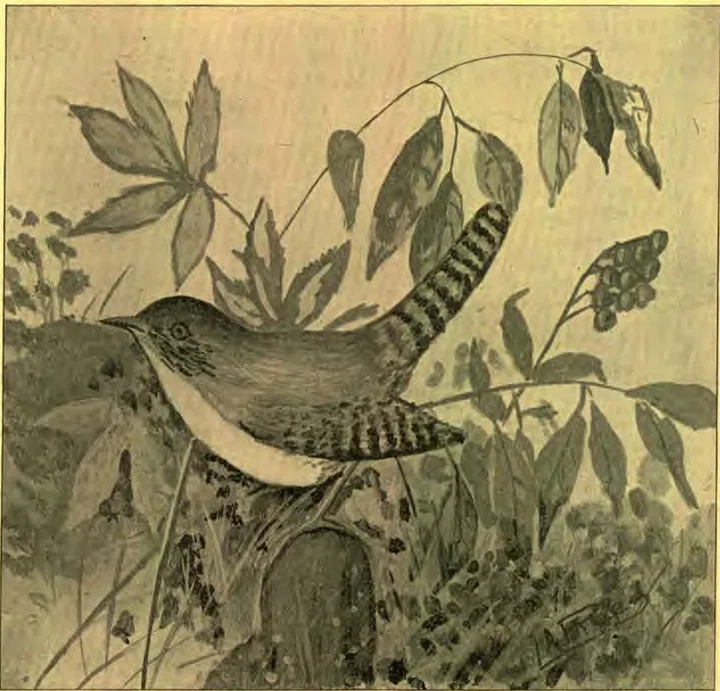
In the picture we have tried to represent a House Wren. This bird is a tame little creature, and an excellent singer, although Bewick’s Wren can outrival him.
When a House Wren once selects a place for a nest, it becomes greatly attached to it, and will return to the same place year after year. The birds will nest in a bird-box if the opening is not larger than a silver quarter. A larger opening will let in the English sparrow, which is apt to drive out the wrens.
At my old home in Wisconsin, a pair of wrens built a nest in the boxing of our picket fence. It was the post at the gate, and it seems strange that they would build so close to where persons were so often passing. They were never molested, however, and we grew very fond of them, and each summer looked for their return. I do not know how many years they nested in the old post, but it was for a number of seasons.
Here in Jacksonville, Ill., two wrens have a nest in a dead limb of an old apple-tree. They have either dug out enough of the rotten wood to make room for the nest, or else this was done for them by some other birds. They seem very happy, and one or the other is singing most of the time.
One writer has said that the House Wren is given to perpetual motion. He surely is a lively little creature. You may as well expect to catch a weasel asleep as to find a wren at rest.
“He is ever hopping, flitting, bobbing, or bowing, pausing only long enough to give voice to his feelings in fidgety, scolding notes, or an effervescing, musical trill, with the force of which his small body trembles. It is a wonderful outburst of song, and the diminutive singer’s enthusiasm and endurance are even more remarkable. The song occupies about three seconds, and I have heard a wren, in response to a rival, sing at the rate of ten songs a minute for two hours at a time.”
The House Wren sometimes uses about half a bushel of twigs in making a nest. In the center of this mass are placed dried grasses. The eggs number from six to eight, and are minutely speckled with pinkish-brown. The House Wren leaves us for the South about October; but before it leaves, the Winter Wren comes from the North. It remains with us until April; and at about the time the House Wren returns, the Winter Wren leaves us again for the North.
L. A. REED.