The Baltimore Oriole

11%

Review and Herald Publishing Company · Battle Creek, Michigan · September 25, 1902

FromThe Youth’s Instructor, Vol. L., No. 38

Read the full edition

The Baltimore Oriole

THERE is no more interesting bird in North America than the Baltimore Oriole. His plumage is brilliant, his song sweet and well modulated, he is amiable in disposition, and a master craftsman in the building of nests.
The Baltimore Oriole is so named from Lord Baltimore, whose titular colors were orange and black. He is also called fire-bird, golden robin, and hang-nest.
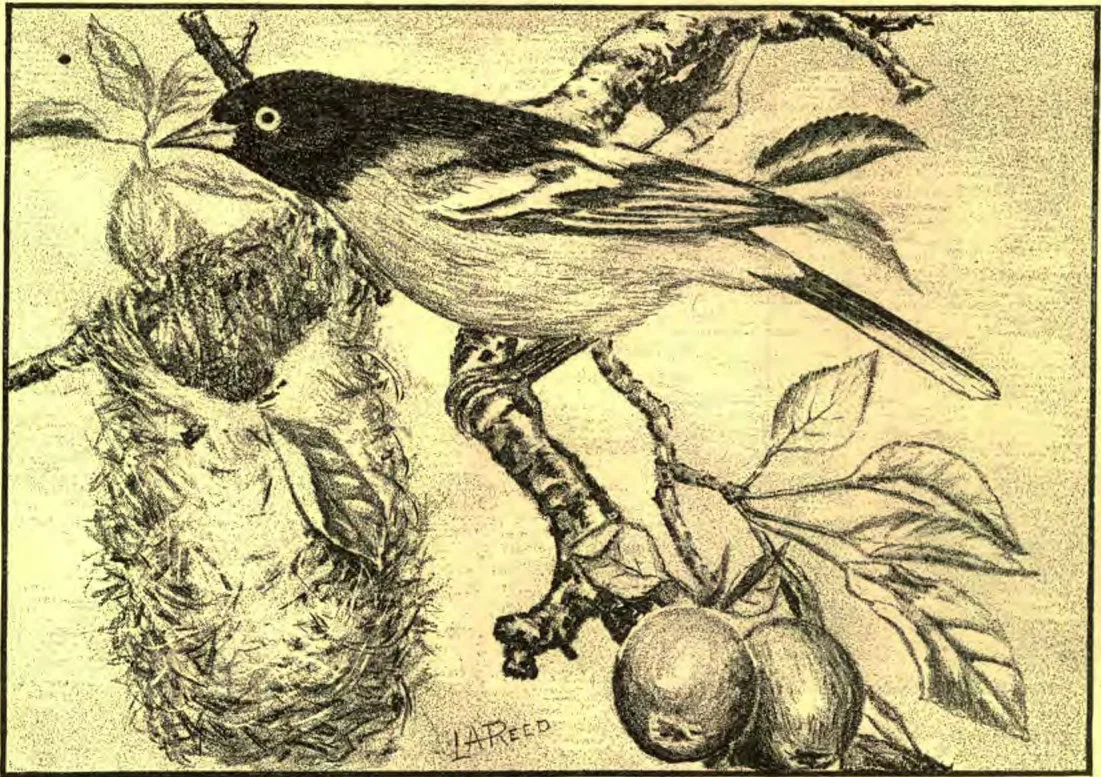
The mother bird is dressed in yellow and brown instead of the orange and black of her mate. Their nest is one of the prettiest you can find. It is a deep bag, skillfully woven of plant fibers, bits of string, and the like, and usually hung at the end of a branch high up in some tall tree, like the elm or willow or some of the maples. When the winds toss the branch, the little nest swings and sways, better than any hammock or cradle that ever was invented.
THE BALTIMORE ORIOLE AND ITS NEST
While the mother bird is sitting on the nest, the mate stays near by and sings to her. But when the little birds hatch out, and have to be fed, he does his part in getting food to stuff into the babies’ hungry mouths. The little birds, as it comes near time for them to fly, move about a great deal, climb up out of their bag-like nest, and often fall to the ground.
This spring I saw a man throwing bits of brick and stone at the nest of an oriole which had been built near my home. One brick struck the nest. The little birds inside screamed at the top of their voices, and the parent birds remonstrated in notes even louder. I promptly stopped the man, but not, I fear, until some damage had been done.
That night we found one of the little birds crying in the grass, took it to the house, and cared for it. When we fed it, it would lift itself up as high as it could stretch, wave its little wings, and seem to say Yum-yum, in a way that delighted us all. Whenever it got hungry, it would cry incessantly until it was fed. I grew used to hearing it, but the morning of the third day, when I awoke, I did not hear its cry. The house was silent. I went where we kept it. It was lying on its back, its feet up in the air, sick unto death. Later in the day it died. We thought it must have been injured when its nest was so rudely struck by the unfeeling man, or that it was hurt in falling to the ground.
Young orioles have been aptly called the crybabies of the bird world; but that day I would have given much could I have brought my little oriole cry-baby to life. L. A. REED.