A Penholder

6%

Review and Herald Publishing Company · Battle Creek, Michigan · September 11, 1902

FromThe Youth’s Instructor, Vol. L., No. 36

Read the full edition

A Penholder

Cover an ordinary wooden penholder with neatly woven horsehair in a suitable pattern, and you will have converted an article worth five cents to one that should sell for from a dollar to a dollar and a half. It is true that some time will be needed to do the work, for both warp and woof should be made of rather fine thread; but horsehair-weaving is something that can be taken up during spare moments, and left when one has other duties to attend to.
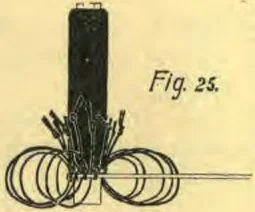
Fig. 25.
Fig. 25.
For a base procure a penholder that has a hollow metal cylinder enclosing two semi-cylindrical metal plates to receive the pen. This will permit the hair to be woven close to the lower end of the holder, which the old-fashioned kind would not. Most holders of this kind are quite large at the lower end, where they are covered with cork, tapering gradually to a point at the top. Remove the cork, and dress down the remainder of the handle with a piece of broken glass or coarse sandpaper. Remember that twice the thickness of your warp, and four times the thickness of the threads of your woof, will be added to the diameter of the base when the holder is finished, and dress down the handle accordingly.
The woof should be composed of threads containing from four to six hairs each. Four strands of number eight thread will be quite large enough for the warp.
Begin weaving at the bottom of the holder; and as that part is quite apt to get stained with ink when in use, it will be well to make it entirely of black hair. After about an inch and a half of the holder has been covered, a sufficient number of white threads to make whatever pattern you choose may be introduced.
The easiest way to finish is to cover the top with needlework. But that is not the best way; for a knob on the tip gives it rather an ungainly appearance. It will be impossible to draw the threads of woof under the work with a needle, as the base at the top will be so small and of such unyielding material that the threaded needle can not be forced between it and the woven fabric. There is still another way of concealing the ends of the threads, which, though somewhat complicated, can be used on any kind of work.
Fig. 27.
Fig. 27.
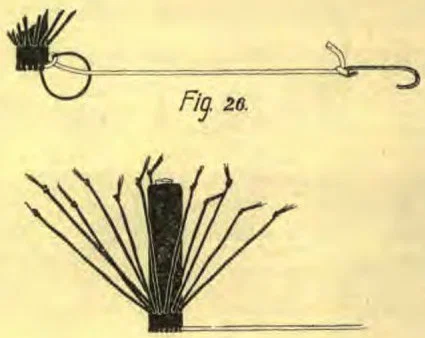
When four more circles of stitches will finish the work, take the end of each thread of woof after a stitch has been made with it, and pass it under the warp, just as you would do in adding a thread with which to splice a short one. This will give you a circle of loops all around the base, as shown in Fig. 25. Now cut off all but about a foot of the warp; and for convenience in handling, fasten a wire hook to the end of it. The object now is to pass the warp through each of the loops in such a manner that, when drawn taut, it will form the regular weaving stitch with the threads of woof. This is shown in Fig. 26.
When the warp has been passed through a loop, it is hooked to some convenient support and drawn taut. Then the thread of woof can be tightened in the regular manner, and the warp unhooked for another stitch. Three or four circles of stitches made in this manner will be sufficient. In order that the work may not end too abruptly, it is well to pass the warp straight through two or three loops. Then take hold of the projecting end of each thread of woof, and draw it through. Now your work will look like Fig. 27, and all that remains to finish it is to cut off the projecting ends of both warp and woof.
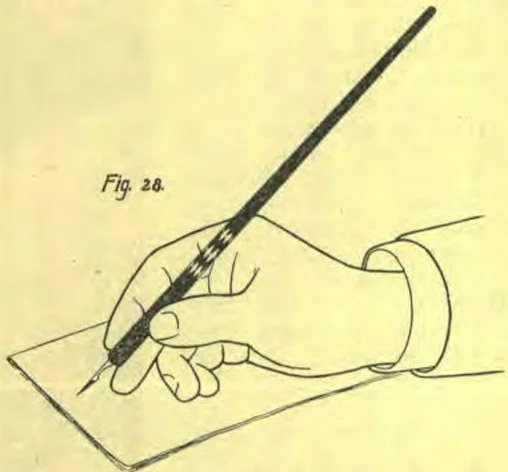
In Fig. 28 a finished penholder is shown.

A Cane

It is no longer good form for a man to carry a cane unless he really needs a walking-stick; so if you wish to cover a cane with woven horsehair, the first thing to do is to secure a stout, serviceable stick, and the next thing is to cover it almost entirely with black hair, allowing just enough white to give it contrast, and show the texture of the fabric, but not enough to make it unduly conspicuous.
If you do not have a cane, do not go to the expense of buying one for this purpose; with no other tool than a plane, or even a pocket-knife and a piece of broken glass, one can be made in a few minutes from a discarded broom handle. The stick should be tapering, and quite small; for the woven work will add quite a little to its diameter. You will have to buy a ferrule, but that will cost very little. The top of the ferrule should be large enough to cover the tip of the cane after the hair has been woven around it. The top of the cane should be a knob just large enough to fit the hollow of the hand comfortably, and a little thicker in proportion to its diameter than a door-knob. This may be made by wrapping twine or narrow strips of cloth around the top of the stick till the desired size and shape are secured, and then fastening in position by driving two or three small nails through the twine ball and into the wood of the cane.
Fig. 28.
Fig. 28.
Begin to cover the cane at the top, and work downward. An attractive pattern is made of black with the introduction of three or four circles of white, diamond-shaped figures about six inches from the top. When you come to within an inch of the tip of the cane, it will be time to stop the weaving. It will not be necessary, however, to hide the threads of woof under the woven work. Instead of this, the warp may be wrapped closely and tightly around to bind the woof to the base. When it has been wrapped to the very tip of the cane, the warp is tied, or fastened with a very small tack to hold it in position. Then the ends of both warp and woof are cut off, and the ferrule is adjusted and fastened in position.
The knob on the top must be covered with needlework, as horsehair can not be woven with warp and woof around a base whose diameter varies so much in so short a distance. But with needlework any shape of base can be readily covered. Black hair may be used; or, if you prefer, alternate black and white rings.
J. EDGAR ROSS.